10-K: Annual report [Section 13 and 15(d), not S-K Item 405]
Published on February 26, 2026
UNITED STATES
SECURITIES AND EXCHANGE COMMISSION
Washington, D.C. 20549
FORM 10-K
(Mark One)
| Annual Report pursuant to Section 13 or 15(d) of the Securities Exchange Act of 1934 | |||||
For the fiscal year ended December 28 , 2025
or
| Transition report pursuant to Section 13 or 15(d) of the Securities Exchange Act of 1934 | |||||
For the transition period from to
Commission File Number: 0-21660
(Exact name of registrant as specified in its charter)
| (State or other jurisdiction of incorporation or organization) | (I.R.S. Employer Identification No.) | ||||
| (Address of principal executive offices) | (Zip Code) | ||||
(502 ) 261-7272
(Registrant’s telephone number, including area code)
___________________________________________________________
Securities registered pursuant to Section 12(b) of the Act:
| (Title of Each Class) | Trading Symbol(s) | (Name of each exchange on which registered) | ||||||||||||
Securities registered pursuant to Section 12(g) of the Act: None
___________________________________________________________
Indicate by check mark if the registrant is a well-known seasoned issuer, as defined in Rule 405 of the Securities Act. Yes x No o
Indicate by check mark if the registrant is not required to file reports pursuant to Section 13 or Section 15(d) of the Act. Yes o No x
Indicate by check mark whether the registrant (1) has filed all reports required to be filed by Section 13 or 15(d) of the Securities Exchange Act of 1934 during the preceding 12 months (or for such shorter period that the registrant was required to file such reports), and (2) has been subject to such filing requirements for the past 90 days. Yes x No o
Indicate by check mark whether the registrant has submitted electronically every Interactive Data File required to be submitted pursuant to Rule 405 of Regulation S-T (§232.405 of this chapter) during the preceding 12 months (or for such shorter period that the registrant was required to submit such files). Yes x No o
Indicate by check mark whether the registrant is a large accelerated filer, an accelerated filer, a non-accelerated filer, a smaller reporting company or an emerging growth company. See the definitions of “large accelerated filer,” “accelerated filer” “smaller reporting company” and “emerging growth company” in Rule 12b-2 of the Exchange Act.
| x | Accelerated filer | o | ||||||||||||
| Non-accelerated filer | o | Smaller reporting company | ||||||||||||
| Emerging growth company | ||||||||||||||
If an emerging growth company, indicate by check mark if the Registrant has elected not to use the extended transition period for complying with any new or revised financial accounting standards provided pursuant to Section 13(a) of the Exchange Act o
Indicate by check mark whether the registrant has filed a report on and attestation to its management’s assessment of the effectiveness of its internal control over financial reporting under Section 404(b) of the Sarbanes-Oxley Act (15 U.S.C. 7262(b)) by the registered public accounting firm that prepared or issued its audit report.x
If securities are registered pursuant to Section 12(b) of the Act, indicate by check mark whether the financial statements of the registrant included in the filing reflect the correction of an error to previously issued financial statements. ☐
Indicate by check mark whether any of those error corrections are restatements that required a recovery analysis of incentive-based compensation received by any of the registrant’s executive officers during the relevant recovery period pursuant to §240.10D-1(b). ☐
Indicate by check mark whether the registrant is a shell company (as defined in Rule 12b-2 of the Act). Yes o No x
The aggregate market value of the common stock held by non-affiliates of the Registrant, computed by reference to the closing sale price on The Nasdaq Stock Market as of the last business day of the Registrant’s most recently completed second fiscal quarter, June 29, 2025, was $1,586,641,166 .
As of February 20, 2026, there were 32,810,752 shares of the Registrant’s common stock outstanding.
DOCUMENTS INCORPORATED BY REFERENCE
TABLE OF CONTENTS
| Page | ||||||||
2
PART I
Item 1. Business
General
Papa John’s International, Inc., a Delaware corporation (referred to as the “Company,” “Papa John’s,” “Papa Johns” or in the first person notations of “we,” “us” and “our”), operates and franchises pizza delivery and carryout restaurants and, in certain international markets, dine-in and delivery restaurants under the trademark “Papa Johns.” Papa Johns began operations in 1984. At December 28, 2025, there were 6,083 Papa Johns restaurants in operation, consisting of 475 Company-owned and 5,608 franchised restaurants operating in 50 countries and territories. In discussions of our business, “Domestic” is defined as within the contiguous United States, “North America” includes Domestic and Canada, and “International” includes the rest of the world other than North America.
Strategy
We are committed to delivering on our brand promise “BETTER INGREDIENTS. BETTER PIZZA.®” and we believe our business strategy is designed to drive sustainable long-term, profitable growth. As Papa Johns transforms the business to accelerate profitable growth across its restaurant system, we are focused on the following strategic priorities:
Focusing on our core product proposition and improving innovation across the barbell. Traditional, superior-quality pizza is the foundation of our success, and accelerating product innovations that expand beyond pizza and complement our core offerings is key to attracting a broad customer base and expanding our addressable market. Consumers know us for BETTER INGREDIENTS. BETTER PIZZA. and we need to deliver on this promise consistently, every day, to every customer, across every restaurant.
Amplifying our marketing message to drive customer consideration and call to action across target segments by emphasizing quality and value. Our approach will leverage our individualized knowledge of our customers and vast consumer data to create more personalized offers, differentiate our brand through creativity and disruption and may include supplemental investments to reach a wider audience through traditional and digital advertising, ensuring a strong presence in key regional and local markets.
Investing in our technology to deliver a more seamless and personalized experience across our digital assets and owned channels as well as to drive greater efficiency throughout our operations by leveraging our data to inform our decisions and better serve our customers. With most of our sales occurring through digital channels, we believe these investments will improve the overall customer and team member experience.
Differentiating our customer experience to meet and exceed the convenience, value and quality expectations of the customer in every channel. By simplifying our processes, optimizing our menu, and employing technology, our teams will be set up to be the best pizza makers in the business while ensuring a frictionless experience to drive purchase and build loyalty.
Partnering with and evolving our franchisee base to be growth oriented – focusing on increasing our market share through strategic new restaurant development in priority markets.
In order to lay the foundation for our next phase of growth, we have enacted broad-ranging plans to transform our North America and International businesses. In 2023, we initiated international transformation initiatives (the “International Transformation Plan”). With the completion of the International Transformation Plan in late 2025, we began a new business transformation program (the “Enterprise Transformation Plan”) in December 2025. Refer to “Item 7 - Management’s Discussion and Analysis of Financial Condition and Results of Operations - Recent Developments and Trends” for further information about these programs.
Segment Overview
Papa Johns has four defined reportable segments: Domestic Company-owned restaurants, North America franchising, North America commissaries, and International.
Domestic Company-owned Restaurants
The Domestic Company-owned restaurant segment consists of the operations of all Domestic Company-owned restaurants and derives its revenues principally from retail sales of pizza and other food and beverage products. Of the total 3,523
3
North American restaurants open as of December 28, 2025, 462 units, or approximately 13%, were Company-owned. In 2025, the 428 Domestic Company-owned restaurants included in the full year’s comparable restaurant base generated average annual unit sales of $1.3 million.
Operating Company-owned restaurants allows us to improve operations, training, marketing and quality standards for the benefit of the entire Papa Johns system.
North America franchising
The North America franchising segment consists of our franchise sales and support activities and derives its revenues from the sale of franchise and development rights and the collection of royalties from our franchisees located in the United States and Canada. Our North American franchised restaurants, which included 2,664 restaurants in the full year’s comparable base for 2025, generated average annual unit sales of $1.1 million. These sales, while not included in the Company’s revenues, contribute to our royalty revenues, franchisee marketing fund contributions, and commissary revenue.
North America commissary
The North America commissary segment comprises 11 full-service regional dough production and distribution centers (Quality Control Centers, or “QC Centers”) in the United States, which supply pizza sauce, dough, food products, paper products, smallwares and cleaning supplies twice weekly to each traditional restaurant served. This system enables us to monitor and control product quality and consistency while lowering food and other costs. We also have one QC Center in Canada, which produces and distributes fresh dough. We evaluate the QC Center system capacity in relation to existing restaurants’ volumes and planned restaurant growth, and facilities are developed or upgraded as operational or economic conditions warrant. To ensure consistent food quality, each Domestic franchisee is required to purchase dough and pizza sauce from our QC Centers and to purchase all other supplies from our QC Centers or other approved suppliers.
International
The International segment is defined as all restaurant operations outside of the United States and Canada. As of December 28, 2025, there were 2,560 International restaurants, comprised of 13 Company-owned restaurants in the United Kingdom (“UK”) and 2,547 franchised restaurants. The Company currently operates one International QC Center in the UK. The International segment also consists of distribution sales to Papa Johns restaurants located in the UK and our franchise sales and support activities, which derive revenues from sales of franchise and development rights and the collection of royalties from our International franchisees. Other QC Centers outside North America are operated by franchisees pursuant to license agreements or by other third parties.
All other
All other business units that do not meet the quantitative or qualitative thresholds for determining reportable segments, which are not operating segments, are referred to as “all other.” These consist of operations that derive revenues from franchise contributions to our marketing funds and the sale, principally to Company-owned and franchised restaurants, of information systems and related services used in restaurant operations, including our point-of-sale system, online and other technology-based ordering platforms.
See “Management’s Discussion and Analysis of Financial Condition and Results of Operations” and “Note 22. Segment Information” of “Notes to Consolidated Financial Statements” for financial information about our segments.
4
Development
At December 28, 2025, there were 6,083 Papa John’s restaurants operating in 50 countries and territories, as follows:
| Domestic Company-owned | Franchised North America | Total North America | International Company-owned | International Franchised | Total International | System-wide | ||||||||||||||||||||||||||||||||||||||
| December 29, 2024 | 539 | 2,975 | 3,514 | 13 | 2,503 | 2,516 | 6,030 | |||||||||||||||||||||||||||||||||||||
| Opened | 9 | 87 | 96 | — | 183 | 183 | 279 | |||||||||||||||||||||||||||||||||||||
| Closed | (1) | (86) | (87) | — | (139) | (139) | (226) | |||||||||||||||||||||||||||||||||||||
| Refranchised | (85) | 85 | — | — | — | — | — | |||||||||||||||||||||||||||||||||||||
| December 28, 2025 | 462 | 3,061 | 3,523 | 13 | 2,547 | 2,560 | 6,083 | |||||||||||||||||||||||||||||||||||||
Net unit growth/(decline) | (77) | 86 | 9 | — | 44 | 44 | 53 | |||||||||||||||||||||||||||||||||||||
Our Domestic Company-owned restaurant growth strategy may entail opening restaurants in existing or new markets as appropriate, thereby increasing consumer awareness, increasing market share, improving customer service and enabling us to take advantage of operational and marketing scale efficiencies, or closing restaurants in existing markets. We have co-developed Domestic markets with some franchisees or divided markets among franchisees and may continue to use market co-development in the future, where appropriate. Our Domestic Company-owned markets continue to include strong performing restaurants that remain attractive as either Company-owned or franchised locations.
Our experience in developing markets indicates that market penetration through the opening of multiple restaurants in a particular region results in increased average restaurant sales over time. We will establish a development or a master franchise agreement with a franchisee for the opening of a specified number of restaurants within a defined period of time and specified geographic area. Similar to our Domestic Company-owned restaurant growth strategy, our International strategy has been shown to build higher consumer awareness, increased market share, and improved operational efficiencies.
Franchise Program
We continue to attract qualified and experienced franchisees that we consider to be a vital part of our continued growth. We believe our relationship with our franchisees is fundamental to the performance of our brand and we strive to maintain a collaborative relationship with our franchisees. Franchisees are approved on the basis of the applicant’s business background, restaurant operating experience and financial resources.
North America Development and Franchise Agreements. We enter into development agreements with our franchisees in North America for the opening of a specified number of restaurants within a defined period of time and specified geographic area. A franchise agreement is generally executed once a franchisee secures a location. Our current standard franchise agreement requires the franchisee to pay a royalty fee of 5% of gross revenue, net of certain taxes, discounts, and refunds, and the majority of our existing franchised restaurants have a 5% contractual royalty rate in effect. Incentives offered from time to time to franchisees may reduce the contractual royalty rate paid.
Substantially all existing franchise agreements have an initial 10-year term with a 10-year renewal option. We have the right to terminate a franchise agreement for a variety of reasons, including a franchisee’s failure to make payments when due or failure to adhere to our operational policies and standards. However, many state franchise laws limit our ability as a franchisor to terminate or refuse to renew a franchise.
International Development Agreements. In international markets, we generally enter into a development agreement for the opening of a specified number of restaurants within a defined period of time and specified geographic area. Under a development agreement with master franchise rights, upon meeting certain conditions, the franchisee has the right to sub-franchise a portion of the development to one or more sub-franchisees approved by us. A unit license agreement is generally executed once a franchisee secures a location.
Our current standard international development agreements and unit license agreements provide for payment to us of a royalty fee of 5% of gross revenue net of certain taxes, discounts, and refunds. For international agreements with master franchise rights, the master franchisee generally sets its own sub-franchise royalty but the sub-franchise royalty received by the Company is generally 3% of gross revenue, net of certain taxes and refunds. The remaining terms applicable to the operation of individual restaurants are substantially equivalent to the terms of our Domestic franchise agreement. In certain
5
cases, development agreements may be negotiated at other-than-standard terms for fees and royalties, and we may offer various development and royalty incentives.
Franchise Operations. All franchisees are required to operate their Papa Johns restaurants in compliance with our policies, standards and specifications, including matters such as menu items, ingredients, and restaurant design. Franchisees have full discretion in human resource practices, and generally have full discretion to determine the prices to be charged to customers, but we generally have the authority to set maximum price points for nationally advertised promotions.
Franchisee Loans. Selected Domestic and International franchisees have borrowed funds from us, principally for the purchase of restaurants from us or other franchisees or, in certain international markets, for construction and development of new restaurants. Loans made to franchisees can bear interest at fixed or floating rates and in most cases are secured by the fixtures, equipment and signage of the restaurant and/or are guaranteed by the franchise owners. At December 28, 2025, net loans outstanding totaled $6.6 million. See “Note 2. Significant Accounting Policies” of “Notes to Consolidated Financial Statements” for additional information.
Marketing Programs
Our Domestic marketing strategy consists of national advertising via television, print, direct mail, digital, mobile marketing, loyalty marketing and social media channels. Our digital marketing activities have increased significantly over the past several years in response to increasing customer use of online and mobile technology. Local advertising efforts may include television, radio, print, direct mail, restaurant-to-door flyers, digital, mobile marketing and local social media channels.
Domestic Company-owned and franchised Papa Johns restaurants within a defined market may, but are not required to, join an area advertising cooperative (“Co-op”). Each member restaurant contributes a percentage of sales to the Co-op for market-wide programs, such as television, radio, digital and print advertising, and sports sponsorships. The rate of contribution and uses of the monies collected are determined by a majority vote of the Co-op’s members.
The domestic marketing efforts are supported by media, print, digital and electronic advertising materials that are produced by Papa John’s Marketing Fund, Inc. (“PJMF”), our national marketing fund. PJMF is a consolidated nonstock corporation, designed to operate at break-even for the purpose of designing and administering advertising and promotional programs for all participating Domestic restaurants. PJMF produces campaigns and buys air time for Papa Johns national television commercials and advertises the Company’s products through digital media including banner advertising, paid search-engine advertising, mobile marketing, social media advertising and marketing, loyalty marketing, text messaging, aggregator advertising and email. PJMF also engages in other brand-building activities, such as consumer research and public relations activities. Domestic Company-owned and franchised Papa Johns restaurants are required to contribute a certain percentage of sales to PJMF.
In international markets, our marketing focuses on reaching customers who live or work within a trading area of a Papa Johns restaurant. Our international markets use a combination of advertising strategies, including television, radio, print, digital, mobile marketing and local social media depending on the size of the local market.
Human Capital
Our team members are critical to our success. As of December 28, 2025, we employed approximately 9,400 persons, of whom approximately 7,000 were team members at Company-owned restaurants, approximately 500 were management personnel at Company-owned restaurants, approximately 700 were corporate personnel and approximately 1,200 were QC Center team members. Our team members are non-unionized, and most restaurant team members work part-time and are paid on an hourly basis.
Our franchisees are independent business owners, so their employees are not our employees and therefore are not included in our employee count. We estimate the total number of persons in the Papa Johns system, including our team members, franchisees and the team members of franchisees, was approximately 89,700 as of December 28, 2025.
Culture
At Papa Johns, we welcome a wide array of voices to our table. An inclusive environment is essential to attracting the talent that makes Papa Johns the world’s best pizza company. As such, we welcome all entrepreneurial spirits, innovators and pizza lovers. We continue to build a culture that reflects our corporate values of People First and Everyone Belongs
6
and creates a competitive advantage in attracting and retaining talent. Across our restaurants, QC Centers and corporate hubs, Papa Johns team members are valued for their contributions, treated fairly, encouraged to share their feedback and ideas, provided the tools needed to ensure their safety and total wellness and given ample opportunities to grow in their careers.
We embed policies and practices that ensure fairness and build trust, and encourage behaviors across the organization that foster belonging and increase employee engagement, including grant-making through the Papa John’s Foundation to national and local nonprofit partners, hosting our annual Week of Service and leveraging our global inclusion resource groups with leaders engaging across the organization.
Talent Attraction, Retention and Development
Creating a culture of connectedness and belonging that supports and values team members is important to attracting and retaining talented, dedicated employees and bringing more innovative thinking and better ideas and solutions to our business. To meet job candidates where they live, and gain a deeper understanding of their personal, educational and professional goals, we sponsor and attend job fairs, scholarship programs and university and professional organization events and offer our team members hiring and referral bonuses.
To help our team members succeed in their roles and to ensure consistent operational execution, we offer continuous training and development opportunities, including providing innovative tools and materials for the operational training and development of team members. Operations personnel complete our management training program and ongoing development programs, including multi-unit training, through which instruction is given on all aspects of our systems and operations. In addition, to further support our team members’ development, we established our Dough & Degrees program in 2019, which allows our team members to earn a college degree for free or at a reduced tuition in partnership with Purdue University Global and the University of Maryland Global Campus, among others. Employees working at least ten hours per week can obtain their High School Diplomas, learn English as a second language, and earn associate’s, bachelor’s and/or master’s degrees. We also offer a tuition reimbursement program that provides another opportunity for our team members to advance their careers.
Compensation and Benefits
One of our core values is People First. As such, we are committed to providing competitive pay and benefits to attract and retain talent, whether in our Domestic Company-owned restaurants, in our supply chain centers or in our restaurant support centers. We pay competitive wages to our front line team members in our Domestic Company-owned restaurants.
Papa Johns offers a comprehensive benefits package to eligible team members. We also make available to our team members several benefits like paid parental leave, adoption support, and health plans that are available to dependents, spouses, and domestic partners. We offer eligible team members a 401(k) plan, with a competitive Company matching component to encourage retirement savings.
In addition, Papa Johns offers wellness services to help team members manage and optimize their health and well-being. These no-cost programs include smoking cessation, diabetes and hypertension management, weight management, and mental health support through the Papa Johns employee assistance program for all part-time and full-time team members and their dependents. Papa Johns also makes available the “Papa Cares” program that provides restaurant support center team members an onsite health clinic that provides a wide range of primary care services for adults, adolescents and children.
Workplace Health and Safety
As part of the Company’s enterprise-wide safety and security management system, we are committed to strategically investing in advanced training, technology and people to ensure the highest level of protection for our customers and team members. All Papa Johns team members, from those at our restaurant support centers to those working in our warehouses and restaurants, undergo annual safety and security training designed to address the unique requirements of their roles. Our QC Centers and restaurant operations are evaluated through comprehensive annual risk assessments, as well as unannounced inspections conducted by our corporate safety and security teams.
7
Industry and Competition
The United States Quick Service Restaurant pizza (“QSR Pizza”) industry is mature and highly competitive with respect to price, service, location, food quality, technology, customer loyalty programs and product innovation. The QSR Pizza industry is largely fragmented, and competitors include a few large national chains and many smaller regional chains, as well as a large number of local independent pizza operators, any of which can utilize a growing number of food delivery services. Some of our competitors have been in existence for longer periods than Papa Johns, have substantially greater resources than Papa Johns and can have higher levels of restaurant penetration, aggressive promotional campaigns and brand awareness in markets where we compete. Additionally, competition from delivery aggregators and other food delivery concepts has increased in recent years. For more information, see “Item 1A—Risk Factors—Industry and Macroeconomic Risks—Our profitability may suffer as a result of intense competition in the QSR Pizza industry.”
Internationally, the pizza delivery model is not as mature as the Domestic market and presents a growth opportunity for Papa Johns. We believe demand from international consumers will continue to increase as the demand for pizza delivery and carryout continues.
With respect to our franchise operating model, we compete with many franchisors of restaurants and other business concepts. There is active competition for management personnel, drivers and hourly team members, and a limited supply of attractive commercial real estate sites suitable for Papa Johns restaurants.
Supply Chain
In the United States, our 11 QC Centers produce dough and distribute substantially all key ingredients, including mozzarella, dough and pizza sauce, and other supplies, including food products, paper products, smallwares and cleaning supplies to Domestic Company-owned restaurants and franchised restaurants to ensure consistent food quality. Each Domestic franchisee is required to purchase pizza sauce and dough from our Domestic QC Centers, and purchases substantially all other food products from our QC Centers. We also have one QC Center in Canada that produces and distributes fresh dough and provides further support to our North American franchisees. In our International segment, we operate one International QC Center in the United Kingdom and other International QC Centers are operated by franchisees pursuant to license agreements or by other third parties. We are dependent on a sole supplier for all of our cheese made from mozzarella domestically and substantially all of our cheese internationally. We also depend on a sole source for our supply of garlic sauce and we source other key ingredients, including meat products, from a limited number of suppliers. For a discussion of the related risks, see “Item 1A—Risk Factors—Company Risks—Increase in ingredient and other operating costs, including those caused by weather, climate change and food safety, could adversely affect our results of operations,” “—Our dependence on a sole supplier or a limited number of suppliers for some ingredients and other supplies could result in disruptions to our business,” and “—Changes in purchasing practices by our Domestic franchisees, or prolonged disruptions in our QC Center operations, could harm our commissary business.”
Government Regulation
We, along with our franchisees, are subject to various federal, state, local and international laws affecting the operation of our respective businesses, including laws and regulations related to our marketing and advertising as well as the preparation and sale of food, food safety and menu labeling. Each Papa Johns restaurant is subject to licensing and regulation by a number of governmental authorities, which include zoning, health, safety, sanitation, building and fire agencies in the state or municipality in which the restaurant is located. Difficulties in obtaining, or the failure to obtain, required permits, licenses or approvals could delay or prevent the opening of a new restaurant in a particular area. Our QC Centers are licensed and subject to regulation by state and local health and fire codes, and the operation of our trucks is subject to federal and state transportation regulations. We are also subject to federal and state environmental regulations. In addition, our Domestic operations are subject to various federal, state and local laws governing such matters as minimum wage requirements, benefits, taxation, working conditions, citizenship requirements, and overtime.
We are subject to Federal Trade Commission (“FTC”) regulation and various state laws regulating the offer and sale of franchises. The FTC requires us to furnish to prospective franchisees a franchise disclosure document containing prescribed information. Many states also regulate substantive aspects of the franchisor-franchisee relationship, including the requirement to register our franchise disclosure document. State laws governing the franchisor-franchisee relationship presently exist in a significant number of states, and bills have been, and may in the future, be introduced in Congress that,
8
if enacted, would provide for federal regulation of certain aspects of the U.S. franchisor-franchisee relationship. State laws often limit, among other things, the duration and scope of non-competition provisions and the ability of a franchisor to terminate or refuse to renew a franchise. Some foreign countries also have disclosure requirements and other laws regulating franchising and the franchisor-franchisee relationship. National, state and local government regulations or initiatives, including health care legislation, “living wage,” or other current or proposed regulations, and increases in minimum wage rates affect Papa Johns as well as others within the restaurant industry. We are also subject to applicable laws in each international jurisdiction in which we operate.
Privacy and Data Protection
We are subject to privacy and data protection laws and regulations globally. The legal and regulatory landscape for privacy and data protection continues to evolve, and there has been an increase in attention given to privacy and data protection issues with the potential to impact our business. This includes recently enacted Securities and Exchange Commission (“SEC”) regulations and existing breach notification laws and regulations in the United States and in other countries which require notification to individuals and government authorities of breaches involving certain categories of personal information. We also expect more states in the United States to enact data privacy laws and regulations in the future. Any changes in privacy and data protection laws or regulations could also adversely impact the way we use e-mail, text messages and other marketing techniques and could require changes to our marketing strategies. Similarly, emerging regulations and laws governing the use of artificial intelligence may adversely impact our use of these technologies. The security of our financial data, customer information and other personal information is a priority for us. We have a privacy policy posted on our website at www.papajohns.com. Information on our website is not incorporated by reference herein and is not a part of this Form 10-K.
Trademarks, Copyrights and Domain Names
We protect our intellectual property through a combination of patents, copyrights, trademarks and trade secrets, foreign intellectual property laws, confidentiality agreements and other contractual provisions. We have also registered, and applied for the registration of, U.S. and international trademarks, service marks, domain names and copyrights. From time to time, we are made aware of the use by other persons in certain geographical areas of names and marks that are the same as or substantially similar to our marks. It is our policy to pursue registration of our marks whenever possible and to vigorously oppose any infringement of our marks.
We hold copyrights in authored works used in our business, including advertisements, packaging, training, website, and promotional materials. In addition, we have registered and maintain Internet domain names, including “papajohns.com,” and country code domains patterned as “papajohns.cc,” or a close variation thereof, with “.cc” representing a specific country code.
Environmental Matters
We are not aware of any federal, state, local or international environmental laws or regulations that we expect to materially affect our earnings or competitive position or result in material capital expenditures. However, we cannot predict the effect of possible future environment legislation or regulations on our operations. During 2025, we had no material environmental compliance-related capital expenditures, and no such material expenditures are anticipated in 2026.
Additional Information
All of our periodic and current reports filed with the SEC pursuant to Section 13(a) or 15(d) of the Securities and Exchange Act of 1934, as amended (the “Exchange Act”), are available, free of charge, through our website located at www.papajohns.com. These reports include our annual reports on Form 10-K, quarterly reports on Form 10-Q, current reports on Form 8-K and any amendments to those reports. These reports are available through our website as soon as reasonably practicable after we electronically file them with the SEC. We also make available free of charge on our website our Corporate Governance Guidelines, Board Committee Charters, and our Code of Ethics, which applies to Papa John’s directors, officers and employees. Printed copies of such documents are also available free of charge upon written request to Investor Relations, Papa John’s International, Inc., P.O. Box 99900, Louisville, KY 40269-0900. The SEC maintains an internet site that contains reports, proxy and information statements, and other information regarding issuers that file electronically with the SEC, including us, at www.sec.gov.
9
We routinely use our investor relations website, at ir.papajohns.com, as a primary channel for disclosing key information to our investors. We may use our website as a means of disclosing material, non-public information and for complying with our disclosure obligations under Regulation FD. Accordingly, investors should monitor our investor relations website, in addition to following our press releases, filings with the SEC, public conference calls, presentations, and webcasts.
The references to our website addresses do not constitute incorporation by reference of the information contained on the websites, which should not be considered part of this Form 10-K.
Item 1A. Risk Factors
We are subject to risks that could have a negative effect on our business, financial condition and results of operations. These risks could cause actual operating results to differ from those expressed in certain “forward-looking statements” contained in this Form 10-K as well as in other Company communications. You should carefully consider the following risk factors together with all other information included in this Form 10-K and our other publicly filed documents.
Industry and Macroeconomic Risks
Economic conditions in the United States and international markets could adversely affect our business and financial results.
Our financial condition and results of operations are impacted by global markets and economic conditions over which neither we nor our franchisees have control. An economic downturn or recession, including deterioration in the economic conditions in the United States or international markets where we or our franchisees operate, or a slowing or stalled recovery therefrom, may have a material adverse effect on our business, financial condition or results of operations, including a reduction in the demand for our products, longer payment cycles, slower adoption of new technologies and increased price competition. Poor economic conditions have in the past adversely affected and may in the future affect the ability of our franchisees to pay royalties or amounts owed and could also disrupt our business and adversely affect our results. Inflationary pressures, and related increases in costs, including interest rates, commodity and labor expenses, as well as currency restrictions and changes in foreign exchange rates, have impacted and may continue to impact our franchisees ability to open new restaurants or operate existing restaurants profitably, and our franchisees’ ability to pay royalties and marketing fees. To navigate such an environment, we may need to offer support for certain franchisees in the form of royalty relief, loans or other support, close unprofitable restaurants or markets, and/or consider other alternatives such as acquiring or purchasing franchised restaurants, QC Centers or operations in order to operate them until they can be refranchised. In addition, adverse macroeconomic conditions, unforeseen geopolitical events, and other business-related changes in circumstances outside of our control have required us to close restaurants in the past and impacted our ability to collect royalties and/or achieve our net unit development targets.
Our profitability may suffer as a result of intense competition in the QSR industry.
The QSR Pizza industry in the United States is mature and highly competitive. Competition is based on, without limitation, price, value, service, location, food quality, convenience, brand recognition and loyalty, product innovation, effectiveness of marketing and promotional activity, use of technology, and the ability to identify and satisfy consumer preferences. Many of our competitors have introduced lower cost menu options, new products, and have employed value marketing strategies that include frequent use of price discounting (including through the use of coupons and other offers), frequent promotions and substantial advertising expenditures. Certain of our larger competitors have also recently employed price competition and promotional strategies in order to win market share. In response, we have previously reduced the prices for some of our products and implemented more value and promotional pricing to respond to competitive and customer pressures, which may adversely affect our profitability. In addition, when commodity and other costs increase, we may be limited in our ability to decrease prices. With the significant level of competition and the pace of innovation, we intend to increase investment spending in several areas, particularly marketing and technology, which can decrease, and has decreased, profitability.
In addition to competition with our larger competitors, we face competition from local quick service pizza delivery restaurants and other competitors such as fast casual pizza concepts. We also face competitive pressures from an array of food delivery concepts and aggregators delivering for QSR or dine in restaurants, using newer delivery technologies or delivering for competitors who previously did not have delivery capabilities, some of which may have more effective marketing or delivery service capabilities. The emergence or continued growth of new competitors, whether in the QSR Pizza category or the broader food-service industry, may make it harder for us to maintain or grow market share and could negatively impact our sales, profit margins, royalties, and our system-wide restaurant operations. An increased percentage
10
of orders delivered through third-party aggregator services could reduce the profitability of these orders in the future compared with those placed through our owned channels. Third-party aggregator services have become an increasingly significant component of the QSR industry and compete with us for sales, market share, online traffic, and delivery drivers. Increases in fees charged by these services, or preferential promotion of our competitors on their platforms, could adversely affect our sales and profitability. We also face increasing competition from other home delivery services and grocery stores that offer an increasing variety of prepped or prepared meals in response to consumer demand. In addition, if our competitors respond more effectively to changes in consumer preferences or increase their market share, it could have a negative effect on our business. As a result, our sales can be directly and negatively impacted by actions of our competitors, the emergence or growth of new competitors, consumer sentiment or other factors outside our control.
We compete within the food service market and the QSR Pizza market not only for customers, but also for management and hourly employees, including restaurant team members, drivers and qualified franchisees, as well as suitable real estate sites.
One of our competitive strengths is our “BETTER INGREDIENTS. BETTER PIZZA.®” brand promise. This means we may use ingredients that cost more than the ingredients some of our competitors may use. Because of our investment in higher-quality ingredients, we could have lower profit margins or lower sales than some of our competitors if we are not able to establish a quality differentiator that resonates with consumers. Customers may also not believe or understand the nature of our quality differentiator in comparison with our competitors, which could impact our sales.
Changes in consumer preferences or discretionary consumer spending could adversely impact our results.
Changes in consumer preferences and trends could negatively affect us (for example, changes in consumer perceptions of certain ingredients that could cause consumers to avoid pizza or some of its ingredients in favor of foods that are or are perceived as healthier, lower-calorie, amenable to certain diets or lower in carbohydrates or otherwise based on their ingredients or nutritional content) or reduced consumption of pizza as a result of weight loss drugs, such as GLP-1 inhibitors and others. Changes to our menu mix, including adding or removing certain products, could potentially result in lower profit margins or sales if these changes do not resonate with our customers or satisfy consumer preferences. Preferences for a dining experience such as fast casual pizza concepts could also adversely affect our restaurant business and reduce the effectiveness of our marketing and technology initiatives. Our success depends to a significant extent on numerous factors affecting consumer confidence and discretionary consumer income and spending, such as general economic conditions, customer sentiment and employment levels. Any factors that could cause consumers to spend less on food or restaurants or shift to lower-priced products could reduce sales or inhibit our ability to maintain or increase pricing, which could adversely affect our operating results.
Our business, financial condition and results of operations could be adversely affected by disruptions in the global economy caused by actual and potential geopolitical conflicts.
The global economy could be and has been negatively impacted by geopolitical and regional conflicts around the world, including the ongoing conflict in Ukraine. Furthermore, governments in the United States, UK, and European Union have each imposed export controls on certain products and financial and economic sanctions on certain industry sectors and parties in Russia. The Company has no Company-owned restaurants in Russia or Ukraine and previously suspended corporate support for the market and its master franchisee in Russia. The Company is unable to predict how long the current environment will last or if it will resume corporate support to impacted franchised restaurants. The Company also has franchise locations in Israel and a significant franchise presence in the Middle East. As a result of the recent conflict in Gaza, some of our franchisees in the Middle East experienced boycotts and other disruptions in the past few years resulting in decreased development prospects, sales and profitability. The Company is unable to predict how long the current environment will last or the long-term impact on these franchised locations.
In addition, our international business is subject to the risks of other geopolitical tensions and conflicts, including, for example, the ongoing conflicts described above and changes in China-Taiwan and United States-China relations. We have franchised restaurants located in China, South Korea, Israel, the Middle East and in Latin America. Although we do not do business in North Korea, any future increase in tensions between South Korea and North Korea, such as an outbreak or escalation of military hostilities, or between Taiwan and China could materially adversely affect our operations in Asia or the global economy, which in turn would adversely impact our business. Likewise, an escalation of conflicts in the Middle East could materially adversely affect our franchisee operations in Israel, Jordan, Egypt and other countries in the Middle East. A continuation or escalation of the tensions between the United States and Venezuela could materially impact our franchise operations there or in the neighboring countries in Latin America and the Caribbean.
11
Our International operations and franchisees are subject to increased risks and other factors that may make it more difficult to achieve or maintain profitability or meet planned growth rates.
Our International operations and franchisees could be negatively impacted by volatility and instability in international economic, political, security, or health conditions in the countries in which the Company or our franchisees operate, especially in emerging markets. In addition, there are risks associated with differing business and social cultures and consumer preferences. We may face limited availability for restaurant locations, higher location costs and difficulties in franchisee selection and financing. We may be subject to difficulties in sourcing and importing high-quality ingredients (and ensuring food safety) in a cost-effective manner, hiring and retaining qualified team members, marketing effectively and adequately investing in information technology, especially in emerging markets.
Our International operations are also subject to additional risk factors, including import and export controls, compliance with anti-corruption and other foreign laws, difficulties enforcing intellectual property and contract rights in foreign jurisdictions, the imposition of increased or new tariffs or trade barriers, consumer boycotts and potential government seizures or nationalization. We intend to continue to expand internationally, which would make the risks related to our International operations more significant over time.
Our International restaurants’ results, which are almost completely franchised, depend heavily on the operating capabilities and financial strength of our franchisees. Any changes in the ability of our franchisees to run their restaurants profitably in accordance with our operating standards, or to effectively sub-franchise restaurants, could result in brand damage, a higher number of restaurant closures and a reduction in the number of new restaurant openings (which could cause us to miss our net unit development targets).
Sales made by our franchisees in international markets and certain loans we previously provided to such franchisees are denominated in their local currencies, and fluctuations in the U.S. dollar occur relative to the local currencies. Accordingly, changes in currency exchange rates will cause our revenues, investment income and operating results to fluctuate. We have not historically hedged our exposure to foreign currency fluctuations. Our International revenues and earnings may be adversely impacted as the U.S. dollar rises against foreign currencies because the local currency will translate into fewer U.S. dollars. Additionally, the value of certain assets or loans denominated in local currencies may deteriorate. Other items denominated in U.S. dollars, including product imports or loans, may also become more expensive, putting pressure on franchisees’ cash flows.
Our International and Canadian franchisees may also be impacted by tariffs or currency restrictions imposed by governmental authorities, which could impact their ability to pay for supplies and/or royalties in compliance with their franchise agreement. In addition, increased tariffs on imports to the United States from Canada and Mexico or other international markets, and any similar or retaliatory tariffs or trade policies, could disrupt and increase the costs of our supply chains and those of our master franchisees in relation to certain products that we and they source internationally. We have also experienced situations with franchisees being subject to currency restrictions and unable pay royalties in U.S. dollars.
Our turnaround efforts in the United Kingdom could stall and adversely affect our business and financial results.
There are approximately 450 Papa Johns restaurants located in the UK, and we also operate an International QC Center in the UK. As discussed further in “Item 7 - Management’s Discussion and Analysis of Financial Condition and Results of Operations - Recent Developments and Trends - International Transformation Plan”, in connection with our turnaround efforts in certain international markets, including the UK, we initiated international transformation initiatives in December 2023 (the “International Transformation Plan”). The International Transformation Plan was designed in part to invest in capabilities to improve our UK operations and to re-position the franchise base to further strengthen our business in the UK by exiting poorly performing franchisees and permanently closing certain restaurants. In 2024, we also divested and closed a number of Company-owned restaurants in the UK that were incurring operating losses, in an effort to re-position the market, and currently operate only 13 Company-owned restaurants in the market. The International Transformation Plan was completed in the fourth quarter of 2025. If our continuing efforts to re-position the franchise base or improve the profitability of our remaining Company-owned restaurants are unsuccessful, we might need to find new operators for certain unprofitable restaurants and/or close additional unprofitable locations in the future, which would require certain lease and/or loan impairments, and could adversely impact the Company’s financial condition and results of operations in the respective region.
In addition, the Company’s UK subsidiary also holds the master leases for nearly all of the corporate and franchise restaurant locations, which exposes us to rent liability. The Company previously provided financial support to certain franchisees in the UK, including in the form of marketing support and loans. This franchisee support may not be sufficient
12
to keep restaurants in the UK from closing, particularly if current economic conditions worsen, or our franchisees may not be able to repay their loans, pay royalties, and/or make rent payments under sub-leases with us. The Company is unable to predict the future macroeconomic environment in the UK or the extent to which our remaining corporate and franchised restaurants will continue to be impacted. There may also be future risks and uncertainties associated with the UK’s withdrawal from the European Union (referred to as “Brexit”), including implications for the free flow of labor and goods in the UK and the European Union and other financial, legal, tax and trade implications.
Food safety and quality concerns may negatively impact our business and profitability.
Incidents or reports of food- or water-borne illness or other food safety issues, investigations or other actions by food safety regulators, food contamination or tampering, employee hygiene and cleanliness failures, improper franchisee or employee conduct, or presence of communicable disease at our restaurants (both Company-owned and franchised), QC Centers, or suppliers could lead to product liability or other claims. If we were to experience any such incidents or reports, our brand and reputation could be negatively impacted. This could result in a significant decrease in customer traffic and could negatively impact our revenues and profits. Similar incidents or reports occurring at quick service restaurants unrelated to us could likewise create negative publicity, which could negatively impact consumer behavior towards us.
We rely on our Domestic and International suppliers, as do our franchisees, to provide quality ingredients and to comply with applicable laws and industry standards. A failure of one or more of our Domestic or International suppliers to meet our quality standards, or comply with Domestic or International food industry standards, could result in a disruption in our supply chain and negatively impact our brand and our results.
Failure to preserve the value and relevance of our brand could have a negative impact on our financial results.
Our results depend upon our ability to differentiate our brand and our reputation for quality. Damage to our brand or reputation could negatively impact our business and financial results. Our brand has been highly rated in past U.S. surveys, and we strive to build the value of our brand as we develop international markets.
Consumer perceptions of our brand are affected by a variety of factors, such as the nutritional content and preparation of our food, the quality of the ingredients we use, our marketing and advertising, our corporate culture, our policies and systems related to corporate responsibility, our business practices, our engagement in local communities and the manner in which we source the commodities we use.
Consumer acceptance of our offerings is subject to change for a variety of reasons, and some changes can occur rapidly. Consumer perceptions may also be affected by third parties, including current or former spokespersons, employees and executives, presenting or promoting adverse commentary or portrayals of our industry, our brand, our suppliers or our franchisees, or otherwise making statements, disclosing information or taking actions that could damage our reputation. If we are unsuccessful in managing incidents that erode consumer trust or confidence, particularly if such incidents receive considerable publicity or result in litigation, our brand value and financial results could be negatively impacted.
Our inability or failure to recognize, respond to and effectively manage the accelerated impact of social media, influencers, and/or shareholder activism could adversely impact our business.
Social media platforms, including blogs, chat platforms, social media websites, and other forms of internet-based communications allow individuals access to a broad audience of consumers and other persons. The popularity of social media and other consumer-oriented technologies has increased the speed and accessibility of information dissemination, and could hamper our ability to promptly correct misrepresentations or otherwise respond effectively to negative publicity, whether or not accurate. The dissemination of proprietary Company or negative information, whether or not accurate, by customers, employees, social media influencers, artificial intelligence, and others via social media could harm our business, brand, reputation, marketing partners, financial condition, and results of operations, regardless of the information’s accuracy. The misrepresentation of our products or inaccurate claims by paid social media influencers could also expose us to legal risks.
In addition, we frequently use social media to communicate with consumers and the public in general. Failure to use social media effectively could negatively impact brand value and revenue. Other risks associated with the use of social media include improper disclosure of proprietary information, negative comments about our brand, exposure of personally identifiable information, fraud, hoaxes or malicious dissemination of false information.
We are also subject to the risk of negative publicity associated with shareholder proposals, campaigns, and other forms of shareholder activism, including publicity related to the Company’s actions regarding the environment, animal welfare,
13
responsible sourcing, shareholder returns, and other corporate responsibility topics. Significant shareholder activism could distract management and create negative publicity for the Company. Despite our best efforts relating to corporate responsibility policies, initiatives and reporting, media reports and social media campaigns can create a negative opinion or perception of the Company’s efforts. Such media reports and negative publicity could impact customer or investor perception of our Company or industry and can have a material adverse effect on our financial results.
In addition, we could be criticized for the scope or nature of our Company goals or performance. If our Company goals or performance fails to meet investor, customer, consumer, employee or other stakeholders’ evolving expectations and standards, are incomplete or inaccurate, or certain groups or customers disagree with our management initiatives or goals, or if we fail to achieve progress with respect to our goals on a timely basis, or at all, our reputation, brand, appeal to investors, employee retention, business, financial performance and growth could be adversely affected.
Our franchise business model presents a number of risks.
Our success significantly relies on the financial success and cooperation of our franchisees, yet we have limited influence over their operations. Our franchisees manage their businesses independently, and therefore are responsible for the day-to-day operation of their restaurants and compliance with applicable laws. The revenues we realize from franchised restaurants are largely dependent on the ability of our franchisees to maintain or grow their sales. If our franchisees do not maintain or grow sales, our revenues and margins could be negatively affected. Also, if sales trends worsen for franchisees, especially in emerging markets and/or high-cost markets, their financial results may deteriorate, which in the past has resulted in, and could in the future result in, among other things, required financial support from us, higher numbers of restaurant closures (which could cause us to miss our net unit development targets), reduced numbers of restaurant openings, franchisee bankruptcies or restructuring activities, delayed or reduced payments to us, or increased franchisee assistance, which reduces our revenues.
Our success also increasingly depends on the willingness and ability of our franchisees to remain aligned with us on current and future operating, promotional and marketing plans, including favorable support of our Domestic system to approve certain marketing initiatives, products, and national promotions. If our Domestic franchisees do not agree to implement these actions or any franchise relations become adversarial in nature, the Company may not be able to adequately respond to the dynamic consumer environment, which in turn could hurt our business and operating results. Franchisees’ ability to continue to grow is also dependent in large part on the availability of franchisee funding at reasonable interest rates and may be negatively impacted by the financial markets in general or by the creditworthiness of our franchisees. Our operating performance could also be negatively affected if our franchisees experience food safety, compliance, or other operational problems or project an image inconsistent with our brand and values, particularly if our contractual and other rights and remedies are limited, costly to exercise or subjected to litigation. If franchisees do not successfully operate restaurants in a manner consistent with our required standards or applicable laws, the brand’s image and reputation could be harmed, which in turn could hurt our business and operating results.
We may be adversely impacted by increases in the cost of food ingredients and other costs.
We are exposed to fluctuations in prices of commodities and ingredients. An increase in the cost or sustained high levels of the cost of cheese or other commodities and ingredients could adversely affect the profitability of our system-wide restaurant operations, particularly if we are unable to increase the selling price of our products to offset increased costs. We have experienced in the past several years, and may continue to experience, increasing commodities prices, including food ingredients, which has significantly increased our operating expenses. Cheese, representing our largest food cost, and other commodities and ingredients can be subject to significant cost fluctuations due to inflation, weather, availability, tariffs, global demand and other factors that are beyond our control. Additionally, increases in labor, mileage, insurance, fuel, and other costs could adversely affect the profitability of our restaurant and QC Center businesses. Many of the factors affecting costs in our system-wide restaurant operations are beyond our control, and we may not be able to adequately mitigate these costs or pass along these costs to our customers or franchisees, given the significant competitive pricing pressures we face.
Changes in privacy or data protection laws could adversely affect our ability to market our products effectively.
We rely on a variety of direct and indirect marketing techniques, including email, text messages, push notifications, social media, behavioral advertising, and postal mailings. Any future restrictions in federal, state or foreign laws regarding marketing and solicitation or Domestic or International data protection laws that govern these activities could adversely affect the continuing effectiveness of email, text messages, social media, behavioral advertising, and postal mailing techniques and could force changes in our marketing strategies. If this occurs, we may need to develop alternative marketing strategies, which may not be as effective and could impact the amount and timing of our revenues.
14
Higher labor costs, increased competition for qualified team members and ensuring adequate staffing in our restaurants and QC Centers increase the cost of doing business. Additionally, changes in employment and labor laws, including health care legislation and minimum wage increases, could increase costs for our system-wide operations.
Our success depends in part on our and our franchisees’ ability to recruit, motivate, train and retain a qualified workforce to work in our restaurants in an intensely competitive environment. We and our franchisees have previously experienced, and could again experience, a shortage of labor for restaurant positions due to job market trends, conditions, and immigration policies, which has previously and could again increase our and our franchisees’ labor expenses and decrease the pool of available qualified talent for key functions. Increased costs associated with recruiting, motivating and retaining qualified employees to work in Company-owned and franchised restaurants have had, and may in the future have, a negative impact on our Company-owned restaurant margins and the margins of franchised restaurants. Competition for qualified drivers for both our restaurants and supply-chain function also continues to increase as more companies compete for drivers or enter the delivery space, including third party aggregators. Additionally, economic actions, such as boycotts, protests, work stoppages or campaigns by labor organizations, could adversely affect us (including our ability to recruit and retain talent) or our franchisees and suppliers. Social media may be used to foster negative perceptions of employment with our Company in particular or in our industry generally, and to promote strikes or boycotts.
We and our franchisees are also subject to federal, state and foreign laws governing such matters as minimum wage requirements, overtime compensation, benefits, working conditions, citizenship requirements and discrimination and family and medical leave and employee related litigation. Labor costs and labor-related benefits are primary components in the cost of operation of our restaurants and QC Centers. Labor shortages, increased employee turnover and health care mandates or rising health insurance premiums could increase our system-wide labor costs.
A significant number of hourly personnel are paid at rates at or slightly above the federal and state minimum wage requirements. Accordingly, the enactment of additional state or local minimum wage increases above federal wage rates or regulations related to exempt employees has increased and could continue to increase labor costs for our Domestic system-wide operations. A significant increase in federal or state minimum wage requirement could adversely impact our financial condition and results of operations, and the viability of our franchisees restaurants in certain markets.
Additionally, while we do not currently have a unionized workforce, certain employees of other companies in our industry have unionized. If a significant portion of our corporate or franchisee’s workforce were to unionize, labor costs could increase and our business could be negatively affected by union requirements that increase costs, disrupt business, reduce flexibility and affect the employer-employee relationship. Further, corporate or franchisees’ response to any union organizing efforts could negatively impact how our brand is perceived. We are also subject to potential vicarious liability, joint-employer liability, for issues that may occur with our franchise operations.
Our business depends on the proper allocation of our human capital and our ability to attract and retain talented management and other key employees.
There can be no assurance that our allocation of our human capital will effectively meet the needs of our business and brand. Further, our business is based on our and our franchisees’ ability to successfully attract and retain talented employees. Competition for delivery drivers and restaurant employees has increased as more companies compete for these employees, particularly as aggregator adoption and usage continues to increase requiring more labor. The market for highly skilled employees and leaders in our industry is extremely competitive. If we are less successful in our recruiting efforts, or if we are unable to retain management and other key employees, our ability to develop and deliver successful products and services may be adversely affected. Effective succession planning is also important to our long-term success. The departure of one or more key executives or employees and/or the failure to ensure an effective transfer of knowledge and a smooth transition upon such departure may be disruptive to the business and could hinder our strategic planning and execution.
We rely on information technology to operate our businesses and enhance our competitiveness, and any failure to invest in or adapt to technological developments or industry trends could harm our business.
We rely heavily on information systems, including digital ordering solutions, through which a majority of our Domestic sales originate. We also rely heavily on point-of-sale processing in our Company-owned and franchised restaurants for data collection and payment systems for the collection of cash, credit and debit card transactions, and other processes and procedures. Our ability to efficiently and effectively manage our business depends on the reliability and capacity of these technology systems. In addition, we anticipate that consumers will continue to have more options to place orders digitally, both domestically and internationally. We have increased investment spending to continue to invest in enhancing and improving the functionality and features of our information technology systems. However, we cannot ensure that our initiatives will be beneficial to the extent, or within the timeframes, expected or that the estimated improvements will be
15
realized as anticipated or at all. Our failure to invest effectively in new technology, upgrade our technology systems, and adapt to technological developments and industry trends, particularly our digital ordering capabilities, could result in a loss of customers and related market share. In 2025, we released our new customer mobile app across the Android and iOS platforms. We also released a modernized website with enhanced mobile web experience. While we are monitoring performance across these platforms, we believe that the rollout of our new omnichannel platforms will lead to a more streamlined ordering journey and simplify the overall experience for our customers. We anticipate completing the full rollout of our new omnichannel platform and retirement of legacy platforms by the end of 2026. There is no guarantee that the rollout and retirement will be completed on the anticipated timeline, or at all, or that the new omnichannel platform will realize the expected benefits. We also plan to replace and upgrade our point-of-sale system over the next few years. Notwithstanding effective investment in new technology, our marketing and technology initiatives, including the omnichannel platform, may not be successful in improving our comparable sales results. Additionally, we are in an environment where the technology life cycle is short and consumer technology demands are high, which requires continued reinvestment in technology that will increase the cost of doing business and will increase the risk that our technology may not be customer-centric or could become obsolete, inefficient or otherwise incompatible with other systems.
We rely on our International franchisees to maintain their own point-of-sale, mobile applications, and online ordering systems, which are often purchased from third-party vendors, potentially exposing International franchisees to more operational risk, including cybersecurity and data privacy risks and governmental regulation compliance risks.
We cannot predict the impact that new or improved technologies, alternative methods of delivery, including autonomous vehicle delivery, or changes in consumer or employee behavior facilitated by these technologies and alternative methods of delivery will have on our business.
Advances in technologies such as artificial intelligence or alternative methods of delivery, including advances in digital ordering technology and autonomous vehicle delivery, or certain changes in consumer behavior driven by these or other technologies and methods of delivery could have a negative effect on our business and market position. Moreover, technology and consumer offerings continue to develop, and we expect that new or enhanced technologies and consumer offerings will be available in the future. We may pursue certain of those technologies and consumer offerings if we believe they offer a sustainable customer proposition and can be successfully integrated into our business model. However, we cannot predict consumer acceptance of these delivery channels or their impact on our business. In addition, our competitors, some of whom have greater resources than we do, may be able to benefit from changes in technologies or consumer acceptance of alternative methods of delivery, which could harm our competitive position. The implementation and use of artificial intelligence technologies also present various risks and uncertainties, and failure to incorporate artificial intelligence technologies into our business as successfully as our competitors could adversely impact us, as could any deficiencies, unreliability or other failures of artificial intelligence systems, which could subject us to competitive harm, regulatory action, legal and financial liability and brand or reputational harm. There is also no guarantee that our investment in these technologies, including artificial intelligence and alternative methods of delivery, will deliver better business results, positive consumer experiences, or an adequate return on investment for the Company.
There can be no assurance that we will be able to successfully respond to changing consumer preferences, including with respect to new technologies and alternative methods of delivery, or to effectively adjust our product mix, service offerings, and marketing and merchandising initiatives for products and services that address, and anticipate advances in, technology and market trends. Alternative methods of delivery may also impact the potential labor pool from which we recruit our delivery drivers and could reduce the available supply of labor.
Company Risks
Our reorganization activities may increase our expenses, may not be successful, and may adversely impact employee hiring and retention.
We have incurred certain non-recurring corporate reorganization costs, including the ongoing restructuring and transformation of our business in connection with the International Transformation Plan, which was completed in the fourth quarter of 2025, and the Enterprise Transformation Plan, and these expenses have impacted and could continue to adversely impact our results of operations during the relevant period, reduce our cash position and/or result in an impairment risk related to these assets. For more information about restructuring and transformation of our business, see “Item 7 - Management’s Discussion and Analysis of Financial Condition and Results of Operations - Recent Developments and Trends.” Additionally, if we do not realize the anticipated benefits from these measures, or if we incur costs greater than anticipated, our financial condition and operating results may be adversely affected. There is no guarantee that our planned investments will deliver better business results or an adequate return for the Company.
16
As a result of any corporate reorganization, we could face turnover in our restaurant support centers and international support teams that could distract our employees, decrease employee morale, harm our reputation, decrease productivity and negatively impact the overall performance of our corporate support teams. These or other similar risks, may adversely affect our business, results of operations and financial condition.
We may not be able to effectively market our products or maintain key marketing partnerships.
The success of our business depends on the effectiveness of our marketing and promotional plans, including local and regional market efforts with our franchisees. We may not be able to effectively execute our national or local marketing plans, particularly if we experience lower sales that result in reduced levels of marketing funds. In addition, our financial results may be harmed if our marketing, advertising, and promotional programs are less effective than those of our competitors, who may have greater resources which enable them to invest more than us in advertising. We may be required to expend additional funds to effectively improve consumer sentiment and sales, and we may also be required to engage in additional activities to retain customers or attract new customers to the brand. Such marketing expenses and promotional activities, which could include discounting our products, could adversely impact our results.
Spokespersons or marketing partners who endorse our products could take actions that harm their reputations, which could also cause harm to our brand. From time to time, in response to changes in the business environment and the audience share of marketing channels, we expect to reallocate marketing resources across social media and other channels. That reallocation may not be effective or as successful as the marketing and advertising allocations of our competitors, which could negatively impact the amount and timing of our revenues.
We may not be able to execute our strategy or achieve our planned growth targets, which could negatively impact our business and our financial results.
Our growth strategy depends on our and our franchisees’ ability to open new restaurants and to operate them on a profitable basis. We expect substantially all of our International unit growth and much of our Domestic unit growth to be franchised units. Accordingly, our profitability significantly depends upon royalty revenues from franchisees. If our franchisees are not able to operate their businesses successfully under our franchised business model, our results could suffer. Additionally, we may fail to attract new qualified franchisees or existing franchisees may close underperforming locations. Planned growth targets and the ability to operate new and existing restaurants profitably are affected by economic, regulatory and competitive conditions and consumer buying habits. A decrease in sales, or increased commodity or operating costs, including, but not limited to, employee compensation and benefits or insurance costs, could slow the rate of new restaurant openings or increase the number of restaurant closings. Our business is susceptible to adverse changes in local, national and global economic conditions, which could make it difficult for us to meet our growth targets. Additionally, we or our franchisees may face challenges securing financing, or securing financing on favorable terms, finding suitable restaurant locations at acceptable terms or securing required domestic or foreign government permits and approvals. Declines in comparable sales, net restaurant openings and related operating profits can impact our stock price. If we do not continue to grow future sales and operating results and meet our related growth targets or external expectations for net restaurant openings or our other strategic objectives in the future, our stock price could decline.
Our franchisees remain dependent on the availability of financing to remodel or renovate existing locations, upgrade systems and enhance technology, or construct and open new restaurants. The Company has provided, and may provide in the future, financing to certain franchisees and prospective franchisees in order to mitigate restaurant closings, allow new units to open, or complete required upgrades. If we are unable or unwilling to provide such financing, which is a function of, among other things, prevailing interest rates and a franchisee’s creditworthiness, the number of new restaurant openings may be lower or the rate of closures may be higher than expected and our results of operations may be adversely impacted. Elevated interest rates increase the cost of this financing to franchisees, which may make the financing less appealing to franchisees and increase the risk of defaults. To the extent we provide financing to franchisees, our results could be negatively impacted by negative performance of these franchisee loans, including franchisees defaulting on payment terms or being unable to repay loans.
Our dependence on a sole supplier or a limited number of suppliers for some ingredients and other supplies could result in disruptions to our business.
Domestic restaurants purchase substantially all food and related products from our QC Centers. We are dependent on a sole supplier for all of our cheese made from mozzarella domestically and substantially all of our cheese internationally. We also depend on a sole source for our supply of garlic sauce, which constitutes a small percentage of our purchased food items. While we have no other sole sources of supply for key ingredients or menu items, we do source other key ingredients from a limited number of suppliers. Although we strive to engage in a competitive bidding process for our
17
ingredients, because certain of these ingredients, including meat products, may only be available from a limited number of vendors, we may not always be able to do so effectively. We may be subject to interruptions in supply or shortages of these items due to factors beyond our control or issues with our suppliers from time to time. Alternative sources of mozzarella cheese and other key ingredients or menu items may not be available on a timely basis or may not be available on terms as favorable to us as under our current arrangements.
Increases in ingredient and other operating costs, including those caused by weather, climate change and food safety, could adversely affect our results of operations.
Our Company-owned and franchised restaurants could also be harmed by supply chain interruptions including those caused by factors beyond our control or the control of our suppliers, or caused by governmental actions. Prolonged disruption in the supply of products from or to our QC Centers due to weather, climate change, natural disasters, public health crises, crop, bird and/or livestock disease, food safety incidents, regulatory compliance, labor dispute or interruption of service by carriers could increase costs, limit the availability of ingredients critical to our restaurant operations and have a significant impact on results. Increasing weather volatility or other long-term changes in global weather patterns, including related to global climate change, could have a significant impact on the price or availability of some of our ingredients, energy and other materials throughout our supply chain. In particular, adverse weather or crop disease affecting the California tomato crop could disrupt the supply of pizza sauce to our and our franchisees’ restaurants. Insolvency of key suppliers could also cause similar business interruptions and negatively impact our business.
We rely on third parties for certain business processes and services, and failure or inability of such third-party vendors to perform subjects us to risks, including business disruption and increased costs.
We depend on the performance of suppliers, aggregators and other third parties in our business operations. In some cases, we rely on a relatively small number of third-party vendors to support these critical business processes and services. Third-party business processes we utilize include information technology, gift card authorization and processing, other payment processing, benefits, and other accounting and business services. We conduct third-party due diligence and seek to obtain contractual assurance that our vendors will maintain adequate controls, such as adequate security against cybersecurity incidents. However, there can be no guarantee that any controls implemented by our vendors will be effective, and the failure of our suppliers to maintain adequate controls or comply with our expectations and standards could have a material adverse effect on our business, financial condition, and operating results.
Changes in purchasing practices by our Domestic franchisees, or prolonged disruptions in our QC Center operations, could harm our commissary business.
Although our Domestic franchisees currently purchase substantially all food products from our QC Centers, the only required QC Center purchases by franchisees are pizza sauce, dough and other items we may designate as proprietary or integral to our system. Any changes in purchasing practices by Domestic franchisees, such as seeking alternative approved suppliers of ingredients or other food products, could adversely affect the financial results of our QC Centers and the Company. In addition, any prolonged disruption in the operations of any of our QC Centers, whether due to technical, systems, operational or labor difficulties, destruction or damage to the facility, real estate issues, limited capacity or other reasons, could adversely affect our business and operating results. Planned infrastructure upgrades or investments in our QC Centers may result in unexpected disruptions, costs, delays or efficiencies. As a result of our increasing the domestic supply chain operating margin, we could experience a decline in our domestic supply chain sales or our franchisees may choose to source non-core products from other suppliers, which would impact the profitability of our QC Centers.
Our current insurance may not be adequate and we may experience claims in excess of our reserves.
Our insurance programs for coverages such as workers’ compensation, owned and non-owned automobiles, general liability, property, cyber insurance, employment practices liability, and health insurance coverage provided to our employees are funded by the Company up to certain retention levels under our retention programs. Retention limits generally range up to $0.8 million, with even higher retention limits for certain types of coverage. These insurance programs may not be adequate to protect us, and it may be difficult or impossible to obtain additional coverage or maintain current coverage at a reasonable cost. We also have experienced claims volatility and high costs for our insurance programs. We estimate loss reserves based on historical trends, actuarial assumptions and other data available to us, but actual results could differ significantly from the estimates under different assumptions or conditions. If we experience claims in excess of our projections, our business could be negatively impacted. Our franchisees could be similarly impacted
18
by higher claims experience, hurting both their operating results and/or limiting their ability to maintain adequate insurance coverage at a reasonable cost.
Risks Related to our Indebtedness
We have incurred substantial debt obligations, which could adversely affect our financial condition, and we may incur more indebtedness, including secured debt, and take other actions that could further exacerbate the risks associated with our substantial indebtedness or affect our ability to satisfy our obligations under our indebtedness.
Our outstanding debt as of December 28, 2025 was $722.3 million, which was comprised of $400.0 million outstanding under our 3.875% senior notes due in 2029 (the “Notes”), as well as $200.0 million under our senior secured term loan (the “Term Loan”) and $122.3 million under our revolving credit facility (the “PJI Revolving Facility”) that forms a part of our Second Amended and Restated Credit Agreement dated as of March 26, 2025 (the “Credit Agreement”). We had approximately $477.7 million of remaining availability under the PJI Revolving Facility as of December 28, 2025.
Our substantial level of indebtedness could have important consequences, including the following:
•require us to dedicate a substantial portion of our cash flow from operations to payments on our indebtedness, thereby reducing the availability of our cash flow to fund working capital, capital expenditures, growth opportunities, acquisitions and other general corporate purposes;
•increase our vulnerability to and limit our flexibility in planning for, or reacting to, changes in our business, the industry in which we operate, regulatory and economic conditions;
•expose us to the risk of increased interest rates as borrowings under our Credit Agreement will be subject to variable rates of interest;
•increase our vulnerability to a downgrade of our credit rating, which could adversely affect our cost of funds, liquidity and access to capital markets;
•place us at a competitive disadvantage compared to our competitors that have less debt; and
•limit our ability to borrow additional funds.
We expect to fund our expenses and to pay the principal of and interest on our indebtedness from cash flow from operations. Our ability to fund our expenses and to pay principal of and interest on our indebtedness when due thus depends on our future performance, which will be affected by financial, business, economic and other factors. We will not be able to control many of these factors, such as economic conditions in the markets where we operate and pressure from competitors.
In addition, subject to restrictions in the agreements governing our existing and any future indebtedness, we may incur additional indebtedness in the future, resulting in higher leverage. The indenture governing our Notes (the “Indenture”) and the Credit Agreement allow us to incur additional indebtedness, including secured debt. Such additional indebtedness may be substantial. Our ability to recapitalize, refinance, incur additional debt and take a number of other actions that are not prohibited by the Indenture or the Credit Agreement could have the effect of exacerbating the risks associated with our substantial indebtedness or diminishing our ability to make payments on our substantial indebtedness when due, which would reduce the availability of cash flow to fund acquisitions, working capital, capital expenditures, other growth opportunities and other general corporate purposes. In addition, increasing or elevated prevailing interest rates will increase the costs of our indebtedness if we incur additional indebtedness or refinance our existing indebtedness at higher rates.
The agreements governing our debt, including the Indenture governing our Notes and the Credit Agreement, contain various covenants that impose restrictions on us.
The Indenture and the Credit Agreement impose operating and financial restrictions on our activities. In particular, such agreements limit or prohibit our ability to, among other things:
•incur additional indebtedness;
•make certain investments;
•sell assets, including capital stock of certain subsidiaries;
•declare or pay dividends, repurchase or redeem stock or make other distributions to stockholders;
•consolidate, merge, liquidate or dissolve;
•enter into transactions with our affiliates; and
•incur liens.
19
In addition, our Credit Agreement requires us to maintain compliance with specified leverage ratios under certain circumstances. Our ability to comply with these provisions may be affected by our business performance or events beyond our control, and these provisions could limit our ability to plan for or react to market conditions, meet capital needs or otherwise conduct our business activities and plans.
These restrictions on our ability to operate our business could seriously harm our business by, among other things, limiting our ability to take advantage of financing, merger and acquisition and other corporate opportunities.
Furthermore, various risks, uncertainties and events beyond our control could affect our ability to comply with these covenants. Failure to comply with any of the covenants in our existing or any future financing agreements could result in a default under those agreements and under other agreements containing cross-default or cross-acceleration provisions, and could increase the costs or availability of credit for us. Such a default would permit lenders to accelerate the maturity of the debt under these agreements and to foreclose upon any collateral securing the debt. Under these circumstances, we might not have sufficient funds or other resources to satisfy all of our obligations. In addition, the limitations imposed by financing agreements on our ability to incur additional debt and to take other actions might significantly impair our ability to obtain other financing. We cannot assure you that we will be granted waivers or amendments to these agreements if for any reason we are unable to comply with these agreements or that we will be able to refinance our debt on terms acceptable to us, or at all.
We are exposed to variable interest rates under our Credit Agreement, and increases in interest rates would also increase our debt service costs and could have a material negative impact our profitability.
We are exposed to variable interest rates under the Credit Agreement. We have entered into interest rate swaps that fix a portion of our variable interest rate risk. However, by using a derivative instrument to hedge exposures to changes in interest rates, we also expose ourselves to credit risk. Credit risk is due to the possible failure of the counterparty to perform under the terms of the derivative contract.
General Risks
Natural disasters, hostilities, social unrest, severe weather and other catastrophic events may disrupt our operations or supply chain.
The occurrence of a natural disaster, hostilities, a cyber-attack, social unrest, terrorist activity, outbreak of an epidemic, a pandemic or other widespread health crisis, power outages, severe weather (such as tornados, hurricanes, blizzards, ice storms, floods, heat waves, etc.) or other catastrophic events may disrupt our operations or supply chain and result in the closure of our restaurants (Company-owned or franchised), our restaurant support centers, any of our QC Centers or the facilities of our suppliers, and can adversely affect consumer spending, consumer confidence levels and supply availability and costs, any of which could materially adversely affect our results of operations.
Climate change may have an adverse impact on our business.
We operate in 50 countries globally and recognize that there are inherent climate-related risks wherever business is conducted. For example, as noted above, the supply and price of our food ingredients can be affected by multiple factors, such as weather and water supply quality and availability, which factors may be caused by or exacerbated by climate change. While we believe our geographic diversity is likely to lessen the impact of individual climate-change related events on our financial results, our restaurants and operations may nonetheless be vulnerable to the adverse effects of climate change, which are predicted to increase the frequency and severity of weather events and other natural cycles such as wildfires, floods and droughts. Such events have the potential to disrupt our and our franchisees’ operations, cause restaurant closures, disrupt the business of our third-party suppliers and impact our customers, all of which may cause us to suffer losses and incur additional costs to maintain or resume operations.
We are subject to risks related to epidemic and pandemic outbreaks, which may have a material adverse effect on our business, financial condition and results of operations.
We are subject to risks related to epidemic and pandemic outbreaks, including but not limited to, our ability to meet consumer demand through the continued availability of our workforce and our franchisees’ workforce during such an event; other changes in labor markets affecting us, our franchisees and suppliers, supply chain disruptions and increases in operating costs; adverse impacts from new laws and regulations affecting our business, increased cyber risks and reliance on technology infrastructure to support our business and operations; fluctuations in foreign currency markets, credit risks of
20
our customers and counterparties, and impairment of long-lived assets, the carrying value of goodwill or other indefinite-lived intangible assets.
Increasingly complex laws and regulations, and any changes to law and regulations, could adversely affect our business.
We operate in an increasingly complex regulatory environment, and the cost of regulatory compliance is increasing. Our failure, or the failure of any of our franchisees, to comply with applicable U.S. and international labor, health care, food, health and safety, consumer protection, data privacy, franchise, anti-bribery and corruption, competition, environmental, and other laws may result in civil and criminal liability, damages, fines and penalties. Enforcement of existing laws and regulations, changes in legal requirements, and/or evolving interpretations of existing regulatory requirements may result in increased compliance costs and create other obligations, financial or otherwise, that could adversely affect our business, financial condition or operating results, and our franchisees. Increased regulatory scrutiny of food matters, online advertising, product marketing claims, mandatory fees, employment-related matters, and increased litigation and enforcement actions may result in increased compliance and legal costs and create other obligations that could adversely affect our business, financial condition or operating results. Governments may also impose requirements and restrictions that impact our business and franchisees. For example, some state and local governments have implemented laws and ordinances that restrict the sale of certain food and drink products, the type of packaging and utensils that may be used, or the manner in which mandatory fees are disclosed to consumers. In addition, the current administration has implemented changes and discussed future changes in regulation and enforcement by certain government agencies; changes in taxation; shifts in international relations, immigration policy, public benefit programs, and trade policy, including an increase in the use of tariffs, which has resulted in retaliatory tariffs by other countries. We cannot predict the timing or impact, if any, of any such future actions if taken by the U.S. Government or other countries.
Compliance with new or additional Domestic and International government data protection laws or regulations, including but not limited to the European Union General Data Protection Regulation (“EU GDPR”), the UK GDPR and DPA 2018, as amended, the Canada Personal Information Protection and Electronic Documents Act, the California Consumer Privacy Act, as amended, and several other data privacy and biometric laws passed or enacted by U.S. states or other countries, which could increase costs for compliance. If we fail to comply with these laws or regulations, it could damage our brand and subject the Company to reputational damage, significant litigation, monetary damages, regulatory enforcement actions or fines in various jurisdictions. For example, a failure to comply with the EU GDPR or UK GDPR could result in fines up to the greater of €20 million or £17.5 million, respectively, or 4% of annual global revenues, whichever is higher, per violation.
There also has been increased stakeholder focus, including by US and foreign governmental authorities, investors, media and non-governmental organizations, on environmental sustainability matters, such as climate change, the reduction of greenhouse gases and water consumption. Legislative, regulatory or other efforts to combat climate change or other environmental concerns could result in future increases in taxes, restrictions on or increases in the costs of supplies, transportation and utilities, any of which could increase our operating costs and those of our franchisees, and necessitate future investments in facilities and equipment. These risks also include the increased pressure to make or eliminate commitments or additional goals which could expose us and our franchisees to market, operational, execution and reputational costs or risks. These initiatives or goals could be difficult and expensive to implement, the technologies needed to implement them may not be cost effective and may not advance at a sufficient pace, and we could be criticized for the accuracy, adequacy or completeness of any disclosure.
Disruptions to our critical business or information technology systems could harm our ability to compete and conduct our business.
Our critical business and information technology systems have in the past and could in the future be damaged or interrupted by events, including power loss, various technological failures, user errors, cyber-attacks, ransomware sabotage, infrastructure transformation efforts, or acts of God. In particular, the Company and our franchisees have experienced occasional interruptions of our digital ordering solutions, which make online ordering unavailable or slow to respond, negatively impacting sales and the experience of our customers. If our digital ordering solutions do not perform with adequate speed and security, our customers may be less inclined to use our digital ordering solutions.
Part of our technology infrastructure, such as our domestic point-of-sale system, is specifically designed for us and our operational systems, and we may not be able to find a suitable replacement or be able to successfully upgrade this critical technology. Infrastructure upgrades or prolonged and widespread technological difficulties related to our technology infrastructure may occur and may result in unexpected costs, delays or efficiencies. Significant portions of our technology infrastructure, particularly in our digital ordering solutions, are provided by third parties, and the performance of these systems is largely beyond our control. Occasionally, we have experienced or could experience temporary disruptions in our
21
business due to third-party systems failing to adequately perform. Failure to manage future failures of these systems could harm our business and the satisfaction of our customers. Such third-party systems could be disrupted through a variety of means, such as system failure, contractual dispute, or a cybersecurity incident. While we may be entitled to damages if our third-party service providers fail to satisfy their obligations to us, any award may be insufficient to cover out damages, or we may be unable to recover such award. In addition, we may not have or be able to obtain adequate protection or insurance to mitigate the risks of these events or compensate for losses related to these events, which could be expensive and difficult to remedy or repair, if at all, and damage our business and reputation.
Failure to maintain the integrity of internal or customer data could result in damage to our reputation, loss of sales, and/or subject us to litigation, penalties or significant costs.
We are subject to a number of privacy and data protection laws and regulations. We collect and retain large volumes of internal and customer data, including credit card data and other personally identifiable information of our employees and customers housed in the various information systems we use. Constantly changing information security threats, particularly persistent cybersecurity threats, pose risks to the security of our systems and networks, and the confidentiality, availability and integrity of our data and the availability and integrity of our critical business functions. Threats could include the theft of our intellectual property, trade secrets, personally identifiable information, or sensitive financial information. As techniques used in cyber-attacks evolve, including but not limited to the potential use of artificial intelligence in such attacks, we may not be able to timely detect threats or anticipate and implement adequate security measures. The integrity and protection of the customer, employee, franchisee and Company data are critical to us. Our information technology systems and databases, and those provided by our third-party vendors, including international vendors, have been and will continue to be subject to computer viruses, malware attacks, unauthorized user attempts, social engineering (e.g. phishing) and denial of service and other unintentional intrusions or malicious cyber-attacks. We have instituted controls, including cybersecurity governance controls that are intended to protect our information systems, our point-of-sale systems, our information technology systems and networks. We have designed our cybersecurity program to adhere to payment card industry data security standards and we limit third party access for vendors that require access to our restaurant networks. However, we cannot control or prevent every cybersecurity risk. The failure to prevent fraud or cybersecurity incidents or to adequately invest in data security could harm our business and revenues due to the reputational damage to our brand. Such an incident could also result in litigation, regulatory actions, investigations, or penalties, increased regulatory scrutiny, a delay in our ability to report financial results, and other significant costs to us and have a material adverse effect on our financial results. These costs could be significant and well in excess of, or not covered by, our cyber insurance coverage. Also, as cyber-attacks increase in frequency and magnitude, we may be unable to obtain cybersecurity insurance coverage in amounts and on terms we view as adequate for our business in the future. Significant costs could be required to investigate security incidents, remedy cybersecurity issues, recover lost data, prevent future cybersecurity incidents and adapt systems and practices to react to the changing cyber environment. These may include costs associated with notifying affected individuals and regulators, assessing and implementing additional security technologies, training, personnel, and experts. These costs, which could be material, could adversely impact our results of operations in the period in which they are incurred, including by requiring significant attention from management or the Board or interfering with the pursuit of other important business strategies and initiatives, and may not meaningfully limit the success of future cyber-attacks or cybersecurity incidents. Media or other reports of existing or perceived security vulnerabilities in our systems or those of our third-party vendors can also adversely impact our brand and reputation and materially impact our business. The interpretation and application of cybersecurity and data protection laws and regulations are often uncertain and evolving. As a result, there can be no assurance that our security measures will be deemed adequate, appropriate, or reasonable by a regulator or court. Moreover, even security measures that are deemed appropriate, reasonable, and/or in accordance with applicable legal requirements may be unable to protect our information technology systems upon which we rely. Additionally, the techniques and sophistication used to conduct cyber-attacks and compromise information technology systems, as well as the sources and targets of these attacks, change frequently and are often not recognized until such attacks are launched or have been in place for a period of time. The rapid evolution and increased adoption of artificial intelligence technologies may also heighten our cybersecurity risks by making cyber-attacks more difficult to detect, contain, and mitigate. The rapid evolution and increased adoption of artificial intelligence technologies may also heighten our cybersecurity risks by making cyber-attacks more difficult to detect, contain, and mitigate.
We have been and will continue to be subject to various types of investigations and litigation, including collective and class action litigation, which could subject us to significant damages or other remedies.
We are subject to the risk of investigations and litigation from various parties, including vendors, customers, franchisees, state and federal agencies, stockholders and employees. From time to time, we are involved in a number of lawsuits, claims, investigations, and proceedings consisting of securities, antitrust, intellectual property, employment, consumer, data privacy, personal injury, corporate governance, commercial and other matters arising in the ordinary course of business.
22
We have been subject to claims in cases containing collective and class action allegations. Plaintiffs in these types of lawsuits often seek recovery of very large or indeterminate amounts, and the magnitude of the potential loss and defense costs relating to such lawsuits may not be accurately estimated. Litigation trends involving personal injury, employment law, intellectual property, data privacy, and the relationship between franchisors and franchisees may increase our cost of doing business. We evaluate all of the claims and proceedings involving us to assess the expected outcome, and where possible, we estimate the amount of potential losses to us. In many cases, particularly collective and class action cases, we may not be able to estimate the amount of potential losses and/or our estimates may prove to be insufficient. These assessments are made by management based on the information available at the time made and require the use of a significant amount of judgment, and actual outcomes or losses may materially differ. Regardless of whether any claims against us are valid, or whether we are ultimately held liable, such litigation may be expensive to defend and may divert resources away from our operations and negatively impact results of operations. Further, we may not be able to obtain adequate insurance to protect us from these types of litigation matters or extraordinary business losses.
We may be subject to harassment or discrimination claims and legal proceedings. Our Code of Ethics and Business Conduct policies prohibit harassment and discrimination in the workplace, in any form. To monitor and enforce these policies, we have ongoing programs for workplace training and compliance, and we investigate and take disciplinary action with respect to alleged violations. Nevertheless, actions by our team members could violate those policies. Franchisees and suppliers are also required to comply with all applicable laws and govern themselves with integrity. Any violations (or perceived violations) by our franchisees or suppliers could have a negative impact on consumer perceptions of us and our business and create reputational or other harm to the Company.
We may not be able to adequately protect our intellectual property rights, which could negatively affect our results of operations.
We depend on the Papa John’s brand name and rely on a combination of trademarks, service marks, copyrights, trade secrets and similar intellectual property rights to protect and promote our brand. We believe the success of our business depends on our continued ability to exclusively use our existing marks to increase brand awareness and further develop our brand, both domestically and internationally. We may not be able to adequately protect our intellectual property rights, and we may be required to pursue litigation to prevent consumer confusion and preserve our brand’s high-quality reputation. Litigation could result in high costs and diversion of resources, which could negatively affect our results of operations, regardless of the outcome.
We have been and may be subject to impairment charges.
We have taken impairment charges in the past and further impairment charges are possible due to the nature and timing of decisions we make about underperforming assets or markets, or if previously opened or acquired restaurants perform below our expectations. This could result in a decrease in our reported asset value and reduction in our net income.
We operate globally and changes in tax laws could adversely affect our results.
We operate globally and changes in tax laws could adversely affect our results. We have international operations and generate substantial revenues and profits in foreign jurisdictions. The Domestic and International tax environments continue to evolve as a result of tax changes in various jurisdictions in which we operate and changes in the tax laws in certain countries, including the United States, could impact our future operating results. A significant increase in the U.S. corporate tax rate could negatively impact our financial results.
Item 1B. Unresolved Staff Comments
None.
Item 1C. Cybersecurity
Papa Johns’ cybersecurity program includes a defense-in-depth model that utilizes a variety of techniques and tools for protecting against, detecting, responding to, and recovering from cybersecurity incidents. Our cybersecurity program is designed to prioritize detection, analysis and response to known and anticipated cyber threats, effective management of cyber risks, and resilience against cybersecurity incidents. Our program leverages industry frameworks, including the Payment Card Industry (PCI) Standards and the Center for Internet Security (CIS) security framework.
23
Cybersecurity Governance
Board Governance
Management Governance
Members of our Cyber Oversight Group also include our Chief Executive Officer, Chief Financial Officer & President of North America, Chief Administrative Officer, VP of International Technology, a representative from Internal Audit, and technology and data privacy in-house counsel . The Cyber Oversight Group is also tasked with reporting to the Audit Committee on cybersecurity risk management strategies, as well as any significant cybersecurity incidents that may occur. In addition, the Cyber Oversight Group meets at least four times per year, or with greater frequency as necessary, to, without limitation:
•review with management the Company’s cybersecurity threat landscape, risks, and data security programs, and the Company’s management and mitigation of cybersecurity risks and incidents;
•review with management the Company’s compliance with applicable information security and data protection laws, regulatory compliance requirements, and industry standards;
•discuss with management the Company’s cybersecurity, technology and information systems policies as to risk assessment and risk management, including the guidelines and policies established by the Company to assess, monitor, and mitigate the Company’s significant cybersecurity, technology and information systems related risk exposures; and
•review and provide oversight on the Company’s crisis preparedness with respect to cybersecurity, technology and information systems, including cybersecurity incident response preparedness, communication plans, and disaster recovery capabilities.
Processes for Assessing, Identifying, and Managing Material Risks from Cybersecurity Threats
Our Cyber Oversight Group utilizes the IRP to: (1) prepare for and protect against cybersecurity incidents; (2) identify and analyze cybersecurity incidents; and (3) contain, eradicate, and help ensure appropriate reporting of cybersecurity events in accordance with our regulatory obligations. In the event of a cybersecurity incident, the IRP provides a framework to coordinate the response. The IRP also addresses escalation protocols to senior management, responsibility with respect to disclosure determinations, and provides for Audit Committee and Board briefings as appropriate. We also manage threats to our systems originating or associated with third-party service providers by integrating cybersecurity requirements and other related obligations into various contracts . Using a comprehensive third-party risk management process, we complete
24
vendor intake evaluations, perform ongoing cyber risk monitoring of our critical technology vendors, and deploy other risk management strategies to evaluate and help mitigate risk associated with our third-party service providers. Vulnerabilities and risks identified for our third-party vendors are handled through ongoing scanning and reviews.
Cybersecurity Risks
Item 2. Properties
As of December 28, 2025, there were 6,083 Papa Johns restaurants worldwide. The following tables provide the locations of our restaurants. “Domestic” is defined as within the contiguous United States, and “North America” includes Domestic and Canada.
25
North America Restaurants:
______________________________
Company (a) | Franchised | Total | ||||||||||||||||||
| Alabama | 3 | 81 | 84 | |||||||||||||||||
| Alaska | — | 9 | 9 | |||||||||||||||||
| Arizona | — | 64 | 64 | |||||||||||||||||
| Arkansas | — | 27 | 27 | |||||||||||||||||
| California | — | 168 | 168 | |||||||||||||||||
| Colorado | — | 50 | 50 | |||||||||||||||||
| Connecticut | — | 6 | 6 | |||||||||||||||||
| Delaware | — | 15 | 15 | |||||||||||||||||
| District of Columbia | — | 9 | 9 | |||||||||||||||||
| Florida | 46 | 271 | 317 | |||||||||||||||||
| Georgia | 97 | 107 | 204 | |||||||||||||||||
| Hawaii | — | 16 | 16 | |||||||||||||||||
| Idaho | — | 13 | 13 | |||||||||||||||||
| Illinois | 8 | 80 | 88 | |||||||||||||||||
| Indiana | 50 | 91 | 141 | |||||||||||||||||
| Iowa | — | 25 | 25 | |||||||||||||||||
| Kansas | 16 | 21 | 37 | |||||||||||||||||
| Kentucky | 42 | 69 | 111 | |||||||||||||||||
| Louisiana | — | 54 | 54 | |||||||||||||||||
| Maine | — | 4 | 4 | |||||||||||||||||
| Maryland | — | 99 | 99 | |||||||||||||||||
| Massachusetts | — | 10 | 10 | |||||||||||||||||
| Michigan | — | 34 | 34 | |||||||||||||||||
| Minnesota | — | 40 | 40 | |||||||||||||||||
| Mississippi | — | 34 | 34 | |||||||||||||||||
| Missouri | 44 | 27 | 71 | |||||||||||||||||
| Montana | — | 9 | 9 | |||||||||||||||||
| Nebraska | — | 14 | 14 | |||||||||||||||||
| Nevada | — | 26 | 26 | |||||||||||||||||
| New Hampshire | — | 3 | 3 | |||||||||||||||||
| New Jersey | — | 60 | 60 | |||||||||||||||||
| New Mexico | — | 15 | 15 | |||||||||||||||||
| New York | — | 95 | 95 | |||||||||||||||||
| North Carolina | 105 | 84 | 189 | |||||||||||||||||
| North Dakota | — | 10 | 10 | |||||||||||||||||
| Ohio | — | 173 | 173 | |||||||||||||||||
| Oklahoma | — | 38 | 38 | |||||||||||||||||
| Oregon | — | 15 | 15 | |||||||||||||||||
| Pennsylvania | — | 105 | 105 | |||||||||||||||||
| Rhode Island | — | 3 | 3 | |||||||||||||||||
| South Carolina | 10 | 65 | 75 | |||||||||||||||||
| South Dakota | — | 11 | 11 | |||||||||||||||||
| Tennessee | 41 | 78 | 119 | |||||||||||||||||
| Texas | — | 300 | 300 | |||||||||||||||||
| Utah | — | 31 | 31 | |||||||||||||||||
| Virginia | — | 149 | 149 | |||||||||||||||||
| Washington | — | 47 | 47 | |||||||||||||||||
| West Virginia | — | 24 | 24 | |||||||||||||||||
| Wisconsin | — | 41 | 41 | |||||||||||||||||
| Wyoming | — | 12 | 12 | |||||||||||||||||
| Total U.S. Papa Johns restaurants | 462 | 2,832 | 3,294 | |||||||||||||||||
| Canada | — | 229 | 229 | |||||||||||||||||
| Total North America Papa Johns restaurants | 462 | 3,061 | 3,523 | |||||||||||||||||
(a) Company-owned Papa Johns restaurants include restaurants owned by majority-owned subsidiaries. There were 13 such restaurants at December 28, 2025 in Georgia.
26
International Restaurants:
| Company | Franchised | Total | ||||||||||||||||||
| Azerbaijan | — | 19 | 19 | |||||||||||||||||
| Bahrain | — | 22 | 22 | |||||||||||||||||
| Bolivia | — | 5 | 5 | |||||||||||||||||
| Bulgaria | — | 6 | 6 | |||||||||||||||||
| Chile | — | 169 | 169 | |||||||||||||||||
| China | — | 266 | 266 | |||||||||||||||||
| Colombia | — | 65 | 65 | |||||||||||||||||
| Costa Rica | — | 65 | 65 | |||||||||||||||||
| Cyprus | — | 15 | 15 | |||||||||||||||||
| Dominican Republic | — | 25 | 25 | |||||||||||||||||
| DR Congo | — | 4 | 4 | |||||||||||||||||
| Ecuador | — | 30 | 30 | |||||||||||||||||
| Egypt | — | 79 | 79 | |||||||||||||||||
| El Salvador | — | 48 | 48 | |||||||||||||||||
| Germany | — | 22 | 22 | |||||||||||||||||
| Guam | — | 2 | 2 | |||||||||||||||||
| Guatemala | — | 38 | 38 | |||||||||||||||||
| Guyana | — | 4 | 4 | |||||||||||||||||
| Honduras | — | 18 | 18 | |||||||||||||||||
| India | — | 6 | 6 | |||||||||||||||||
| Ireland | — | 92 | 92 | |||||||||||||||||
| Israel | — | 42 | 42 | |||||||||||||||||
| Jordan | — | 6 | 6 | |||||||||||||||||
| Kazakhstan | — | 13 | 13 | |||||||||||||||||
| Kenya | — | 10 | 10 | |||||||||||||||||
| Kuwait | — | 46 | 46 | |||||||||||||||||
| Mexico | — | 46 | 46 | |||||||||||||||||
| Morocco | — | 10 | 10 | |||||||||||||||||
| Netherlands | — | 11 | 11 | |||||||||||||||||
| Nicaragua | — | 4 | 4 | |||||||||||||||||
| Oman | — | 29 | 29 | |||||||||||||||||
| Pakistan | — | 30 | 30 | |||||||||||||||||
| Panama | — | 37 | 37 | |||||||||||||||||
| Peru | — | 78 | 78 | |||||||||||||||||
| Poland | — | 17 | 17 | |||||||||||||||||
| Portugal | — | 7 | 7 | |||||||||||||||||
| Puerto Rico | — | 25 | 25 | |||||||||||||||||
| Qatar | — | 58 | 58 | |||||||||||||||||
| Saudi Arabia | — | 61 | 61 | |||||||||||||||||
| South Korea | — | 278 | 278 | |||||||||||||||||
| Spain | — | 97 | 97 | |||||||||||||||||
| Trinidad | — | 10 | 10 | |||||||||||||||||
| Tunisia | — | 13 | 13 | |||||||||||||||||
| Turkey | — | 54 | 54 | |||||||||||||||||
| United Arab Emirates | — | 92 | 92 | |||||||||||||||||
| United Kingdom | 13 | 438 | 451 | |||||||||||||||||
| Uzbekistan | — | 21 | 21 | |||||||||||||||||
| Venezuela | — | 14 | 14 | |||||||||||||||||
| Total International Papa Johns restaurants | 13 | 2,547 | 2,560 | |||||||||||||||||
Most Papa Johns Company-owned restaurants are located in leased space. The initial term of most Domestic restaurant leases is five years with most leases providing for one or more options to renew for at least one additional term. Generally, the leases are triple net leases, which require us to pay all or a portion of the cost of insurance, taxes and utilities. As a
27
result of assigning our interest in obligations under property leases as a condition of the refranchising of certain restaurants, we are also contingently liable for payment of approximately 80 Domestic leases.
Our restaurant support center in Atlanta, Georgia, is located in a leased space. 11 of our 12 North America QC Centers are located in leased spaces, with the remaining QC Center located in a building we own. Our restaurant support center located in Louisville, Kentucky is in a building owned by us. We also maintain a Company-owned office and a full-service QC Center outside of London, England, where our International operations are managed.
At December 28, 2025, we leased and subleased approximately 330 Papa John’s restaurant sites to franchisees in the UK. The initial lease terms on the franchised sites in the UK are generally 15 years, many of which have an early break-lease provision. The Company has the option to negotiate an extension toward the end of the lease term at the landlord’s discretion. The initial lease terms of the franchisee subleases are generally five to ten years. See “Note 3. Leases” of “Notes to Consolidated Financial Statements” for additional information.
Item 3. Legal Proceedings
The information contained in “Note 18. Litigation, Commitments and Contingencies” of “Notes to Consolidated Financial Statements” is incorporated by reference herein.
Item 4. Mine Safety Disclosures
None.
28
Information About Our Executive Officers
Set forth below are the current executive officers of Papa Johns:
| Name | Age1 | Position | First Elected Executive Officer | |||||||||||||||||
| Todd A. Penegor | 60 | President and Chief Executive Officer | 2024 | |||||||||||||||||
| Ravi Thanawala | 41 | Chief Financial Officer and President, North America | 2023 | |||||||||||||||||
| Caroline M. Oyler | 60 | Chief Administrative Officer and Corporate Secretary | 2018 | |||||||||||||||||
| Kevin Vasconi | 64 | Chief Digital and Technology Officer | 2025 | |||||||||||||||||
Todd A. Penegor was appointed as President and Chief Executive Officer in August 2024 with 20 years of experience in the restaurant and consumer goods industries. He was also appointed to the Board of Directors. Mr. Penegor joined Papa Johns from The Wendy’s Company, where he served as President and CEO from May 2016 to February 2024 and Chief Financial Officer from September 2013 to May 2016, among other executive leadership roles. During his tenure as President and CEO of Wendy’s, the company achieved substantial growth in sales, earnings and new restaurant counts, including the expansion of Wendy’s footprint to more than 7,000 restaurants worldwide and the 12th consecutive year of same-restaurant sales growth. Prior to Wendy’s, Mr. Penegor held several leadership roles at Kellogg Company, including Vice President of Kellogg and President of U.S. Snacks. Prior to Kellogg, Mr. Penegor worked at Ford Motor Company in various capacities within the Company’s finance organization supporting mergers and acquisitions, global joint ventures and treasury.
Ravi Thanawala was appointed Chief Financial Officer and President, North America in November 2025 after serving as Chief Financial Officer and Executive Vice President, International since September 2024. Mr. Thanawala also served as the Company’s interim Chief Executive Officer, in addition to his role as Chief Financial Officer, from March 2024 to August 2024. He joined the Company as Chief Financial Officer in July 2023. He joined Papa Johns from Nike, Inc., where he served as Chief Financial Officer of Nike North America. During his seven years at Nike, Inc., Mr. Thanawala also served as the Global VP and CFO of the Converse brand, which included working within a franchise model that comprised most of the brand’s international business. In addition, he was the Global VP of Retail Excellence, overseeing the brand’s performance across its business channels of franchises, licenses, direct to consumer and wholesale during a time of digital transformation for the business. Prior to Nike, Inc., Mr. Thanawala spent eight years at ANN INC. with progressively increasing responsibilities in finance and operations. He served in the finance leadership role for LOFT; led ANN INC’s Asia operations, global logistics and international trade based in Hong Kong; and eventually became CFO of the ANN INC. business, a subsidiary of Ascena Retail Group, Inc.
Caroline M. Oyler was appointed Corporate Secretary in July 2020 and Chief Administrative Officer in June 2025, after serving as Chief Legal & Risk Officer since October 2018. Ms. Oyler previously served as Senior Vice President, Chief Legal Officer from May 2018 to October 2018 and Senior Vice President, General Counsel from May 2014 to May 2018. Additionally, Ms. Oyler served as Senior Vice President, Legal Affairs from November 2012 to May 2014 and as Vice President and Senior Counsel since joining the Company’s legal department in 1999. She also served as interim head of Human Resources from December 2008 to September 2009. Prior to joining Papa Johns, Ms. Oyler practiced law with the firm Wyatt, Tarrant and Combs LLP.
Kevin Vasconi was appointed Chief Digital and Technology Officer in September 2024. Mr. Vasconi has 35 years of experience leading global technology strategy in the QSR industry and with leading brands. Prior to joining the Company, from October 2020 to September 2024, Mr. Vasconi served as Chief Information Officer of The Wendy’s Company where he led all aspects of its global technology efforts, including Consumer-facing Digital, Restaurant Technology, Enterprise Architecture and Technology, and Information Security. He also served as Executive Vice President, Chief Information Officer of Domino’s Pizza, Inc. from March 2012 to October 2020. In this role, he served on the executive leadership team and was responsible for developing and leading all domestic and international technology capabilities for the company. Before joining Domino’s, Mr. Vasconi held technology leadership roles at Stanley Black & Decker, R.L. Polk & Co., Covisint LLC., and Ford Motor Company.
There are no family relationships between any of the directors or executive officers of the Company.
1 Ages are as of January 1, 2026
29
PART II
Item 5. Market for Registrant’s Common Equity, Related Stockholder Matters and Issuer Purchases of Equity Securities
Our common stock trades on The Nasdaq Global Select Market tier of The Nasdaq Stock Market under the symbol “PZZA.” As of February 20, 2026, there were 1,412 record holders of our common stock. However, there are significantly more beneficial owners of our common stock than there are record holders.
On January 26, 2026, our Board of Directors declared a first quarter 2026 dividend of $0.46 per common share. The dividend was paid on February 20, 2026 to stockholders of record as of the close of business on February 9, 2026.
We anticipate continuing the payment of a quarterly cash dividend. The actual amount of such dividends is subject to declaration by our Board of Directors and will depend upon results of operations, capital expenditures, debt service requirements, our financial condition, and other factors that our Board of Directors may consider relevant. There can be no assurance that the Company will continue to pay quarterly cash dividends at the current rate or at all.
On October 28, 2021, our Board of Directors approved a share repurchase program with an indefinite duration for up to $425.0 million of the Company’s common stock. There was no share repurchase activity in fiscal 2025, and we did not repurchase any shares subsequent to December 28, 2025. Approximately $90.2 million remained available under the Company’s share repurchase program as of February 20, 2026.
The Company utilizes a written trading plan under Rule 10b5-1 under the Securities Exchange Act of 1934, as amended, from time to time to facilitate the repurchase of shares of our common stock under this share repurchase program. There can be no assurance that we will repurchase shares of our common stock either through a Rule 10b5-1 trading plan or otherwise.
The information required by Item 5 with respect to securities authorized for issuance under equity compensation plans is incorporated herein by reference to Part III, Item 12 of this Form 10-K.
30
Stock Performance Graph
The following performance graph compares the cumulative shareholder return of the Company’s common stock for the five-year period between December 27, 2020 and December 28, 2025 to (i) the Nasdaq U.S. Benchmark TR Index and (ii) a group of the Company’s peers consisting of U.S. companies listed on Nasdaq with standard industry classification (SIC) codes 5800-5899 (eating and drinking places). Management believes the companies included in this peer group appropriately reflect the scope of the Company’s operations and match the competitive market in which the Company operates. The graph assumes the value of hypothetical investments in the Company’s common stock and in each index was $100 on December 27, 2020, and that all dividends were reinvested on the day of issuance. The returns shown are based on historical results and are not intended to suggest future performance.
Comparison of Cumulative 5-Year Total Shareholder Return
Stock Price Plus Reinvested Dividends
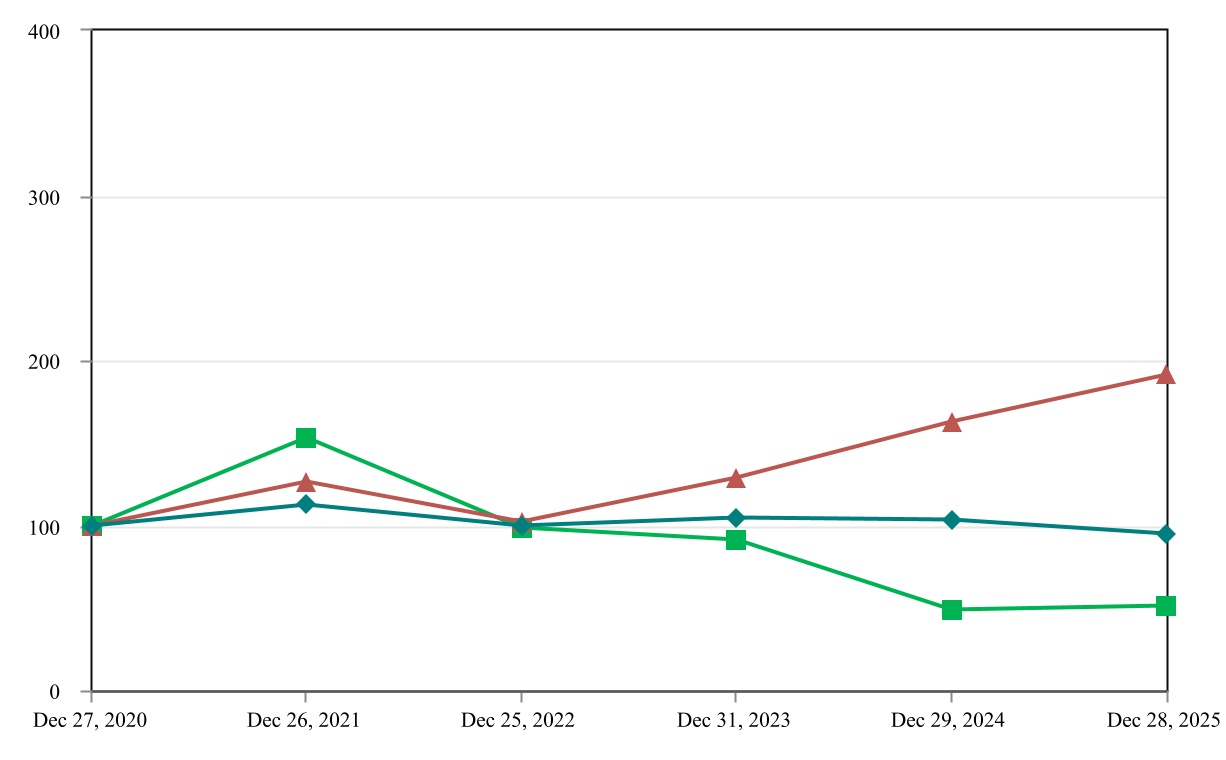
 Papa Johns International, Inc. Papa Johns International, Inc.  NASDAQ U.S. Benchmark TR Index NASDAQ U.S. Benchmark TR Index  NASDAQ Stocks (SIC 5800-5899 U.S. Companies) Eating and Drinking NASDAQ Stocks (SIC 5800-5899 U.S. Companies) Eating and Drinking | |||||||||||||||||
| Dec. 26, 2021 | Dec. 25, 2022 | Dec. 31, 2023 | Dec. 29, 2024 | Dec. 28, 2025 | |||||||||||||
| Papa John’s International, Inc. | $152.99 | $98.50 | $91.47 | $49.08 | $51.02 | ||||||||||||
| NASDAQ U.S. Benchmark, TR Index | $126.17 | $102.03 | $128.93 | $162.86 | $191.14 | ||||||||||||
| NASDAQ Stocks - Eating and Drinking | $112.67 | $99.95 | $104.49 | $103.11 | $94.71 | ||||||||||||
Item 6. [Reserved]
31
Item 7. Management’s Discussion and Analysis of Financial Condition and Results of Operations
Introduction and Overview
The following Management’s Discussion and Analysis (“MD&A”) should be read in conjunction with the Consolidated Financial Statements in Item 8. Financial Statements and Supplementary Data and the Risk Factors set forth in Item 1A. Risk Factors.
This section of this Annual Report on Form 10-K generally discusses fiscal 2025 and 2024 items and year-to-year comparisons between the years ended December 28, 2025 and December 29, 2024. Discussion of 2023 items and year-to-year comparisons between the years ended December 29, 2024 and December 31, 2023 that are not included in this Form 10-K can be found in “Management’s Discussion and Analysis of Financial Condition and Results of Operations” in Part II, Item 7 of the Company’s Annual Report on Form 10-K for the fiscal year ended December 29, 2024.
Our fiscal year ends on the last Sunday in December of each year. All fiscal years presented consist of 52 weeks except for the 2023 fiscal year, which consisted of 53 weeks.
Papa John’s International, Inc. (referred to as the “Company,” “Papa John’s,” “Papa Johns” or in the first-person notations of “we,” “us” and “our”) began operations in 1984. At December 28, 2025, there were 6,083 Papa Johns restaurants in operation, consisting of 475 Company-owned and 5,608 franchised restaurants. Our revenues are derived from retail sales of pizza and other food and beverage products to the general public by Company-owned restaurants, franchise royalties and sales of franchise and development rights. Additionally, we generate revenue from sales to franchisees of various items including food and paper products from our North America Quality Control Centers (“QC Centers”) and operation of our International QC Center in the United Kingdom, contributions received by Papa John’s Marketing Fund, Inc. (“PJMF”) which is our national marketing fund, and fees related to the use of information systems equipment as well as software and related services. We believe that in addition to supporting both Company and franchised profitability and growth, these activities contribute to product quality and consistency throughout the Papa Johns system.
In discussions of our business, “Domestic” is defined as within the contiguous United States, “North America” includes Domestic and Canada, and “International” includes the rest of the world other than North America.
Recent Developments and Trends
In 2025, we remained focused on executing our strategic priorities as we position the business for long-term success amidst a challenging and softer consumer environment in North America and a dynamic market internationally. We continued to steer our efforts and investments towards initiatives that improve our value perception and enhance the customer journey across our digital platforms to increase conversion and reduce friction within the customer experience. Our key areas of focus include:
Marketing strategy: We continued investments in our messaging to showcase our BETTER INGREDIENTS. BETTER PIZZA® platform by highlighting our six simple ingredients, fresh, never frozen original dough and the craftsmanship behind the products we serve, which we believe are key differentiators of our brand. We also sharpened our value perception with limited-time promotional offers while continuing to emphasize our Papa Pairings mix and match platform. We plan to maintain a compelling value proposition while staying true to our premium positioning and layering in exciting menu innovation to expand our addressable market and strengthen our barbell strategy. We spent an incremental $21 million in marketing investments throughout 2025 compared with 2024, including investments in our customer relationship management platform and our loyalty program. This incremental investment aided in ensuring a strong presence nationally as well as in key regional and local markets while leveraging our data to create more personalized offers for our customers.
Digital and loyalty strategy: Most of our sales occur through digital channels, and we are investing in our technology infrastructure to deliver a more seamless experience across our owned channels, better connect with customers, and support greater efficiency across our operations. In 2025, we introduced our new omnichannel platform, releasing new mobile apps across both Android and iOS platforms as well as our refreshed website and mobile web experience. We believe that the rollout of our new omnichannel platform will lead to a more streamlined ordering journey and simplify the overall experience for our customers. We may incur an additional $5 million to $10 million of accelerated depreciation expense related to the potential replacement and retirement of related technology assets currently in service as this project continues.
32
We also recently announced plans to begin a multi-year initiative to transition to a new point-of-sale system across all U.S. Company-owned and franchised restaurants that, if successful, could replace our existing point-of-sale system. At the time we determine that our legacy point-of-sale system will be replaced, these legacy technology assets may require adjustments to their useful lives to best reflect remaining technology utilization and become subject to future accelerated depreciation, which could have a material impact on our depreciation expenses.
Transforming our cost structure: In 2025, we initiated a comprehensive review of our expense structure. In connection with this review, in December 2025 our Board of Directors approved the first phase of a new business transformation program (the “Enterprise Transformation Plan”), with the goal of creating capacity to invest in our next phase of growth by reducing non-consumer-facing spending and optimizing our restaurant portfolio to improve unit economics. The initiation of the first phase, designed to reduce overhead duplication and non-consumer-facing spending, resulted in restructuring charges of $7.7 million incurred during the fourth quarter of 2025 and primarily consisted of employee severance costs related to reducing our corporate workforce as well as professional services fees. In February 2026, our Board of Directors approved the second phase of the Enterprise Transformation Plan, which focuses on optimizing our restaurant portfolio and improving restaurant-level profitability. We currently estimate that we will incur restructuring charges of approximately $24 million to $31 million related to actions approved thus far, inclusive of the $7.7 million recognized during 2025 and the remainder of which we expect will be recognized during 2026 and 2027. We believe that these initiatives will improve systemwide health and facilitate future growth, and we have identified at least $25 million of savings, exclusive of marketing spend, to be captured across fiscal years 2026 and 2027.
The implementation of the Enterprise Transformation Plan remains ongoing and may result in additional restructuring charges, although the amounts and nature of future expenses are currently not estimable as no specific actions necessitating additional expenses have been determined or approved by our Board of Directors. These actions are expected to include elevated levels of restaurant closures in North America during 2026 and 2027, as we focus on improving the health of our restaurant portfolio by closing underperforming restaurants that lack a path to sustainable financial improvement, allowing our franchisees to invest resources in their remaining restaurants to accelerate growth.
Optimizing our supply chain: We are also finalizing our previously announced internal review of our North American supply chain and have identified productivity initiatives that we believe will optimize our commissary business in an effort to reduce the overall cost to serve across all of our Domestic Company-owned and franchised restaurants, without impacting our commitment to product quality. We expect to achieve at least $60 million in North America systemwide supply chain savings over the next two years, equating to meaningful restaurant-level margin improvement with approximately $20 million to $25 million of the savings to be recognized by the end of 2026.
Development strategy: Development is a key long-term growth driver as we believe there is significant opportunity to offer our quality products to more customers globally and domestically. Our near-term development plan in North America includes focused development within our priority markets and on improving the quality and profitability of our restaurant portfolio, with fewer new restaurant openings expected in 2026. To aid our franchisees in pursuing profitable growth in conjunction with the supply chain and restaurant optimization initiatives described above, we are offering royalty incentives for new restaurants opening in 2026, which we believe will add scale in key markets and attract growth-driven franchisees.
Accelerating our refranchising program: We also achieved a key milestone in the acceleration of our Domestic refranchising program, completing the refranchising of 85 restaurants during the fourth quarter of 2025. Refranchising is a strategic action that we plan to continue to pursue across our Company-owned restaurants as it provides developing franchisees opportunities to expand their businesses and strengthens the long-term health of Papa Johns while providing additional means to reinvest into our transformation initiatives.
33
International Transformation Plan
We completed our previously announced international transformation initiatives (the “International Transformation Plan”) during the fourth quarter of 2025 and incurred total restructuring related costs of $34.4 million over the entire duration of the program, approximately $20 million of which were cash expenditures. Comparable sales for our International business increased by 5.0% during the year ended December 28, 2025, which we believe is attributable to the International Transformation Plan and the operational improvement resulting from its implementation.
Announced in December 2023, the International Transformation Plan was designed to evolve our business structure to deliver an enhanced value proposition to our International customers and franchisees, ensure targeted investments and efficient resource management, and better position certain international markets, including the United Kingdom, for long-term profitable growth and brand strength. See “Note 16. Restructuring” of “Notes to Consolidated Financial Statements” for additional details.
34
Presentation of Financial Results
Critical Accounting Policies and Estimates
The results of operations are based on our Consolidated Financial Statements, which were prepared in conformity with accounting principles generally accepted in the United States (“GAAP”). The preparation of Consolidated Financial Statements requires management to make estimates and judgments that affect the amounts reported in the Consolidated Financial Statements. A number of our significant accounting policies involve a significant level of estimation uncertainty and have had or are reasonably likely to have a material impact on our financial condition or results of operations. On an ongoing basis, our management evaluates its estimates, including those related to insurance reserves, long-lived assets, the allowance for credit losses on franchisee notes receivable, and income taxes. Actual results may differ from those estimates, and significant changes in assumptions and/or conditions in our critical accounting policies could materially impact our operating results. The Company’s significant accounting policies, including recently issued accounting pronouncements, are also described in “Note 2. Significant Accounting Policies” of “Notes to Consolidated Financial Statements.”
We believe that our most critical accounting estimates are:
Insurance Reserves
Our insurance programs for workers’ compensation, owned and non-owned automobiles, general liability and property insurance coverage are funded by the Company up to certain retention levels ranging up to $0.8 million. We record the liability for losses based upon undiscounted estimates of the liability for claims incurred and for events that have occurred but have not been reported using certain third-party actuarial projections and our historical claims loss experience.
As of December 28, 2025, our insurance reserves were $61.8 million compared to $65.7 million at December 29, 2024. Reserves are included in Accrued expenses and other current liabilities and Other long-term liabilities on the Consolidated Balance Sheets. Our insurance reserves primarily relate to auto liability and workers’ compensation claims and include the gross up of claims above our retention levels, with a corresponding receivable of $42.8 million and $45.2 million as of December 28, 2025 and December 29, 2024, respectively, recorded in Prepaid expenses and other current assets and Other assets on the Consolidated Balance Sheets. The insurance reserves represent the mid-point of the range as determined by our actuarial analysis, which considered various actuarial valuation methodologies. The determination of the recorded insurance reserves is complex due to the actuarial valuation methods utilized in determining the reserve and the assumptions related to the loss development factors and loss trends.
Property and Equipment, Net and Impairment of Long-Lived Assets
We record property and equipment at its historical cost, which includes all costs necessarily incurred to bring the asset to the condition and location necessary for its intended use. Purchases of property and equipment were $74.4 million in 2025 and $72.5 million in 2024. Purchase of property and equipment for 2025 included $9.7 million of capital expenditures related to damages from natural disasters. Property and equipment are depreciated on a straight-line basis over their useful lives, which are based on management’s estimates of the period over which the assets provide a benefit to the Company. The useful lives are estimated based on historical experience with similar assets as well as other information regarding condition and utility of the assets. Our asset useful lives are generally five to ten years for restaurant, commissary, and other equipment, twenty to forty years for buildings and improvements, and five years for technology and capitalized software. Leasehold improvements are amortized over the shorter of their estimated useful lives or the term of the respective lease, including the first renewal period (generally five to ten years). We will re-assess our useful life estimate for an asset when facts and circumstances indicate the period over which the asset is expected to provide economic benefits has changed, which can occur for various reasons including technological advancements, a demonstrable change in usage patterns, market demand, or legal or regulatory changes. Depreciation expense was $80.8 million in 2025 and $59.6 million in 2024. The increase in 2025 was due mainly to $18.4 million of accelerated depreciation expense related to investments in technology platforms, primarily our new omnichannel experience.
We evaluate property and equipment and other long-lived assets (primarily right-of-use operating lease assets) for potential indicators of impairment at least annually, or as facts and circumstances indicate that the carrying value of the asset may not be recoverable. We perform these assessments at the operating market level for Domestic restaurants and at the restaurant level for our Company-owned restaurants in the United Kingdom (“UK”), as this represents the lowest level for which identifiable cash flows are largely independent of the cash flows of other assets and liabilities. If we determine there are indicators of impairment, we compare the net carrying value of the asset group to the projected undiscounted cash flows to be generated from the use of the asset group. If the carrying amount of the long-lived asset group exceeds the amount of
35
estimated future undiscounted cash flows, then we estimate the fair value of the asset group and record an impairment loss if the carrying value exceeds fair value. If indicators of impairment are present, calculating projected undiscounted cash flows requires management to make assumptions and estimates for factors that include future comparable sales growth and gross margin based on internal projections as well as the historical performance of the market or individual restaurant and whether that is an indicator of future performance. These assumptions for future growth are subjective and may be negatively impacted by future changes in operating performance or economic conditions.
We recorded total impairment losses of $8.6 million in 2025, consisting of property and equipment and lease asset impairment, related primarily to damages to our QC Centers in Grand Prairie, Texas and Louisville, Kentucky caused by tornadoes as well as restructuring activities under our International Transformation Plan and Enterprise Transformation Plan. Of these amounts, we recorded an anticipated insurance recovery for $6.4 million as we believe such losses are probable of recovery under our insurance policy. We recorded impairment losses of $11.7 million in 2024, primarily consisting of property and equipment and lease asset impairment, related to the closure of 43 UK Company-owned restaurants and 30 UK franchised restaurants as well as five UK Company-owned restaurants where the carrying value of the asset group was not deemed to be recoverable. We also incurred impairment losses of $5.5 million during 2024 in connection with the refranchising of 15 Domestic Company-owned restaurants.
Allowance for Credit Losses on Franchisee Notes Receivable
The Company has provided financing (recorded as notes receivable) to select Domestic and International franchisees principally for use in the construction and development of their restaurants and for the purchase of restaurants from the Company or other franchisees. Most notes receivable bear interest at fixed or floating rates and are generally secured by the assets of each restaurant and the ownership interests in the franchise.
The Company establishes an allowance for credit losses on franchisee notes receivables based on management’s estimate of the lifetime expected loss on the notes. The allowance for credit losses on notes receivable is judgmental and subjective based on management’s evaluation of historical collection experience and external market data and other factors, including those related to current market conditions and events. The Company is provided collateral rights of the franchisee’s restaurants (e.g., underlying franchise business, property and equipment) and personal guarantees from the operators to recover the carrying value of the outstanding note receivable in the event collectability concerns arise. Therefore, the Company considers the fair value of the underlying collateral rights (e.g., underlying franchisee business, property and equipment) and any guarantees when assessing the allowance for credit losses (which may require third-party valuations of fair value). Notes receivable balances are charged off against the allowance after recovery efforts have ceased.
Franchisee notes receivable was $24.4 million with an allowance for credit losses of $17.8 million as of December 28, 2025 compared to $29.0 million with an allowance for credit losses of $15.2 million as of December 29, 2024. See “Note 10. Allowance for Credit Losses” of “Notes to Consolidated Financial Statements” for further information.
Income Tax Accounts and Tax Reserves
Papa John’s is subject to income taxes in the United States and several foreign jurisdictions. Judgment is required in determining Papa John’s provision for income taxes and the related assets and liabilities. The provision for income taxes includes income taxes paid, currently payable or receivable and those deferred. Deferred tax assets and liabilities are determined based on differences between financial reporting and tax basis of assets and liabilities and are measured using enacted tax rates and laws that are expected to be in effect when the differences reverse. Deferred tax assets are also recognized for the estimated future effects of tax attribute carryforwards (e.g., net operating losses, capital losses, and foreign tax credits). The effect on deferred taxes of changes in tax rates is recognized in the period in which the new tax rate is enacted.
Valuation allowances are established when necessary on a jurisdictional basis to reduce deferred tax assets to the amounts we expect to realize and were $48.2 million and $44.5 million as of December 28, 2025 and December 29, 2024, respectively. The determination as to whether a deferred tax asset will be realized is based on the evaluation of historical profitability, future market growth, future taxable income, the expected timing of the reversals of existing temporary differences and tax planning strategies. The Company assesses deferred taxes and the adequacy or need for a valuation allowance on a quarterly basis.
Tax authorities periodically audit the Company. We record reserves and related interest and penalties for identified exposures as income tax expense. We evaluate these issues and adjust for events, such as statute of limitations expirations, court rulings or audit settlements, which may impact our ultimate payment for such exposures.
36
In the event the Company is unable to generate future taxable income, there is a material change in the actual effective tax rates, the time period within which the underlying temporary differences become taxable or deductible, or if the tax laws change unfavorably, then we could be required to increase the valuation allowance against deferred tax assets, resulting in an increase in income tax expense and the effective tax rate. We estimate that a one percent change in the effective income tax rate would impact the 2025 income tax expense by $0.5 million. See “Note 17. Income Taxes” of “Notes to Consolidated Financial Statements” for additional information.
Global Restaurant Sales and Unit Information
“Comparable sales” represents sales for the same base of restaurants for the same fiscal periods. “Comparable sales growth (decline)” represents the change in year-over-year comparable sales. “Global system-wide restaurant sales” represents total restaurant sales for all Company-owned and franchised restaurants open during the comparable periods, and “Global system-wide restaurant sales growth (decline)” represents the change in global system-wide restaurant sales year-over-year. Comparable sales, Comparable sales growth (decline), Global system-wide restaurant sales and Global system-wide sales growth (decline) exclude franchisees for which we suspended corporate support.
“Equivalent units” represents the number of restaurants open at the beginning of a given period, adjusted for restaurants opened, closed, acquired or sold during the period on a weighted average basis.
We believe Domestic Company-owned, North America franchised, and International comparable sales and comparable sales growth (decline) and Global system-wide restaurant sales and sales growth information is useful in analyzing our results since our franchisees pay royalties and marketing fund contributions that are based on a percentage of franchise sales. Comparable sales and Global system-wide restaurant sales results for restaurants operating outside of the United States are reported on a constant dollar basis, which excludes the impact of foreign currency translation. Franchise sales also generate commissary revenue in the United States and in certain international markets. Comparable sales growth (decline) and Global system-wide restaurant sales information is also useful for comparison to industry trends and evaluating the strength of our brand. Management believes the presentation of Global system-wide restaurant sales growth, excluding the impact of foreign currency, provides investors with useful information regarding underlying sales trends and the impact of new unit growth without being impacted by swings in the external factor of foreign currency. Franchise restaurant sales are not included in the Company’s revenues.
| Year Ended | ||||||||||||||
| Amounts below exclude the impact of foreign currency | December 28, 2025 | December 29, 2024 | ||||||||||||
| Comparable sales growth (decline): | ||||||||||||||
| Domestic Company-owned restaurants | (3.3) | % | (4.9) | % | ||||||||||
| North America franchised restaurants | (2.3) | % | (3.5) | % | ||||||||||
| North America restaurants | (2.5) | % | (3.8) | % | ||||||||||
| International restaurants | 5.0 | % | (0.8) | % | ||||||||||
| Total comparable sales growth (decline) | (0.6) | % | (3.1) | % | ||||||||||
| System-wide restaurant sales growth (decline): | ||||||||||||||
| Domestic Company-owned restaurants | (1.2) | % | (4.7) | % | ||||||||||
| North America franchised restaurants | (1.0) | % | (4.1) | % | ||||||||||
| North America restaurants | (1.0) | % | (4.2) | % | ||||||||||
| International restaurants | 7.7 | % | 0.4 | % | ||||||||||
| Total global system-wide restaurant sales growth (decline) | 1.1 | % | (3.1) | % | ||||||||||
37
| Restaurant Progression | Year Ended | |||||||||||||
| December 28, 2025 | December 29, 2024 | |||||||||||||
| North America Company-owned: | ||||||||||||||
| Beginning of period | 539 | 531 | ||||||||||||
| Opened | 9 | 22 | ||||||||||||
| Closed | (1) | — | ||||||||||||
| Acquired | — | 1 | ||||||||||||
| Refranchised | (85) | (15) | ||||||||||||
| End of period | 462 | 539 | ||||||||||||
| North America franchised: | ||||||||||||||
| Beginning of period | 2,975 | 2,902 | ||||||||||||
| Opened | 87 | 90 | ||||||||||||
| Closed | (86) | (31) | ||||||||||||
| Sold | — | (1) | ||||||||||||
| Refranchised | 85 | 15 | ||||||||||||
| End of period | 3,061 | 2,975 | ||||||||||||
| International Company-owned | ||||||||||||||
| Beginning of period | 13 | 117 | ||||||||||||
| Closed | — | (43) | ||||||||||||
| Refranchised | — | (61) | ||||||||||||
| End of period | 13 | 13 | ||||||||||||
| International franchised: | ||||||||||||||
| Beginning of period | 2,503 | 2,356 | ||||||||||||
| Opened | 183 | 198 | ||||||||||||
| Closed | (139) | (112) | ||||||||||||
| Refranchised | — | 61 | ||||||||||||
| End of period | 2,547 | 2,503 | ||||||||||||
| Total restaurants – end of period | 6,083 | 6,030 | ||||||||||||
| Full year net restaurant growth | 53 | 124 | ||||||||||||
Fiscal Year
Our fiscal year ends on the last Sunday in December of each year. All fiscal years presented in the accompanying Consolidated Financial Statements consist of 52 weeks except for the 2023 fiscal year, which consisted of 53 weeks.
38
Results of Operations
Revenues
The following table sets forth the various components of Revenues from the Consolidated Statements of Operations.
| (Dollars in thousands) | December 28, 2025 | December 29, 2024 | Increase (Decrease) | |||||||||||||||||
| Revenues: | ||||||||||||||||||||
| Company-owned restaurant sales | $ | 675,657 | $ | 724,666 | (6.8) | % | ||||||||||||||
| Franchise royalties and fees | 190,952 | 187,032 | 2.1 | % | ||||||||||||||||
| Commissary revenues | 929,944 | 899,664 | 3.4 | % | ||||||||||||||||
| Other revenues | 90,526 | 83,682 | 8.2 | % | ||||||||||||||||
| Advertising funds revenue | 166,729 | 164,343 | 1.5 | % | ||||||||||||||||
| Total revenues | $ | 2,053,808 | $ | 2,059,387 | (0.3) | % | ||||||||||||||
The comparability of 2025 and 2024 results is impacted by the following transactions that have changed the composition of our Domestic and UK restaurants:
•On November 24, 2025, the Company completed the refranchising of 85 Domestic Company-owned restaurants previously owned and operated by Colonel’s Limited, LLC, a consolidated joint venture (the “2025 refranchising transaction”). Additionally, the Company refranchised 15 Domestic Company-owned restaurants on September 30, 2024 (collectively referred to with the 2025 refranchising transaction as the “Domestic refranchising transactions”). See “Note 21. Divestitures” of the “Notes to Consolidated Financial Statements” for additional information on these transactions.
•At the beginning of 2024, the Company operated 117 UK Company-owned restaurants. In the second and third quarters of 2024, the Company closed 43 Company-owned restaurants in the UK and refranchised 60 formerly Company-owned restaurants in the UK. After prior disposal of one mobile restaurant, the Company operated 13 UK Company-owned restaurants subsequent to July 1, 2024. See “Note 16. Restructuring” of the “Notes to Consolidated Financial Statements” for additional information on these transactions.
Total revenues decreased $5.6 million, or 0.3%, to $2.05 billion for the year ended December 28, 2025, as compared to the prior year.
Company-owned restaurant sales, which include sales from both Domestic and International Company-owned restaurants, decreased $49.0 million, or 6.8% for the year ended December 28, 2025 compared to the prior year, primarily due to the transactions discussed above. Company-owned restaurant sales in the UK declined by approximately $18.8 million compared to 2024 due to the UK Company-owned restaurant closures and refranchising transactions in 2024, and the Domestic refranchising transactions discussed above resulted in a decrease of approximately $18.5 million as compared to the prior year. Additionally, the 2024 period included approximately $5 million of additional deferred revenue related to lowering the redemption thresholds for our Papa Rewards program in 2024, which allowed consumers to redeem rewards more quickly. The remaining decline was a result of a decline in Domestic company-owned restaurant comparable sales of 3.3% driven by lower transaction volumes, partially offset by increases in International comparable sales of 5.0% compared to the prior year.
Franchise royalties and fees, which include revenues generated from both North American and International franchisees, increased $3.9 million, or 2.1%, for the year ended December 28, 2025 compared to the prior year. The increase was primarily due to a $4.0 million increase from our International franchisees due to growth in International comparable sales of 5.0%. Royalties and fees from our North America franchisees were flat for the year ended December 28, 2025 compared to the prior year, as an increase in franchise equivalent units of 2.6% and fewer royalty waivers in 2025 as compared to 2024 were offset by declines in comparable sales for our North America franchised restaurants of 2.3%.
North America franchise restaurant sales are not included in Company revenues; however, our North America franchise royalties are derived from these sales. North America franchise restaurant sales decreased 1.0% to $2.93 billion for the year ended December 28, 2025 compared to the prior year, excluding the impact of foreign currency fluctuations. The decrease in franchise restaurant sales was due to the 2.3% decline in comparable sales, partially offset by North America equivalent unit growth noted above.
39
International franchise restaurant sales are also not included in Company revenues; however, our International franchise royalty revenue is derived from these sales. International franchise restaurant sales increased $123.7 million to $1.29 billion for the year ended December 28, 2025 compared to the prior year. The UK restaurant closures and refranchising transactions in 2024 impacted the comparability of International franchise restaurant sales earned as compared to the prior year period. Excluding the impact of the UK restaurant changes and excluding foreign currency fluctuations, International franchise restaurant sales would have increased 7.6% to $1.27 billion for the year ended December 28, 2025 compared to the prior year. The increase is due to growth in International comparable sales of 5.0% noted above as well as restaurant growth.
Commissary revenues, which includes sales from our North American and International QC Centers, increased $30.3 million or 3.4%, for the year ended December 28, 2025 compared to the prior year. The increase in Commissary revenues was primarily a result of higher prices and higher transaction volumes, partially offset by changes in product mix as compared to the prior year comparable period.
Other revenues, which primarily includes revenues derived from our online and mobile ordering business, increased $6.8 million, or 8.2% in 2025. This was primarily due to higher revenues generated from technology services as a result of an increase in the technology fee charged to franchisees that began in the second half of 2024 and continued through the first half of 2025.
Advertising funds revenue, which includes the operations of PJMF, local marketing funds, and International marketing funds, increased $2.4 million, or 1.5%, in 2025. The increase was primarily due to global system-wide restaurant sales growth of 1.1% as well as increases in the PJMF contribution percentage that took effect in the second quarter of 2024 and increases to contribution percentages in certain International markets. This was partially offset by national marketing fund rebates offered to franchisees and a decrease in local marketing spend in 2025.
Costs and Expenses
The following table sets forth the various components of Costs and expenses from the Consolidated Statements of Operations:
| (Dollars in thousands) | Year Ended | |||||||||||||||||||
| December 28, 2025 | December 29, 2024 | Increase (Decrease) | ||||||||||||||||||
| Costs and expenses: | ||||||||||||||||||||
| Cost of sales | $ | 1,460,492 | $ | 1,478,426 | (1.2) | % | ||||||||||||||
| General and administrative expenses | 244,282 | 190,515 | 28.2 | % | ||||||||||||||||
| Depreciation and amortization | 92,245 | 69,407 | 32.9 | % | ||||||||||||||||
| Advertising funds expense | 167,642 | 164,335 | 2.0 | % | ||||||||||||||||
| Total costs and expenses | $ | 1,964,661 | $ | 1,902,683 | 3.3 | % | ||||||||||||||
Total costs and expenses were approximately $1.96 billion, or 95.7% of total revenues in 2025, as compared to $1.90 billion, or 92.4% of total revenues for the prior year.
Cost of sales consists primarily of Company-owned store and supply chain costs incurred to generate related revenues. Components of cost of sales primarily include food and paper products, labor, freight and delivery, occupancy costs, local advertising costs, and insurance expense. Cost of sales was $1.46 billion in 2025, a decrease of $17.9 million, or 1.2%, from the prior year.
40
Cost of sales by segment for the years ended December 28, 2025 and December 29, 2024 were as follows:
| (Dollars in thousands) | December 28, 2025 | December 29, 2024 | Increase (Decrease) | |||||||||||||||||
Domestic Company-owned restaurants (a) | $ | 594,434 | $ | 611,685 | (2.8) | % | ||||||||||||||
North America commissaries (a) | 944,940 | 934,980 | 1.1 | % | ||||||||||||||||
International (a) | 90,808 | 104,138 | (12.8) | % | ||||||||||||||||
Total cost of sales by segment(b) | 1,630,182 | 1,650,803 | (1.2) | % | ||||||||||||||||
All other (c) | 55,972 | 51,347 | 9.0 | % | ||||||||||||||||
| Intersegment cost of sales | (225,662) | (223,724) | 0.9 | % | ||||||||||||||||
| Total cost of sales | $ | 1,460,492 | $ | 1,478,426 | (1.2) | % | ||||||||||||||
______________________________
(a) Segment cost of sales include stock-based compensation expenses and other adjustments that are excluded from our segment results, which are presented on an adjusted basis (see “Note 22. Segment Information” of the “Notes to Consolidated Financial Statements”).
(b) The North America franchising segment does not incur costs of sales, and therefore is not included in total cost of sales by segment. The North America franchising segment consists of our franchise sales and support activities for our franchisees located in the United States and Canada.
(c) “All other” refers to all other business units that do not meet the quantitative or qualitative thresholds for determining reportable segments, and primarily includes our online and mobile ordering business and our marketing funds and are not operating segments.
The decrease in cost of sales primarily relates to lower volumes for our Domestic Company-owned restaurants and International Company-owned restaurants as a result of the Domestic refranchising transactions and the 2024 UK restaurant closures and refranchising transactions. The decreases were also due to lower local advertising costs for our Domestic Company-owned restaurants, partially offset by higher food costs for our Domestic Company-owned restaurants and higher volumes for our Domestic QC Centers compared to the prior year.
General and administrative expenses (“G&A expenses”) were $244.3 million, or 11.9%, of total revenues for 2025 compared to $190.5 million, or 9.3%, of total revenues for the prior year. G&A expenses consisted of the following components (in thousands):
| (Dollars in thousands) | Year Ended | |||||||||||||
| December 28, 2025 | December 29, 2024 | |||||||||||||
Administrative and other general expenses (a) | $ | 240,935 | $ | 199,036 | ||||||||||
Gain on refranchising transaction, net and sale of QC Center properties (b) | (17,053) | (41,289) | ||||||||||||
Restructuring costs (c) | 12,593 | 27,273 | ||||||||||||
Other costs (d) | 7,807 | 5,495 | ||||||||||||
| General and administrative expenses | $ | 244,282 | $ | 190,515 | ||||||||||
(a) Administrative and other general expenses, net increased by $41.9 million to $240.9 million for the year ended December 28, 2025 compared to the prior year. The increase was primarily due to incremental marketing investments of $21.2 million, an increase in management incentive compensation of $13.8 million, and expenses resulting from our biannual franchise operating conference held in the first quarter of 2025.
(b) For the year ended December 28, 2025, represents pre-tax gain on sale, net of transaction costs, realized upon the completion of the refranchising of 85 restaurants on November 24, 2025. Net gain attributable to noncontrolling interests for the transaction was approximately $1.0 million. See “Note 21. Divestitures” for additional details. For the year ended December 29, 2024, represents pre-tax gain on sale, net of transaction costs, realized upon the August 2, 2024 completion of the sale of our Texas and Florida QC Center properties. See “Note 21. Divestitures” for additional details.
(c) Represents costs associated with the Company’s Enterprise Transformation Plan and International Transformation Plan. See “Note 16. Restructuring” for additional details.
(d) For the year ended December 28, 2025, other costs is comprised of the following:
i.Losses on disposal of equipment incurred in connection with the termination of a COVID-era program that pre-purchased store equipment due to supply chain challenges;
41
ii.Costs associated with project-based strategic initiatives that are not related to our ongoing operations.
iii.Costs incurred, net of anticipated insurance recoveries, arising from tornadoes that damaged the Texas QC Center as well as the restaurant support center and QC Center in Louisville, Kentucky.
For the year ended December 29, 2024, other costs represents non-cash impairment and remeasurement charges related primarily to fixed and intangible assets from the refranchising of 15 Domestic Company-owned restaurants.
Depreciation and amortization expense was $92.2 million, or 4.5% of revenues in 2025, as compared to $69.4 million, or 3.4% of revenues for the prior year, due mainly to accelerated depreciation expense related to the rollout of our new omnichannel experience and the corresponding retirement of certain assets within our legacy technology platforms. We began accelerating depreciation of legacy omnichannel and other technology assets during the third quarter of 2025 following the completion of the initial development and release of our new omnichannel platform, with the retirement of certain technology assets beginning shortly thereafter. We recognized $18.4 million in additional depreciation expense during the year ended December 28, 2025 related to the accelerated depreciation of these assets. We currently estimate that we may incur an additional $5 million to $10 million of accelerated depreciation expense by the end of 2026 related to the potential replacement and retirement of related legacy technology assets currently in service.
Advertising funds expense was $167.6 million, or 100.5% of advertising revenues in 2025, as compared to $164.3 million, or 100.0% of advertising revenues for the prior year. Advertising funds expense is comprised primarily of expenses incurred by PJMF, which is designed to operate at break-even as it spends all annual contributions received from the system. The increase was primarily due to higher advertising spend resulting from the previously discussed increase in contributions to the national marketing fund during the second quarter of 2024.
Segment Financial Performance
We evaluate the performance of our reportable segments and allocate resources to them based on earnings before interest, taxes, depreciation, amortization, stock-based compensation expense, and other adjustments, referred to as Segment adjusted EBITDA. See “Note 22. Segment Information” of “Notes to Consolidated Financial Statements,” for further information regarding the Company’s segments. Segment adjusted EBITDA for each of our reportable segments is summarized in the table below.
| Year Ended | ||||||||||||||||||||
| (Dollars in thousands) | December 28, 2025 | December 29, 2024 | Increase (Decrease) | |||||||||||||||||
| Segment adjusted EBITDA: | ||||||||||||||||||||
| Domestic Company-owned restaurants | $ | 28,371 | $ | 43,659 | $ | (15,288) | ||||||||||||||
| North America franchising | 105,364 | 110,213 | (4,849) | |||||||||||||||||
| North America commissaries | 78,819 | 65,749 | 13,070 | |||||||||||||||||
| International | 22,581 | 18,297 | 4,284 | |||||||||||||||||
Domestic Company-owned restaurants decreased $15.3 million as compared to the prior year, primarily due to a 3.3% decrease in comparable sales, higher food costs, and the prior period benefit of approximately $5 million related to changes in our Papa Rewards program, as discussed above. The decrease was partially offset by lower local advertising costs in 2025 and the impact of refranchising 15 restaurants during the third quarter of 2024.
North America franchising decreased $4.8 million as compared to the prior year, primarily due to higher management incentive compensation allocated to the segment compared to the prior year period. Royalties and fees revenue from our North America franchisees were flat compared to the prior year, as discussed above.
North America commissaries increased $13.1 million as compared to the prior year, primarily due to higher prices and transaction volumes previously mentioned, partially offset by changes in product mix, higher salaries and benefits, and increases in rent due to the sale and subsequent leaseback of two Domestic QC Centers in Texas and Florida in the third quarter of 2024.
International increased $4.3 million as compared to the prior year. The increase was primarily to system-wide sales growth of 7.7%, comparable sales growth of 5.0%, and prior period operating losses attributable to the UK Company-owned restaurants. These increases were partially offset by increases in advertising spend in 2025.
42
4-wall EBITDA
4-wall EBITDA and 4-wall EBITDA margin are non-GAAP measures used to evaluate the performance of our Domestic Company-owned restaurants. See “Non-GAAP Measures” for the definition of 4-wall EBITDA and 4-wall EBITDA margin as well as a reconciliation to the most comparable U.S. GAAP measures.
4-wall EBITDA and 4-wall EBITDA margin are presented in the table below (in thousands). Segment revenue and segment cost of sales for our Domestic Company-owned restaurants in the table below are presented in the segment footnote to our Consolidated Financial Statements in accordance with Accounting Standards Codification 280. See “Note 22. Segment Information” of “Notes to Consolidated Financial Statements,” for further information on our segments.
| Domestic Company-owned restaurants | Year Ended | |||||||||||||||||||||||||
| December 28, 2025 | % of Related Revenues | December 29, 2024 | % of Related Revenues | |||||||||||||||||||||||
| Segment Revenue | $ | 662,523 | $ | 692,736 | ||||||||||||||||||||||
| COS - Product Costs | (203,443) | 30.7 | % | (207,704) | 30.0 | % | ||||||||||||||||||||
| COS - Salaries & Benefits | (221,033) | 33.4 | % | (225,269) | 32.5 | % | ||||||||||||||||||||
| COS - Other | (168,971) | 25.5 | % | (177,656) | 25.6 | % | ||||||||||||||||||||
Training Costs (a) | — | — | % | 3,194 | (0.5) | % | ||||||||||||||||||||
| 4-wall EBITDA | $ | 69,076 | $ | 85,301 | ||||||||||||||||||||||
| 4-wall EBITDA margin | 10.4% | 12.3% | ||||||||||||||||||||||||
(a) Training costs for our Domestic Company-owned restaurants were reclassified from Cost of sales to General & administrative expenses prospectively beginning with the year ended December 28, 2025. We have excluded these training costs from Cost of sales in the historical period when calculating 4-wall EBITDA to ensure comparability.
4-wall EBITDA decreased $16.2 million as compared to the prior year, resulting in a 1.9% decrease in 4-wall EBITDA margin. The decrease was primarily due to an increase in COS - Product Costs and COS - Salaries & Benefits as a percentage of segment revenue of 0.7% and 0.9%, respectively. Domestic Company-owned restaurant cost of sales as a percentage of segment revenue increased due to higher food costs and a 3.3% decline in comparable sales as well as the prior period benefit of approximately $5 million related to changes in our Papa Rewards program. These increases in cost of sales were offset by lower local advertising costs in 2025 and the impact of refranchising 15 restaurants during the third quarter of 2024, as discussed above.
Items Below Operating Income
The following table sets forth the various items below Operating income from the Consolidated Statements of Operations:
| (In thousands, except per share amounts) | Year Ended | |||||||||||||||||||
| December 28, 2025 | December 29, 2024 | Increase (Decrease) | ||||||||||||||||||
| Operating income | $ | 89,147 | $ | 156,704 | $ | (67,557) | ||||||||||||||
| Net interest expense | (40,769) | (42,578) | (1,809) | |||||||||||||||||
| Income before income taxes | 48,378 | 114,126 | (65,748) | |||||||||||||||||
Income tax expense (a) | (16,261) | (29,929) | (13,668) | |||||||||||||||||
| Net income | 32,117 | 84,197 | (52,080) | |||||||||||||||||
| Net income attributable to noncontrolling interests | (1,586) | (711) | 875 | |||||||||||||||||
| Net income attributable to the Company | $ | 30,531 | $ | 83,486 | $ | (52,955) | ||||||||||||||
| Net income attributable to common shareholders | $ | 29,569 | $ | 83,320 | $ | (53,751) | ||||||||||||||
| Basic earnings per common share | $ | 0.90 | $ | 2.55 | $ | (1.65) | ||||||||||||||
| Diluted earnings per common share | $ | 0.90 | $ | 2.54 | $ | (1.64) | ||||||||||||||
43
(a) The signage of Income tax expense has been changed from the historic presentation for purposes of signage consistency with other expense items.
Net Interest Expense
Net interest expense decreased approximately $1.8 million for the year ended December 28, 2025 compared to the prior year primarily due to lower average interest rates during 2025.
Income Tax Expense
The effective income tax rate was 33.6% for 2025 and 26.2% for 2024. The higher effective rate in 2025 was primarily due to lower pretax book income and larger tax shortfall generated by vesting of restricted shares during 2025.
| (Dollars in thousands) | Year Ended | |||||||||||||
| December 28, 2025 | December 29, 2024 | |||||||||||||
| Income before income taxes | $ | 48,378 | $ | 114,126 | ||||||||||
| Income tax expense | $ | (16,261) | $ | (29,929) | ||||||||||
| Effective tax rate | 33.6 | % | 26.2 | % | ||||||||||
See “Note 17. Income Taxes” of “Notes to Consolidated Financial Statements” for additional information.
Net Income Attributable to Noncontrolling Interests
Net income included income attributable to noncontrolling interests of $1.6 million during 2025 and $0.7 million for the prior year. The increase was due primarily to the refranchising of 85 Domestic Company-owned restaurants previously owned and operated by Colonel’s Limited, LLC, a consolidated joint venture. The 2025 refranchising transaction resulted in the recognition of a $17.1 million gain during the year ended December 28, 2025, a portion of which was attributable to noncontrolling interests. See “Note 21. Divestitures” of “Notes to Consolidated Financial Statements” for further information.
Diluted Earnings Per Share
Diluted earnings per common share was $0.90 for the year ended December 28, 2025 compared to $2.54 for the year ended December 29, 2024, representing a decrease of $1.64. Adjusted diluted earnings per common share, a non-GAAP measure, was $1.43 for the year ended December 28, 2025 compared to $2.34 for the year ended December 29, 2024, representing a decrease of $0.91. See “Non-GAAP Measures” for additional information. These changes were driven by the same factors impacting operating income and income tax expense as discussed above.
Non-GAAP Measures
In addition to the results provided in accordance with U.S. GAAP, we provide certain non-GAAP measures, which present results on an adjusted basis. These are supplemental measures of performance that are not required by or presented in accordance with U.S. GAAP and include the following: adjusted EBITDA, 4-wall EBITDA, 4-wall EBITDA margin, adjusted net income attributable to common shareholders, and adjusted diluted earnings per common share. We believe that our non-GAAP financial measures enable investors to assess the operating performance of our business relative to our performance based on U.S. GAAP results and relative to other companies. We believe that the disclosure of these non-GAAP measures is useful to investors as they reflect metrics that our management team and Board utilize to evaluate our operating performance, allocate resources and administer employee incentive plans. The most directly comparable U.S. GAAP measures to adjusted EBITDA, 4-wall EBITDA, adjusted net income attributable to common shareholders, and adjusted diluted earnings per common share, are net income, segment adjusted EBITDA, net income attributable to common shareholders, and diluted earnings per common share, respectively. These non-GAAP measures should not be construed as a substitute for or a better indicator of the Company’s performance than the Company’s U.S. GAAP results.
44
The table below reconciles our GAAP financial results to our non-GAAP financial measures.
| Year Ended | ||||||||||||||
| (In thousands, except per share amounts) | December 28, 2025 | December 29, 2024 | ||||||||||||
| Net Income | $ | 32,117 | $ | 84,197 | ||||||||||
| Income tax expense | 16,261 | 29,929 | ||||||||||||
| Net interest expense | 40,769 | 42,578 | ||||||||||||
| Depreciation and amortization | 92,245 | 69,407 | ||||||||||||
| Stock-based compensation expense | 14,980 | 9,590 | ||||||||||||
Gain on refranchising transaction, net and sale of QC Center properties (a) | (17,053) | (41,289) | ||||||||||||
Restructuring costs (b) | 13,780 | 27,363 | ||||||||||||
Other costs (c) | 8,012 | 5,495 | ||||||||||||
| Adjusted EBITDA | $ | 201,111 | $ | 227,270 | ||||||||||
| Segment adjusted EBITDA - Domestic Company-owned restaurants | $ | 28,371 | $ | 43,659 | ||||||||||
| General & Administrative - Domestic Company-owned restaurants | 40,705 | 38,448 | ||||||||||||
Training Costs - Domestic Company-owned restaurants (f) | — | 3,194 | ||||||||||||
4-wall EBITDA (g) | $ | 69,076 | $ | 85,301 | ||||||||||
| Segment revenue - Domestic Company-owned restaurants | $ | 662,523 | $ | 692,736 | ||||||||||
4-wall EBITDA margin (g) | 10.4 | % | 12.3 | % | ||||||||||
| Net income attributable to common shareholders | $ | 29,569 | $ | 83,320 | ||||||||||
Gain on refranchising transaction, net and sale of QC Center properties (a) | (16,028) | (41,289) | ||||||||||||
Restructuring costs (b) | 12,593 | 27,273 | ||||||||||||
Accelerated software depreciation (d) | 18,380 | — | ||||||||||||
Other costs (c) | 8,012 | 5,495 | ||||||||||||
Tax effect of adjustments (e) | (5,326) | 1,934 | ||||||||||||
Adjusted net income attributable to common shareholders | $ | 47,200 | $ | 76,733 | ||||||||||
| Diluted earnings per common share | $ | 0.90 | $ | 2.54 | ||||||||||
Gain on refranchising transaction, net and QC Center properties (a) | (0.49) | (1.25) | ||||||||||||
Restructuring costs (b) | 0.38 | 0.82 | ||||||||||||
Accelerated software depreciation (d) | 0.56 | — | ||||||||||||
Other costs (c) | 0.24 | 0.17 | ||||||||||||
Tax effect of adjustments (e) | (0.16) | 0.06 | ||||||||||||
Adjusted diluted earnings per common share | $ | 1.43 | $ | 2.34 | ||||||||||
(a) For the year ended December 28, 2025, represents pre-tax gain on sale, net of transaction costs, realized upon the completion of the refranchising of 85 restaurants on November 24, 2025. Net gain attributable to noncontrolling interests for the transaction was approximately $1.0 million. See “Note 21. Divestitures for additional details. For the year ended December 29, 2024, represents pre-tax gain on sale, net of transaction costs, realized upon the August 2, 2024 completion of the sale of our Texas and Florida QC Center properties. See “Note 21. Divestitures” for additional details.
(b) Represents costs associated with the Company’s Enterprise Transformation Plan and International Transformation Plan. Includes non-cash reversal of $1.2 million and $0.1 million related to the forfeiture of unvested stock-based compensation awards during the years ending December 28, 2025 and December 29, 2024, respectively. See “Note 16. Restructuring” for additional details.
45
(c) For the year ended December 28, 2025, other costs is comprised of the following:
i.Losses on disposal of equipment incurred in connection with the termination of a COVID-era program that pre-purchased store equipment due to supply chain challenges;
ii.Costs associated with project-based strategic initiatives that are not related to our ongoing operations.
iii.Costs incurred, net of anticipated insurance recoveries, arising from tornadoes that damaged the Texas QC Center as well as the restaurant support center and QC Center in Louisville, Kentucky.
For the year ended December 29, 2024, other costs represents non-cash impairment and remeasurement charges related primarily to fixed and intangible assets from the refranchising of 15 Domestic Company-owned restaurants.
(d) Represents incremental depreciation expense related to the shortened useful life of legacy capitalized software assets due to the ongoing development and deployment of our new omnichannel platforms and other technology improvements.
(e) The tax effect on non-GAAP adjustments was calculated by applying the marginal tax rate of 23.2% and 22.7% for the years ended December 28, 2025 and December 29, 2024, respectively.
(f) Training costs for our Domestic Company-owned restaurants were reclassified from Cost of sales to General & administrative expenses prospectively beginning with the year ended December 28, 2025. We have included these training costs along with general & administrative expenses in the historical period when reconciling Segment adjusted EBITDA to 4-wall EBITDA to ensure comparability.
(g) 4-wall EBITDA is defined as Domestic Company-owned restaurants segment revenue less total Domestic Company-owned restaurants segment cost of sales. Domestic Company-owned restaurants cost of sales include expenses incurred by our Domestic Company-owned restaurants in generating revenue, including cost of food, paper, and cleaning products (‘COS – Product Costs’), cost of restaurant-level labor (‘COS – Salaries & Benefits’), and costs of delivery expenses, Company-owned restaurant advertising costs, insurance, rent, aggregator fees, and other costs (‘COS – Other’). 4-wall EBITDA margin is defined as 4-wall EBITDA divided by segment revenue for our Domestic Company-owned restaurants segment. We use 4-wall EBITDA for the purposes of internally evaluating the performance of our Domestic Company-owned restaurants, and we believe 4-wall EBITDA provides additional information to investors as to the unit economics and restaurant-level profitability of our Domestic Company-owned restaurants. The most directly comparable U.S. GAAP measure to 4-wall EBITDA is segment adjusted EBITDA, which is our segment performance measure as presented in the segment footnote to our Consolidated Financial Statements in accordance with Accounting Standards Codification 280. See “Note 22. Segment Information” of “Notes to Consolidated Financial Statements,” for further information regarding the Company’s segments.
In addition, we present free cash flow in this report, which is a non-GAAP measure. Please see “Liquidity and Capital Resources – Free Cash Flow” for a discussion of why we believe free cash flow provides useful information regarding our financial condition and results of operations, and a reconciliation of free cash flow to the most directly comparable U.S. GAAP measure.
46
Liquidity and Capital Resources
Our primary sources of liquidity and capital resources are cash flows from operations and borrowings under the revolving credit facility (the “PJI Revolving Facility”) that forms a part of our Second Amended and Restated Credit Agreement dated as of March 26, 2025 (the “Credit Agreement”). Our principal uses of cash are operating expenses, capital expenditures, and returning value to our shareholders in the form of cash dividends and share repurchases. Our capital priorities are:
•investing for growth
•maintaining a strong balance sheet, and
•returning capital to shareholders
The Company believes that its balances of cash and cash equivalents and borrowing capacity, along with cash generated by operations and from asset sales, will be sufficient to satisfy its cash requirements, cash dividends, interest payments and share repurchases over the next twelve months and beyond.
Cash Flows
The table below summarizes our cash flows for each of the last two fiscal years (in thousands):
| 2025 | 2024 | |||||||||||||
| Total cash provided by (used in): | ||||||||||||||
| Operating activities | $ | 126,000 | $ | 106,632 | ||||||||||
| Investing activities | (21,486) | (17,348) | ||||||||||||
| Financing activities | (106,257) | (91,672) | ||||||||||||
| Effect of exchange rate changes on cash and cash equivalents | 738 | (244) | ||||||||||||
| Change in cash and cash equivalents | $ | (1,005) | $ | (2,632) | ||||||||||
Operating Activities
Total cash provided by operating activities was $126.0 million for the year ended December 28, 2025 compared to $106.6 million for the prior year. The increase of $19.4 million primarily reflects favorable changes in working capital accounts related to higher accrued expenses and lower accounts payable cash outflows, as well as a favorable impact from timing of marketing spend within our advertising fund and a reduction in cash taxes paid compared to the prior period.
Investing Activities
Total cash used in investing activities was $21.5 million in 2025 compared to $17.3 million in 2024. Net cash used in investing activities during 2025 primarily reflects $74.4 million of capital expenditures, which includes $9.7 million of additional capital expenditures related to natural disasters, partially offset by $6.3 million of related insurance proceeds. These were partially offset by $34.5 million of proceeds received in the 2025 refranchising transaction and $6.4 million of repayments received on notes issued to franchisees.
Net cash used in investing activities during 2024 primarily reflects $72.5 million of capital expenditures, partially offset by net proceeds of $46.7 million from the sale of two Domestic QC Centers and $4.2 million of repayments received on notes issued to franchisees.
Financing Activities
Total cash used in financing activities was $106.3 million in 2025 compared to $91.7 million in 2024. In 2025, the principal financing outflows were related to dividend payments of $61.1 million, payments related to finance leases of $10.1 million, and distributions to noncontrolling interests of $5.7 million which were primarily to distribute proceeds from the 2025 refranchising transaction to our noncontrolling interest. Cash used in financing activities also reflects the impact of net repayments of $27.7 million under the PJI Revolving Facility throughout the year, which includes the refinancing of our debt via the Credit Agreement during the first quarter of 2025. This refinancing resulted in borrowings of $200.0 million under the new $200.0 million senior secured term loan (the “Term Loan”) that forms part of the Credit Agreement, from which the proceeds were used to repay $196.8 million to the PJI Revolving Facility as well as $3.2 million in related issuance costs.
47
In 2024, the principal financing outflows included dividend payments of $60.6 million, net repayments of $17.3 million under the PJI Revolving Facility, and payments related to finance leases of $8.5 million.
Debt
On September 14, 2021, the Company issued $400.0 million of 3.875% senior notes (the “Notes”) which will mature on September 15, 2029.
On March 26, 2025, the Company amended and restated the Amended and Restated Credit Agreement, dated as of September 14, 2021 and amended May 30, 2023 (together, the “Previous Credit Agreement”) with the Credit Agreement. The Credit Agreement contains the Term Loan with a principal amount of $200.0 million and the PJI Revolving Facility, a senior secured revolving credit facility in an aggregate available principal amount of $600.0 million (together with the Term Loan, the “PJI Credit Facilities”), of which up to $40.0 million is available as swingline loans and up to $80.0 million as letters of credit. The PJI Credit Facilities will mature on March 26, 2030 (the “Maturity Date”) with term loans amortizing in quarterly installments commencing on June 30, 2026 in amounts as set forth in the Second Amended and Restated Credit Agreement and the unpaid balance maturing on the Maturity Date.
Our outstanding debt as of December 28, 2025 was $722.3 million, which was comprised of $400.0 million outstanding under the Notes, $200.0 million outstanding under the Term Loan, and $122.3 million outstanding under the PJI Revolving Facility. Remaining availability under the PJI Revolving Facility was $477.7 million as of December 28, 2025.
The Credit Agreement contains customary affirmative and negative covenants that, among other things, require customary reporting obligations, and restrict, subject to certain exceptions, the incurrence of additional indebtedness and liens, the consummation of certain mergers, consolidations, sales of assets and similar transactions, the making of investments, equity distributions and other restricted payments, and transactions with affiliates. The Company is also subject to certain financial covenants, as shown in the following table, that could restrict or impose constraints on the liquidity of our business:
| Permitted Ratio | Actual Ratio for the Year Ended December 28, 2025 | |||||||||||||
| Leverage ratio | Not to exceed 5.25 to 1.0 | 3.2 to 1.0 | ||||||||||||
| Interest coverage ratio | Not less than 2.00 to 1.0 | 3.2 to 1.0 | ||||||||||||
Our leverage ratio is defined as outstanding debt divided by Consolidated EBITDA (as defined in the Credit Agreement), for the most recent four fiscal quarters. Our interest coverage ratio is defined as the sum of Consolidated EBITDA and consolidated rental expense for the most recent four fiscal quarters divided by the sum of consolidated interest expense and consolidated rental expense for the most recent four fiscal quarters. We were in compliance with all financial covenants as of December 28, 2025.
In addition, the Indenture governing the Notes contains customary covenants that, among other things and subject to certain exceptions, limit our ability and the ability of certain of our subsidiaries to: incur additional indebtedness and guarantee indebtedness; pay dividends or make other distributions or repurchase or redeem our capital stock; prepay, redeem or repurchase certain debt; issue certain preferred stock or similar equity securities; make loans and investments; sell assets; incur liens; enter into transactions with affiliates; enter into agreements restricting our subsidiaries’ ability to pay dividends; and consolidate, merge or sell all or substantially all of our assets.
PJMF, our national marketing fund, has a $30.0 million revolving line of credit (the “PJMF Revolving Facility”) pursuant to a Revolving Loan Agreement, dated September 30, 2015, that was most recently amended on September 30, 2025. The PJMF Revolving Facility is secured by substantially all the assets of PJMF. The PJMF Revolving Facility matures on September 30, 2026, but is subject to annual renewals. The borrowings under the PJMF Revolving Facility accrue interest at a variable rate of a one month SOFR plus 1.975%. There was no debt outstanding under the PJMF Revolving Facility as of December 28, 2025 or December 29, 2024. The PJMF operating results and the related debt outstanding do not impact the financial covenants under the Credit Agreement.
See “Note 12. Debt” of “Notes to Consolidated Financial Statements” for additional information.
48
Share Repurchases
Share repurchases are part of our long-term growth and capital allocation strategy. On October 28, 2021, our Board of Directors approved a share repurchase program with an indefinite duration for up to $425.0 million of the Company’s common stock. There was no share repurchase activity during the years ended December 28, 2025 and December 29, 2024, and we did not repurchase any shares subsequent to December 28, 2025. Approximately $90.2 million remained available under the Company’s share repurchase program as of February 20, 2026.
The Company utilizes a written trading plan under Rule 10b5-1 under the Securities Exchange Act of 1934, as amended, from time to time to facilitate the repurchase of shares of our common stock under this share repurchase program. There can be no assurance that we will repurchase shares of our common stock either through a Rule 10b5-1 trading plan or otherwise.
Dividends
The Company paid aggregate cash dividends to common stockholders of $61.1 million ($1.84 per share) and $60.6 million ($1.84 per share) for the years ended December 28, 2025 and December 29, 2024, respectively.
On January 26, 2026, our Board of Directors declared a first quarter 2026 dividend of $0.46 per common share, representing a $15.3 million aggregate dividend that was paid on February 20, 2026 to stockholders of record as of the close of business on February 9, 2026. The declaration and payment of any future dividends will be at the discretion of our Board of Directors.
Free Cash Flow
Free cash flow, a non-GAAP measure, is defined as net cash provided by operating activities (from the Consolidated Statements of Cash Flows) less the purchases of property and equipment, excluding purchases of property and equipment related to damages from natural disasters. We view free cash flow as an important financial measure because it is one factor that management uses in determining the amount of cash available for discretionary investment. Free cash flow is not a term defined by GAAP, and as a result, our measure of free cash flow might not be comparable to similarly titled measures used by other companies. Free cash flow should not be construed as a substitute for or a better indicator of the Company’s performance than the Company’s GAAP measures.
The Company’s free cash flow for the last two years was as follows (in thousands):
| Year Ended | ||||||||||||||
| December 28, 2025 | December 29, 2024 | |||||||||||||
| Net cash provided by operating activities | $ | 126,000 | $ | 106,632 | ||||||||||
| Purchases of property and equipment | (64,695) | (72,484) | ||||||||||||
| Free cash flow | $ | 61,305 | $ | 34,148 | ||||||||||
Contractual Obligations
The Company’s cash requirements greater than twelve months from contractual obligations and commitments include:
•Debt Obligations and Interest Payments: Refer to “Note 12. Debt” of “Notes to Consolidated Financial Statements” for further information on our obligations and the timing of expected payments.
•Operating and Finance Leases: Refer to “Note 3 Leases” of “Notes to Consolidated Financial Statements” for further information on our obligations and the timing of expected payments.
We estimate that our capital expenditures during 2026 will be approximately $70 million to $80 million. This estimate includes capital outlays for development for existing Company-owned restaurants and for development of new restaurants as well as investments in technology platforms and our supply chain. We intend to fund our capital expenditures with cash generated by operations and borrowings under our PJI Revolving Facility, as necessary.
We guarantee leases for certain Papa Johns North American franchisees who have purchased restaurants that were previously Company-owned. We are contingently liable on these leases. The leases have varying terms, the latest of which
49
expires in 2036. As of December 28, 2025, the estimated maximum amount of undiscounted payments the Company could be required to make in the event of nonpayment by the primary lessees was approximately $12.1 million.
We have certain other commercial commitments where payment is contingent upon the occurrence of certain events. With our insurance programs, we are party to surety bonds with off-balance sheet risk for a total of $17.1 million as of December 28, 2025. The surety bond arrangements expire within one year but have automatic renewal clauses. See “Note 12. Debt” and “Note 18. Litigation, Commitments and Contingencies” of “Notes to Consolidated Financial Statements” for additional information related to contractual and other commitments.
International and Enterprise Transformation Plans
We have incurred and expect to continue to incur certain corporate reorganization costs as a result of the ongoing restructuring and transformation of our business. In December 2023, we announced the International Transformation Plan, which was completed during the fourth quarter of 2025. We incurred total restructuring related costs of $34.4 million in connection with the International Transformation Plan. As previously discussed, in December 2025, our Board of Directors approved the first phase of the Enterprise Transformation Plan. The initiation of these actions resulted in costs of $7.7 million incurred during the fourth quarter of 2025. In February 2026, our Board of Directors approved the second phase of the Enterprise Transformation Plan. We currently estimate that we will incur restructuring charges between approximately $24 million and $31 million related to actions approved to date, inclusive of the $7.7 million recognized during 2025, and the remainder we expect will be recognized during 2026 and 2027.
Impact of Inflation and Macroeconomic Trends
Inflationary pressures affect our profitability both directly, in our Company-owned restaurants and delivery mechanisms and through gross margins experienced by sales of food and supply items via our QC Centers, as well as indirectly, through higher food ingredient and paper and supply costs, rising fees from delivery aggregators driven by higher wage demands and increases in delivery costs that, once reflected in upward price adjustments on their fees, can exert downward pressure on unit sales, reducing royalty fees we realize from our Domestic and International franchisees. Compensating menu price increases are subject to competitive pressure in the markets in which we operate. Expense control measures are also deployed to offset higher costs when possible. Food costs, in particular the cost of cheese, are managed to an extent by pricing agreements with suppliers and forward purchase contracts we enter into, as discussed in “Item 7A. Quantitative and Qualitative Disclosures About Market Risk.”
While we continue to monitor the impact of current and potential tariffs and assess our ability to manage any impacts, we currently do not believe that tariffs in the form currently proposed or enacted by the United States government would have a significant negative impact to our Domestic business, as a substantial proportion of our ingredients and supply items are sourced domestically. However, the extent to which tariffs may increase the price of other goods and services and how they may alter discretionary spending patterns by our customers or impact our franchisees’ profitability is currently unknown.
Forward-Looking Statements
Certain matters discussed in this Annual Report on Form 10-K and other Company communications that are not statements of historical fact constitute forward-looking statements within the meaning of the federal securities laws. Generally, the use of words such as “expect,” “intend,” “estimate,” “believe,” “anticipate,” “will,” “forecast,” “outlook”, “plan,” “project,” or similar words identify forward-looking statements that we intend to be included within the safe harbor protections provided by the federal securities laws. Such forward-looking statements include or may relate to projections or guidance concerning business performance, revenue, earnings, cash flow, earnings per share, share repurchases, depreciation and amortization, interest expenses, tax rates, system-wide sales, transformation plans, adjusted EBITDA, 4-wall EBITDA, the current economic environment, industry trends, consumer behavior and preferences, commodity and labor costs, currency fluctuations, profit margins, supply chain operating margin, net unit growth, unit level performance, capital expenditures, restaurant and franchise development, restaurant acquisitions, restaurant closures, labor shortages, labor cost increases, changes in management, inflation, royalty relief, franchisee support and incentives, the effectiveness of our menu innovations and other business initiatives, investments in product, investments in digital and technology innovation, marketing efforts and investments, liquidity, compliance with debt covenants, impairments, strategic decisions and actions, changes to our national marketing fund, changes to our commissary model, dividends, effective tax rates, regulatory changes and impacts, impacts of tariffs, insurance recoveries for damages related to natural disasters, adoption of new accounting standards, and other financial and operational measures. Such statements are not guarantees of future performance and involve certain risks, uncertainties and assumptions, which are difficult to predict and many of which are beyond our control. Therefore, actual outcomes and results may differ materially from those matters expressed or implied
50
in such forward-looking statements. The risks, uncertainties and assumptions that are involved in our forward-looking statements include, but are not limited to:
•economic conditions in the United States and international markets;
•changes in pricing or other marketing or promotional strategies by competitors, which has adversely affected, and may continue to adversely affect, sales and profitability; and new product and concept developments by food industry competitors;
•changes in consumer preferences or consumer buying habits, including the growing popularity of delivery aggregators, as well as changes in general economic conditions or other factors that may affect consumer confidence and discretionary spending, including higher unemployment;
•increased risks associated with our International operations, including economic and political conditions, instability or uncertainty in our international markets, especially emerging markets, fluctuations in currency exchange rates, difficulty in meeting planned sales targets, regulatory changes, increased tariffs and other trade barriers, and new restaurant growth;
•the adverse impact on the Company or our results caused by global health concerns, product recalls, food quality or safety issues, incidences of foodborne illness, food contamination and other general public health concerns about our Company-owned or franchised restaurants or others in the restaurant industry;
•the ability of the Company to retain key management and manage staffing and labor shortages at Company and/or franchised restaurants and our Quality Control Centers;
•increases in labor costs, food costs or sustained higher other operating costs, including as a result of supply chain disruption, inflation and related impacts, increased tariffs or other trade barriers, immigration policies, or climate change;
•the potential for delayed new restaurant openings, both domestically and internationally;
•the increased risk of phishing, ransomware and other cyber-attacks;
•risks to the global economy and our business related to geopolitical conflicts in areas in which we or our franchisees operate;
•increased costs for branding initiatives and launching new advertising and marketing campaigns and promotions to boost consumer sentiment and sales trends, and the risk that such initiatives will not be effective;
•risks related to a possible economic slowdown that could, among other things, reduce consumer spending or demand and result in changing consumer practices;
•risks related to social media, including publicity adversely and rapidly impacting our brand and reputation;
•the effectiveness of our technology investments and changes in unit-level operations;
•the ability of the Company and its franchisees to meet planned growth targets and operate new and existing restaurants profitably, including difficulties finding qualified franchisees, restaurant level employees or suitable sites;
•increases in insurance claims and related costs for programs funded by the Company up to certain retention limits, including medical, owned and non-owned vehicles, workers’ compensation, general liability and property;
•disruption of our supply chain or commissary operations which could be caused by our sole source of supply of mozzarella cheese, desserts, garlic cups or limited source of suppliers for other key ingredients or more generally due to weather, natural disasters including drought, disease, or geopolitical or other disruptions beyond our control;
•the impact of current or future claims and litigation and our ability to comply with current, proposed or future legislation that could impact our business;
•risks related to our indebtedness and borrowing costs, including prolonged higher interest rates, and the current state of the credit markets;
•the Company’s ability to continue to pay dividends to stockholders based upon profitability, cash flows and capital adequacy if restaurant sales and operating results decline;
•our ability to effectively operate and improve the performance of International Company-owned restaurants;
51
•disruption of critical business or information technology systems, or those of our suppliers, and risks associated with systems failures and data privacy and cybersecurity incidents, including theft of confidential Company, employee and customer information, including payment cards; and
•changes in Federal or state income, general and other tax laws, rules and regulations and changes in generally accepted accounting principles.
These and other risk factors are discussed in detail in “Part I. Item 1A. — Risk Factors” of this Annual Report on Form 10-K, and they may be updated from time to time in our future reports filed with the Securities and Exchange Commission. We undertake no obligation to update publicly any forward-looking statements, whether as a result of future events, new information or otherwise, except as required by law.
Item 7A. Quantitative and Qualitative Disclosures About Market Risk
Interest Rate Risk
We are exposed to the impact of interest rate changes on our PJI Revolving Facility. We attempt to minimize interest rate risk exposure by fixing our interest rate through the utilization of interest rate swaps, which are derivative financial instruments. Our swaps are entered into with financial institutions that participate in the PJI Revolving Facility. By using a derivative instrument to hedge exposures to changes in interest rates, we expose ourselves to credit risk due to the possible failure of the counterparty to perform under the terms of the derivative contract. We do not enter into contracts for trading purposes and do not use leveraged instruments. See “Note 12. Debt” of “Notes to Consolidated Financial Statements” for additional information on our debt obligations and derivative instruments.
Foreign Currency Exchange Rate Risk
We are exposed to foreign currency exchange rate fluctuations from our operations outside of the United States, which can adversely impact our revenues, net income and cash flows. Our International operations principally consist of distribution sales to franchised Papa John’s restaurants located in the UK, operation of Company-owned restaurants in the UK, and our franchise sales and support activities, which derive revenues from sales of franchise and development rights and the collection of royalties from our International franchisees. Approximately 8.5% of our 2025 revenues, 8.5% of our 2024 revenues and 7.4% of our 2023 revenues were derived from these International operations.
We have not historically hedged our exposure to foreign currency fluctuations. Foreign currency exchange rate fluctuations had a favorable impact of approximately $4.0 million on our total revenues in 2025 compared to a favorable impact of $2.2 million in 2024 and a favorable impact of approximately $1.7 million in 2023. Foreign currency exchange rate fluctuations had a favorable impact of $4.0 million on our operating income in 2025 compared to an unfavorable impact of $2.1 million in 2024 and an unfavorable impact of $0.9 million in 2023. A 10% adverse change in the foreign currency rates for our International markets would result in a negative impact on annual revenue and operating income of approximately $15.1 million and $3.1 million, respectively, based on annual revenue and operating income for the year ended December 28, 2025.
Commodity Price Risk
In the ordinary course of business, the food and paper products we purchase, including cheese (our largest ingredient cost), are subject to seasonal fluctuations, weather, availability, demand and other factors that are beyond our control. We have pricing agreements with some of our vendors, including forward pricing agreements for a portion of our cheese purchases for our Domestic Company-owned restaurants, which are accounted for as normal purchases; however, we still remain exposed to ongoing commodity volatility, and increases in commodity prices or food costs, including as a result of inflation, could negatively impact our business, financial condition or results of operations. We have not historically entered into other financial instruments that would be accounted for as hedging instruments to manage this risk.
52
Item 8. Financial Statements and Supplementary Data
Report of Independent Registered Public Accounting Firm (PCAOB ID: 42 )
Consolidated Financial Statements:
•Consolidated Balance Sheets as of December 28, 2025 and December 29, 2024
•Consolidated Statements of Operations for the years ended December 28, 2025, December 29, 2024 and December 31, 2023
•Consolidated Statements of Comprehensive Income for the years ended December 28, 2025, December 29, 2024 and December 31, 2023
•Consolidated Statements of Stockholders’ Deficit for the years ended December 28, 2025, December 29, 2024 and December 31, 2023
•Consolidated Statements of Cash Flows for the years ended December 28, 2025, December 29, 2024 and December 31, 2023
•Notes to Consolidated Financial Statements
53
Report of Independent Registered Public Accounting Firm
To the Stockholders and the Board of Directors of Papa John’s International, Inc.
Opinion on the Financial Statements
We have audited the accompanying consolidated balance sheets of Papa John’s International, Inc. and subsidiaries (the Company) as of December 28, 2025 and December 29, 2024, the related consolidated statements of operations, comprehensive income, stockholders' deficit and cash flows for each of the three years in the period ended December 28, 2025, and the related notes (collectively referred to as the “consolidated financial statements”). In our opinion, the consolidated financial statements present fairly, in all material respects, the financial position of the Company at December 28, 2025 and December 29, 2024, and the results of its operations and its cash flows for each of the three years in the period ended December 28, 2025, in conformity with U.S. generally accepted accounting principles.
We also have audited, in accordance with the standards of the Public Company Accounting Oversight Board (United States) (PCAOB), the Company's internal control over financial reporting as of December 28, 2025, based on criteria established in Internal Control—Integrated Framework issued by the Committee of Sponsoring Organizations of the Treadway Commission (2013 framework), and our report dated February 26, 2026 expressed an unqualified opinion thereon.
Basis for Opinion
These financial statements are the responsibility of the Company's management. Our responsibility is to express an opinion on the Company’s financial statements based on our audits. We are a public accounting firm registered with the PCAOB and are required to be independent with respect to the Company in accordance with the U.S. federal securities laws and the applicable rules and regulations of the Securities and Exchange Commission and the PCAOB.
We conducted our audits in accordance with the standards of the PCAOB. Those standards require that we plan and perform the audit to obtain reasonable assurance about whether the financial statements are free of material misstatement, whether due to error or fraud. Our audits included performing procedures to assess the risks of material misstatement of the financial statements, whether due to error or fraud, and performing procedures that respond to those risks. Such procedures included examining, on a test basis, evidence regarding the amounts and disclosures in the financial statements. Our audits also included evaluating the accounting principles used and significant estimates made by management, as well as evaluating the overall presentation of the financial statements. We believe that our audits provide a reasonable basis for our opinion.
Critical Audit Matter
The critical audit matter communicated below is a matter arising from the current period audit of the financial statements that was communicated or required to be communicated to the audit committee and that: (1) relates to accounts or disclosures that are material to the financial statements and (2) involved our especially challenging, subjective, or complex judgments. The communication of the critical audit matter does not alter in any way our opinion on the consolidated financial statements, taken as a whole, and we are not, by communicating the critical audit matter below, providing a separate opinion on the critical audit matter or on the accounts or disclosure to which it relates.
54
| Insurance Reserves | |||||
| Description of the Matter | As described in Note 2 to the consolidated financial statements, the Company maintains insurance programs for workers’ compensation, owned and non-owned automobiles, general liability and property insurance coverage. As of December 28, 2025, the Company’s insurance reserve was $61.8 million. The insurance reserves are accrued based upon undiscounted estimates of the liability for claims incurred and for events that have occurred but have not been reported using certain third-party actuarial projections and the Company’s claim loss experience. Auditing the insurance reserve was complex and judgmental due to the actuarial valuation methods and assumptions related to the loss development factors and loss trends. | ||||
| How We Addressed the Matter in Our Audit | We obtained an understanding, evaluated the design and tested the operating effectiveness of controls that address the valuation of the insurance reserve. This included management’s review of the actuarial valuation methods and the assumptions related to the loss development factors and loss trends. To test the valuation of the Company’s insurance reserve, we performed audit procedures that included, among others, assessing the appropriateness of the actuarial valuation methods and testing the significant assumptions discussed above. We also developed an independent range of reserves for comparison to the Company’s recorded amounts, using standard actuarial methods. We involved our actuarial specialists to assist with our audit procedures. | ||||
/s/ Ernst & Young LLP
We have served as the Company’s auditor since 2019.
February 26, 2026
55
Papa John’s International, Inc. and Subsidiaries
Consolidated Balance Sheets
| (In thousands, except per share amounts) | December 28, 2025 | December 29, 2024 | ||||||||||||
| Assets | ||||||||||||||
| Current assets: | ||||||||||||||
| Cash, cash equivalents, and restricted cash | $ | $ | ||||||||||||
Accounts receivable (less allowance for credit losses of $ | ||||||||||||||
| Notes receivable, current portion | ||||||||||||||
| Income tax receivable | ||||||||||||||
| Inventories | ||||||||||||||
| Prepaid expenses and other current assets | ||||||||||||||
| Assets held for sale | ||||||||||||||
| Total current assets | ||||||||||||||
| Property and equipment, net | ||||||||||||||
| Finance lease right-of-use assets, net | ||||||||||||||
| Operating lease right-of-use assets | ||||||||||||||
Notes receivable, less current portion (less allowance for credit losses of $ | ||||||||||||||
| Goodwill | ||||||||||||||
| Other assets | ||||||||||||||
| Total assets | $ | $ | ||||||||||||
| Liabilities, Redeemable noncontrolling interests and Stockholders’ deficit | ||||||||||||||
| Current liabilities: | ||||||||||||||
| Accounts payable | $ | $ | ||||||||||||
| Income and other taxes payable | ||||||||||||||
| Accrued expenses and other current liabilities | ||||||||||||||
| Current deferred revenue | ||||||||||||||
| Current finance lease liabilities | ||||||||||||||
| Current operating lease liabilities | ||||||||||||||
| Current portion of long-term debt | ||||||||||||||
| Total current liabilities | ||||||||||||||
| Deferred revenue | ||||||||||||||
| Long-term finance lease liabilities | ||||||||||||||
| Long-term operating lease liabilities | ||||||||||||||
| Long-term debt, net | ||||||||||||||
| Other long-term liabilities | ||||||||||||||
| Total liabilities | ||||||||||||||
| Commitments and contingencies (Note 18) | ||||||||||||||
| Redeemable noncontrolling interests | ||||||||||||||
| Stockholders’ deficit: | ||||||||||||||
Common stock ($ | ||||||||||||||
| Additional paid-in capital | ||||||||||||||
| Accumulated other comprehensive loss | ( | ( | ||||||||||||
| Retained earnings | ||||||||||||||
Treasury stock ( | ( | ( | ||||||||||||
| Total stockholders’ deficit | ( | ( | ||||||||||||
| Noncontrolling interests in subsidiaries | ||||||||||||||
| Total Stockholders’ deficit | ( | ( | ||||||||||||
| Total Liabilities, Redeemable noncontrolling interests and Stockholders’ deficit | $ | $ | ||||||||||||
See accompanying notes.
56
Papa John’s International, Inc. and Subsidiaries
Consolidated Statements of Operations
| Year ended | ||||||||||||||||||||
| (In thousands, except per share amounts) | December 28, 2025 | December 29, 2024 | December 31, 2023 | |||||||||||||||||
| Revenues: | ||||||||||||||||||||
| Company-owned restaurant sales | $ | $ | $ | |||||||||||||||||
| Franchise royalties and fees | ||||||||||||||||||||
| Commissary revenues | ||||||||||||||||||||
| Other revenues | ||||||||||||||||||||
| Advertising funds revenue | ||||||||||||||||||||
| Total revenues | ||||||||||||||||||||
| Costs and expenses: | ||||||||||||||||||||
| Cost of sales | ||||||||||||||||||||
| General and administrative expenses | ||||||||||||||||||||
| Depreciation and amortization | ||||||||||||||||||||
| Advertising funds expense | ||||||||||||||||||||
| Total costs and expenses | ||||||||||||||||||||
| Operating income | ||||||||||||||||||||
| Net interest expense | ( | ( | ( | |||||||||||||||||
| Income before income taxes | ||||||||||||||||||||
Income tax expense (a) | ( | ( | ( | |||||||||||||||||
| Net income | ||||||||||||||||||||
| Net income attributable to noncontrolling interests | ( | ( | ( | |||||||||||||||||
| Net income attributable to the Company | $ | $ | $ | |||||||||||||||||
| Net income attributable to common shareholders | $ | $ | $ | |||||||||||||||||
| Basic earnings per common share | $ | $ | $ | |||||||||||||||||
| Diluted earnings per common share | $ | $ | $ | |||||||||||||||||
| Basic weighted average common shares outstanding | ||||||||||||||||||||
| Diluted weighted average common shares outstanding | ||||||||||||||||||||
(a) The signage of Income tax expense has been changed from the historic presentation for purposes of signage consistency with other expense items.
See accompanying notes.
57
Papa John’s International, Inc. and Subsidiaries
Consolidated Statements of Comprehensive Income
| Year Ended | ||||||||||||||||||||
| (In thousands) | December 28, 2025 | December 29, 2024 | December 31, 2023 | |||||||||||||||||
| Net income | $ | $ | $ | |||||||||||||||||
| Other comprehensive income (loss), before tax: | ||||||||||||||||||||
| Foreign currency translation adjustments | ( | |||||||||||||||||||
Interest rate swaps (1) | ( | |||||||||||||||||||
| Other comprehensive income (loss), before tax | ( | |||||||||||||||||||
| Income tax effect: | ||||||||||||||||||||
| Foreign currency translation adjustments | ( | ( | ||||||||||||||||||
Interest rate swaps (2) | ( | ( | ||||||||||||||||||
| Income tax effect | ( | ( | ||||||||||||||||||
| Other comprehensive income (loss), net of tax | ( | |||||||||||||||||||
| Comprehensive income before attribution to noncontrolling interests | ||||||||||||||||||||
| Less: comprehensive income, redeemable noncontrolling interests | ( | ( | ( | |||||||||||||||||
| Less: comprehensive income, nonredeemable noncontrolling interests | ( | ( | ( | |||||||||||||||||
| Comprehensive income attributable to the Company | $ | $ | $ | |||||||||||||||||
___________________________________
(1)Amounts reclassified out of accumulated other comprehensive loss into net interest expense include $223 , $632 and $173 for the years ended December 28, 2025, December 29, 2024 and December 31, 2023, respectively.
(2)The income tax effects of amounts reclassified out of accumulated other comprehensive loss were $(52 ), $(143 ) and $(39 ) for the years ended December 28, 2025, December 29, 2024 and December 31, 2023, respectively.
See accompanying notes.
58
Papa John’s International, Inc. and Subsidiaries
Consolidated Statements of Stockholders’ Deficit
| Papa John’s International, Inc. | ||||||||||||||||||||||||||||||||||||||||||||||||||
| (In thousands) | Common Stock Shares Outstanding | Common Stock | Additional Paid-In Capital | Accumulated Other Comprehensive Loss (2) | Retained Earnings | Treasury Stock | Non-redeemable Noncontrolling Interests in Subsidiaries | Total Stockholders’ Deficit | ||||||||||||||||||||||||||||||||||||||||||
| Balance at December 29, 2024 | $ | $ | $ | ( | $ | $ | ( | $ | $ | ( | ||||||||||||||||||||||||||||||||||||||||
Net income (1) | — | — | — | — | — | |||||||||||||||||||||||||||||||||||||||||||||
| Other comprehensive income, net of tax | — | — | — | — | — | — | ||||||||||||||||||||||||||||||||||||||||||||
Dividends on common stock ($ | — | — | — | ( | — | — | ( | |||||||||||||||||||||||||||||||||||||||||||
| Exercise of stock options | — | — | — | — | — | |||||||||||||||||||||||||||||||||||||||||||||
| Stock-based compensation expense | — | — | — | — | — | — | ||||||||||||||||||||||||||||||||||||||||||||
| Issuance of restricted stock | — | ( | — | — | — | ( | ||||||||||||||||||||||||||||||||||||||||||||
| Tax effect of restricted stock awards | ( | — | ( | — | — | — | — | ( | ||||||||||||||||||||||||||||||||||||||||||
| Distributions to noncontrolling interests | — | — | — | — | — | — | ( | ( | ||||||||||||||||||||||||||||||||||||||||||
| Other | — | ( | — | — | — | |||||||||||||||||||||||||||||||||||||||||||||
| Balance at December 28, 2025 | $ | $ | $ | ( | $ | $ | ( | $ | $ | ( | ||||||||||||||||||||||||||||||||||||||||
___________________________________
(1) Net income for the year ended December 28, 2025 excludes $140 allocable to the redeemable noncontrolling interests for our joint venture arrangements.
(2) At December 28, 2025, the accumulated other comprehensive loss of $6,452 was comprised of net unrealized foreign currency translation loss of $5,828 and a net unrealized loss on the interest rate swap agreements of $624 .
See accompanying notes.
59
Papa John’s International, Inc. and Subsidiaries
Consolidated Statements of Stockholders’ Deficit
| Papa John’s International, Inc. | ||||||||||||||||||||||||||||||||||||||||||||||||||
| (In thousands) | Common Stock Shares Outstanding | Common Stock | Additional Paid-In Capital | Accumulated Other Comprehensive Loss (2) | Retained Earnings | Treasury Stock | Non-redeemable Noncontrolling Interests in Subsidiaries | Total Stockholders’ Deficit | ||||||||||||||||||||||||||||||||||||||||||
| Balance at December 31, 2023 | $ | $ | $ | ( | $ | $ | ( | $ | $ | ( | ||||||||||||||||||||||||||||||||||||||||
Net income (1) | — | — | — | — | — | |||||||||||||||||||||||||||||||||||||||||||||
| Other comprehensive income, net of tax | — | — | — | ( | — | — | — | ( | ||||||||||||||||||||||||||||||||||||||||||
Dividends on common stock ($ | — | — | — | ( | — | — | ( | |||||||||||||||||||||||||||||||||||||||||||
| Exercise of stock options | — | — | — | — | ||||||||||||||||||||||||||||||||||||||||||||||
| Stock-based compensation expense | — | — | — | — | — | — | ||||||||||||||||||||||||||||||||||||||||||||
| Issuance of restricted stock | — | ( | — | — | — | |||||||||||||||||||||||||||||||||||||||||||||
| Tax effect of restricted stock awards | ( | — | ( | — | — | — | — | ( | ||||||||||||||||||||||||||||||||||||||||||
| Distributions to noncontrolling interests | — | — | — | — | — | — | ( | ( | ||||||||||||||||||||||||||||||||||||||||||
| Other | — | ( | — | — | — | |||||||||||||||||||||||||||||||||||||||||||||
| Balance at December 29, 2024 | $ | $ | $ | ( | $ | $ | ( | $ | $ | ( | ||||||||||||||||||||||||||||||||||||||||
(1) Net income for the year ended December 29, 2024 excludes $274 allocable to the redeemable noncontrolling interests for our joint venture arrangements.
(2) At December 29, 2024, the accumulated other comprehensive loss of $8,456 was comprised of net unrealized foreign currency translation loss of $8,332 and a net unrealized loss on the interest rate swap agreements of $124 .
See accompanying notes.
60
Papa John’s International, Inc. and Subsidiaries
Consolidated Statements of Stockholders’ Deficit
| Papa John’s International, Inc. | ||||||||||||||||||||||||||||||||||||||||||||||||||
| (In thousands) | Common Stock Shares Outstanding | Common Stock | Additional Paid-In Capital | Accumulated Other Comprehensive Loss (2) | Retained Earnings | Treasury Stock | Non-redeemable Noncontrolling Interests in Subsidiaries | Total Stockholders’ Deficit | ||||||||||||||||||||||||||||||||||||||||||
| Balance at December 25, 2022 | $ | $ | $ | ( | $ | $ | ( | $ | $ | ( | ||||||||||||||||||||||||||||||||||||||||
Net income (1) | — | — | — | — | — | |||||||||||||||||||||||||||||||||||||||||||||
| Other comprehensive loss, net of tax | — | — | — | — | — | — | ||||||||||||||||||||||||||||||||||||||||||||
Dividends on common stock ($ | — | — | — | ( | — | — | ( | |||||||||||||||||||||||||||||||||||||||||||
| Exercise of stock options | — | — | — | — | ||||||||||||||||||||||||||||||||||||||||||||||
Acquisition of Company common stock (3) | ( | — | — | — | — | ( | — | ( | ||||||||||||||||||||||||||||||||||||||||||
| Stock-based compensation expense | — | — | — | — | — | — | ||||||||||||||||||||||||||||||||||||||||||||
| Issuance of restricted stock | — | ( | — | — | — | |||||||||||||||||||||||||||||||||||||||||||||
| Tax effect of restricted stock awards | ( | — | ( | — | — | — | — | ( | ||||||||||||||||||||||||||||||||||||||||||
| Distributions to noncontrolling interests | — | — | — | — | — | — | ( | ( | ||||||||||||||||||||||||||||||||||||||||||
| Other | — | ( | — | — | ||||||||||||||||||||||||||||||||||||||||||||||
| Balance at December 31, 2023 | $ | $ | $ | ( | $ | $ | ( | $ | $ | ( | ||||||||||||||||||||||||||||||||||||||||
(1) Net income for the year ended December 31, 2023 excludes $198 allocable to the redeemable noncontrolling interests for our joint venture arrangements.
(2) At December 31, 2023, the accumulated other comprehensive loss of $7,803 was comprised of net unrealized foreign currency translation loss of $7,490 and a net unrealized loss on the interest rate swap agreements of $314 .
(3) Acquisition of Company common stock for the year ended December 31, 2023, includes $2,804 of transaction costs directly attributable to share repurchases, including a 1% excise tax incurred under the Inflation Reduction Act of 2022.
See accompanying notes.
61
Papa John’s International, Inc. and Subsidiaries
Consolidated Statements of Cash Flows
| Year ended | ||||||||||||||||||||
| (In thousands) | December 28, 2025 | December 29, 2024 | December 31, 2023 | |||||||||||||||||
| Operating activities | ||||||||||||||||||||
| Net income | $ | $ | $ | |||||||||||||||||
| Adjustments to reconcile net income to net cash provided by operating activities: | ||||||||||||||||||||
| Provision for allowance for credit losses on accounts and notes receivable | ||||||||||||||||||||
| Depreciation and amortization | ||||||||||||||||||||
| Refranchising (gain)/loss and impairment loss | ( | |||||||||||||||||||
| Deferred income taxes | ( | ( | ||||||||||||||||||
| Stock-based compensation expense | ||||||||||||||||||||
| Loss/(gain) on disposal of property and equipment | ( | |||||||||||||||||||
| Other | ||||||||||||||||||||
| Changes in operating assets and liabilities, net of acquisitions: | ||||||||||||||||||||
| Accounts receivable | ( | ( | ( | |||||||||||||||||
| Income tax receivable | ( | |||||||||||||||||||
| Inventories | ||||||||||||||||||||
| Prepaid expenses and other current assets | ||||||||||||||||||||
| Other assets and liabilities | ( | ( | ( | |||||||||||||||||
| Accounts payable | ( | ( | ||||||||||||||||||
| Income and other taxes payable | ( | ( | ||||||||||||||||||
| Accrued expenses and other current liabilities | ( | |||||||||||||||||||
| Deferred revenue | ( | ( | ( | |||||||||||||||||
| Advertising fund assets and liabilities | ( | ( | ||||||||||||||||||
| Net cash provided by operating activities | ||||||||||||||||||||
| Investing activities | ||||||||||||||||||||
| Purchases of property and equipment | ( | ( | ( | |||||||||||||||||
| Purchases of property and equipment related to damages from natural disasters | ( | |||||||||||||||||||
| Insurance proceeds related to damages from natural disasters | ||||||||||||||||||||
| Notes issued | ( | ( | ||||||||||||||||||
| Repayments of notes issued | ||||||||||||||||||||
| Acquisitions, net of cash acquired | ( | ( | ||||||||||||||||||
| Proceeds from dispositions and refranchising, net of cash transferred | ||||||||||||||||||||
| Proceeds from investments | ||||||||||||||||||||
| Proceeds from the sale of property and equipment | ||||||||||||||||||||
| Other | ( | ( | ||||||||||||||||||
| Net cash used in investing activities | ( | ( | ( | |||||||||||||||||
| Financing activities | ||||||||||||||||||||
| Net (repayments) proceeds from revolving credit facilities | ( | ( | ||||||||||||||||||
| Proceeds from term loan | ||||||||||||||||||||
| Debt issuance costs | ( | |||||||||||||||||||
| Proceeds from exercise of stock options | ||||||||||||||||||||
| Acquisition of Company common stock (including excise tax payment) | ( | ( | ||||||||||||||||||
| Dividends paid to common stockholders | ( | ( | ( | |||||||||||||||||
| Tax payments for equity award issuances | ( | ( | ( | |||||||||||||||||
| Distributions to noncontrolling interests | ( | ( | ( | |||||||||||||||||
| Principal payments on finance leases | ( | ( | ( | |||||||||||||||||
| Other | ( | |||||||||||||||||||
| Net cash used in financing activities | ( | ( | ( | |||||||||||||||||
| Effect of exchange rate changes on cash, cash equivalents, and restricted cash | ( | ( | ||||||||||||||||||
| Change in cash, cash equivalents, and restricted cash | ( | ( | ( | |||||||||||||||||
| Cash, cash equivalents, and restricted cash at beginning of period | ||||||||||||||||||||
| Cash, cash equivalents, and restricted cash at end of period | $ | $ | $ | |||||||||||||||||
See accompanying notes.
62
Papa John’s International, Inc. and Subsidiaries
Notes to Consolidated Financial Statements
1. Description of Business
Papa John’s International, Inc. (referred to as the “Company,” “Papa John’s,” “Papa Johns” or in the first person notations of “we,” “us” and “our”), operates and franchises pizza delivery and carryout restaurants under the trademark “Papa Johns,” in 50 countries and territories as of December 28, 2025. Our revenues are derived from retail sales of pizza and other food and beverage products to the general public by Company-owned restaurants, franchise royalties and sales of franchise and development rights, information systems equipment, and software and related services. We generate revenues from the operation of our Quality Control Centers (“QC Centers”) which supply pizza sauce, dough, food products, paper products, smallwares and cleaning supplies to restaurants. We also derive revenue from contributions received into our national marketing fund.
In discussions of our business, “Domestic” is defined as within the contiguous United States, “North America” includes Domestic and Canada, and “International” includes the rest of the world other than North America.
2. Significant Accounting Policies
Principles of Consolidation
Variable Interest Entity
Fiscal Year
Our fiscal year ends on the last Sunday in December of each year. All fiscal years presented consist of 52 weeks except for the 2023 fiscal year, which consists of 53 weeks.
Use of Estimates
The preparation of Consolidated Financial Statements in conformity with accounting principles generally accepted in the United States (“GAAP” or “U.S. GAAP”) requires management to make estimates and assumptions that affect the amounts reported in the Consolidated Financial Statements and accompanying notes. Significant items that are subject to such estimates and assumptions include the allowance for credit losses on accounts and notes receivable, property and equipment, net and impairment of long-lived assets, insurance reserves and tax reserves. Although management bases its estimates on historical experience and assumptions that are believed to be reasonable under the circumstances, actual results could significantly differ from these estimates.
Revenue Recognition
Revenue is measured based on consideration received from customers and excludes waivers or incentives and amounts collected on behalf of third parties, primarily sales tax. The Company recognizes revenue when it satisfies a performance obligation by transferring control over a product or service to a customer. Taxes assessed by a governmental authority that are both imposed on and concurrent with a specific revenue-producing transaction, that are collected by the Company from a customer, are excluded from revenue. Delivery costs, including freight associated with our Domestic commissaries and other sales, are accounted for as fulfillment costs and are included in operating costs.
63
The following describes principal activities, separated by major product or service, from which the Company generates its revenues:
Company-owned Restaurant Sales
Our Company-owned restaurants principally generate revenues from retail sales of pizza and other food and beverage products. Revenues from Company-owned restaurants are recognized when the products are delivered to or carried out by customers, which is the point in time the performance obligation is satisfied.
Our North American customer loyalty program, Papa Rewards, is a spend-based program that rewards customers with points for each purchase. Papa Rewards points are accumulated and redeemed for dollar off discounts (“Papa Dough”), and points expire after a year of inactivity. Once points are redeemed, Papa Dough may be used on future purchases within a six-month expiration window. Effective in January 2026, Papa Dough earned on new orders may be used on future purchases within a 60-day expiration window. The accrued liability in the Consolidated Balance Sheets, and corresponding reduction of Company-owned restaurant sales in the Consolidated Statements of Operations, is for the estimated reward redemptions at Domestic Company-owned restaurants based upon estimated redemption patterns. The liability related to Papa Rewards is calculated using the estimated redemption value for which the points and accumulated rewards are expected to be redeemed. Revenue is recognized when the customer redeems the Papa Dough reward and when the points or Papa Dough reward expires.
Franchise Royalties and Fees
Franchise royalties, which are based on a percentage of franchise restaurant sales, are recognized as those restaurant sales occur. Franchise royalties are contractually based and require the franchisee to remit continuing fees to the Company as a percentage of the applicable restaurant’s sales in exchange for the right to use certain intellectual property. Our current standard franchise agreement requires the franchisee to pay a royalty fee of 5 % of sales for franchised units and 3 % of sales for sub-franchised units, with the majority of our existing franchised restaurants having a 5 % contractual royalty rate in effect. Franchise royalties are billed on a monthly basis. Incentives offered from time to time, including new restaurant incentives, will reduce the contractual royalty rate paid. Any royalty reductions, including waivers or those offered as part of a new restaurant development incentive or as incentive for other behaviors, including acceleration of restaurant remodels or equipment upgrades, are recognized at the same time as the related royalty, as they are not separately distinguishable from the full royalty rate.
The majority of initial franchise license fees and area development exclusivity fees are from International locations. Initial franchise license fees are billed at the restaurant opening date. The pre-opening services provided to franchisees do not contain separate and distinct performance obligations from the franchise right; thus, the fees collected will be deferred and amortized on a straight-line basis beginning at the restaurant opening date through the term of the franchise agreement, which is typically 10 years. Franchise license renewal fees for both Domestic and International locations, which generally occur every 10 years, are billed before the renewal date. Fees received for future license renewal periods are deferred and amortized over the life of the renewal period. Area development exclusivity fees are billed upon execution of the development agreements which grant the right to develop franchised restaurants in future periods in specific geographic areas. Area development exclusivity fees are allocated on a pro rata basis to all restaurants opened under that specific development agreement. These fees are deferred and amortized over the term of the related franchise agreements, which is typically 10 years.
Commissary Revenues
Commissary revenues are comprised of food and supplies sold to franchised restaurants at a fixed markup and are recognized as revenue upon shipment of the related products to the franchisees, which is the point in time the performance obligation is satisfied. Payments are generally due within 30 days. Franchisees have the opportunity to earn incentive-based rebates as they increase volume and open new restaurants, which are recorded as a reduction to Commissary revenues. Other incentive programs are offered to franchisees related to new restaurant openings, such as new restaurant equipment incentives. New restaurant equipment incentives are recorded as a reduction of Commissary revenues over the term of the related incentive agreement, which is generally to five years .
Other Revenues
Other revenues primarily includes revenues derived from our online and mobile ordering business and fees for information services. Fees for information services, including software maintenance fees, help desk fees, centralized call center fees, and online ordering fees are recognized as revenue as such services are provided and are included in Other revenues.
64
Our gift cards do not have expiration dates and we do not deduct non-usage fees. While the Company and the franchisees continue to honor all gift cards presented for payment, the likelihood of redemption may be determined to be remote for certain cards due to long periods of inactivity. In these circumstances, the Company recognizes breakage revenue for amounts not subject to unclaimed property laws. Based upon our analysis of historical gift card redemption patterns, we can reasonably estimate the amount of gift cards for which redemption is remote. Breakage revenue is recognized over time in proportion to estimated redemption patterns as Other revenues. Commissions on gift cards sold by third parties are recorded as a reduction to Deferred revenue and a reduction to Other revenues based upon estimated redemption patterns.
Rental income, primarily derived from properties leased by the Company and subleased to franchisees in the United Kingdom, is recognized on a straight-line basis over the respective operating lease terms.
Advertising Funds Revenue
Advertising funds revenue primarily represents contributions made to PJMF, our national marketing fund, via a required established percentage of monthly restaurant sales (subject, in certain instances, to lower rates based on certain incentives). Advertising funds revenue also contains contributions made to a marketing fund designated for Canada, Alaska, and Hawaii, other Domestic local marketing funds (“Co-op” or “Co-operative” funds), and our international marketing funds. When we are determined to be the principal in these arrangements, advertising fund contributions and expenditures are reported on a gross basis in the Consolidated Statements of Operations. Our obligation related to these funds is to develop and conduct advertising activities in a specific country, region, or market, including the placement of electronic and print materials.
Advertising Funds Expense
Advertising funds expense includes the costs of developing and administering our advertising and promotional activities, which are administered through PJMF, our marketing fund for Canada, Alaska, and Hawaii, various local market Co-operative advertising funds for the Domestic Papa Johns system, and through our international marketing funds to support our International business. This includes the cost of advertising via television, print, digital, mobile marketing and social media channels as well as local restaurant activities such as mail coupons, door hangers and promotional items. The Co-op funds are responsible for developing and conducting advertising activities in a specific market, including the placement of electronic and print materials developed by PJMF. Marketing expenses incurred by PJMF are accrued and expensed when the franchise advertising revenues are recognized, as PJMF is designed to operate at break-even.
Leases
Lease expense is recognized on a straight-line basis over the expected life of the lease term for operating leases, whereas lease expense follows an accelerated expense recognition for finance leases. A lease term often includes option periods, available at the inception of the lease. Lease expense is comprised of operating and finance lease costs, short-term lease costs, and variable lease costs, which primarily include common area maintenance, real estate taxes, and insurance for the Company’s real estate leases. Lease costs also include variable rent, which is primarily related to the Company’s supply chain tractor and trailer leases that are based on a rate per mile.
Stock-Based Compensation
Cash Equivalents and Restricted Cash
65
| (In thousands) | December 28, 2025 | December 29, 2024 | ||||||||||||
| Cash and cash equivalents | $ | $ | ||||||||||||
| Restricted cash | ||||||||||||||
| Total cash, cash equivalents, and restricted cash | $ | $ | ||||||||||||
Accounts Receivable
Substantially all accounts receivable is due from franchisees for purchases of food, paper products, point of sale equipment, information systems and related services, marketing and royalties. Credit is extended based on an evaluation of the franchisee’s financial condition and collateral is generally not required. An allowance for credit losses is an estimate of lifetime losses, even if remote, based upon historical account write-off trends, facts about the current financial condition of the debtor, forecasts of future operating results based upon current trends of select operating metrics and macroeconomic factors. Account balances are charged off against the allowance after recovery efforts have ceased.
Notes Receivable
Interest income recorded on franchisee loans was approximately $0.6 million in 2025 and $1.1
Inventories
Inventories, which consist of food products, paper goods, supplies and smallwares are stated at the lower of cost, determined under the first-in, first-out (FIFO) method, or net realizable value.
Property and Equipment
Property and equipment are stated at cost. Depreciation is recorded using the straight-line method over the estimated useful lives of the assets (generally to ten years for restaurant, commissary and other equipment, to forty years for buildings and improvements, and five years for technology and communication assets). The useful life estimate for an asset is re-assessed when facts and circumstances indicate the period over which the asset is expected to provide economic benefit has changed, which can occur for various reasons including technological advancements, a demonstrable change in usage patterns, market demand, or legal or regulatory changes. Leasehold improvements are amortized over the shorter of their estimated useful lives or the terms of the respective leases, including the first renewal period (generally to ten years ).
Depreciation expense was $80.8 million in 2025, $59.6 million in 2024 and $54.3 million in 2023. The increase in 2025 was due mainly to $18.4 million of accelerated depreciation expense related to investments in technology platforms, primarily our new omnichannel experience.
Deferred Costs
66
Acquisitions
During 2023, as part of our investment to reposition our UK business, the Company acquired a portfolio of 118 previously franchised Papa Johns restaurants in the UK market. During the year ended December 31, 2023, the Company incurred $2.1 million of acquisition and transition costs related to these acquisitions, which were recorded within General and administrative expenses and within the International segment in the Consolidated Statements of Operations. Total consideration was approximately $15.2 million, of which $13.7 million was pre-existing accounts receivable and notes receivable and is classified as a noncash investing transaction within the Consolidated Statements of Cash Flows for the year ended December 31, 2023. The effect of the acquisitions was not material to the Company’s Consolidated Financial Statements.
We also acquired one Domestic restaurant during the year ended December 29, 2024 and ten Domestic restaurants during the year ended December 31, 2023. Cash payments, net of cash acquired related to these acquisitions were $0.1 million and $4.1 million during the years ended December 29, 2024 and December 31, 2023, respectively, which were classified as cash used in investing activities within the Consolidated Statements of Cash Flows. The effect of the acquisitions was not material to the Company’s Consolidated Financial Statements.
Intangible Assets — Goodwill
We evaluate goodwill annually as of the first day of the fourth quarter or whenever we identify certain triggering events or circumstances that would more-likely-than-not reduce the fair value of a reporting unit below its carrying amount. Such tests are completed separately with respect to the goodwill of each of our reporting units, which includes our Domestic Company-owned restaurants, United Kingdom, and China operations. We may perform a qualitative assessment or move directly to the quantitative assessment for any reporting unit in any period if we believe that it is more efficient or if impairment indicators exist.
We performed our annual goodwill impairment testing as of the first day of the fourth quarter of 2025. We elected to perform a quantitative assessment for our Domestic Company-owned restaurants, United Kingdom, and China reporting units with the assistance of a third-party valuation specialist. Our fair value calculations for each reporting unit considered both an income approach and a market approach. The income approach used discounted projected net cash flows, for which the most sensitive inputs requiring management estimation are future revenue growth rates and operating margins. In determining a weighted-average cost of capital for the income approach, the selected discount rate considered the risk and nature of each reporting unit’s cash flow and the rates of return market participants would require to invest their capital in the reporting unit. Our market approach, which includes the guideline public company method, utilized pricing multiples derived from an analysis of comparable publicly traded companies. We believe the comparable companies we evaluate as market participants serve as an appropriate reference because those companies have similar risks, participate in similar markets, provide similar products and services for their customers and compete with us directly.
Deferred Income Tax Accounts and Tax Reserves
We are subject to income taxes in the United States and several foreign jurisdictions. Management judgment is required in determining the provision for income taxes and the related assets and liabilities. The provision for income taxes includes income taxes paid, currently payable or receivable and those deferred. The effective income tax rate includes the estimated domestic state effective income tax rate and applicable foreign income tax rates. The effective income tax rate is also impacted by various permanent items and credits, net of any related valuation allowances, and can vary based on changes in estimated annual income. Our effective income tax rates were 33.6 % and 26.2 % for the years ended December 28, 2025 and December 29, 2024, respectively. The higher effective tax rates during 2025 were primarily due to lower pretax book income and larger tax shortfall generated by vesting of restricted shares.
Deferred tax assets and liabilities are determined based on differences between financial reporting and tax basis of assets and liabilities and are measured using enacted tax rates and laws that are expected to be in effect when the differences reverse. Deferred tax assets and liabilities are netted by tax jurisdiction. Deferred tax assets are also recognized for the estimated future effects of tax attribute carryforwards (e.g., net operating losses, capital losses, and foreign tax credits). The effect on deferred taxes due to changes in tax rates is recognized in the period in which the new tax rate is enacted. Valuation allowances are established when necessary on a jurisdictional basis to reduce deferred tax assets to the amounts
67
we expect to realize. Deferred tax assets and liabilities are recorded within Other assets and Other long-term liabilities on the Consolidated Balance Sheets.
Insurance Reserves
Our insurance programs for workers’ compensation, owned and non-owned automobiles, general liability and property insurance coverage provided to our employees are funded by the Company up to certain retention limits which range up to $0.8 million.
As of December 28, 2025, our insurance reserve was $61.8 million as compared to $65.7 million as of December 29, 2024 and was primarily related to auto liability and workers’ compensation claims. Of these amounts, approximately $30.7 million and $32.0 million were recorded in Accrued expenses and other current liabilities and $31.1 million and $33.7 million were recorded in Other long-term liabilities on the Consolidated Balance Sheets as of December 28, 2025 and December 29, 2024, respectively. Our reserves include claim costs above our retention that have a corresponding receivable. Our insurance receivable for claims above retention totaled $42.8 million and $45.2 million as of December 28, 2025 and December 29, 2024, respectively. Of these amounts, approximately $21.4 million and $22.3 million were recorded in Prepaid expenses and other current assets, and $21.3 million and $22.9 million were recorded in Other assets on the Consolidated Balance Sheets as of December 28, 2025 and December 29, 2024, respectively.
Derivative Financial Instruments
Noncontrolling Interests
Papa Johns has joint venture arrangements in which there are noncontrolling interests held by third parties that included 13 and 98 restaurants at December 28, 2025 and December 29, 2024, respectively. As further described in “Note 21. Divestitures,” on November 24, 2025, the Company completed the refranchising of 85 Domestic Company-owned restaurants previously owned and operated by Colonel’s Limited, LLC, a 70 % owned consolidated joint venture. Consolidated net income is required to be reported separately at amounts attributable to both the Company and the noncontrolling interests held by third parties. Additionally, disclosures are required to clearly identify and distinguish between the interests of the Company and the interests of the noncontrolling owners, including a disclosure on the face of the Consolidated Statements of Operations of income attributable to the noncontrolling interest holder.
68
The following summarizes the redemption feature, location and related accounting within the Consolidated Balance Sheets for these joint venture arrangements:
| Type of Joint Venture Arrangement | Location within the Consolidated Balance Sheets | Recorded Value | ||||||||||||
| Joint ventures with no redemption feature | Permanent equity | Carrying value | ||||||||||||
| Joint venture with option to require the Company to purchase the noncontrolling interest - not currently redeemable or redemption not probable | Temporary equity | Carrying value | ||||||||||||
See “Note 9. Noncontrolling Interests” for additional information regarding noncontrolling interests.
Foreign Currency Translation
The local currency is the functional currency for each of our foreign subsidiaries. Revenues and expenses are translated into United States (“U.S.”) dollars using monthly average exchange rates, while assets and liabilities are translated using year-end exchange rates. The resulting translation adjustments are included as a component of AOCL, net of income taxes. Foreign currency remeasurement gains and losses are included in determining net income.
Impairment of Long-lived Assets
Tornado Impact
During the year ended December 28, 2025, a tornado caused real and personal property damage to the Company’s leased QC Center in Grand Prairie, Texas. The Company recorded pre-tax expenses of $0.9 million during the year related to these damages, which primarily reflect operating lease right-of-use asset impairment charges related to the leased property offset by expected property-related insurance proceeds. Expenses incurred and the related anticipated insurance proceeds were recorded within General and administrative expenses in the Consolidated Statements of Operations.
Also during the year ended December 28, 2025, a tornado caused real and personal property damage to the Company’s restaurant support center and QC Center in Louisville, Kentucky. The Company recorded asset impairment charges of $2.7 million and incurred additional operating expenses of $1.7 million during the year ended December 28, 2025, for which we recorded an anticipated insurance recovery as we believe such losses are probable of recovery under our insurance policy.
The Company received $7.8 million of insurance proceeds related to the two incidents during the year ended December 28, 2025, of which $6.3 million were classified as cash inflows from investing activities and $1.5 million were classified as cash inflows from operating activities based on the nature of the underlying losses and expected usage of the proceeds. As of December 28, 2025, the remaining amount receivable from our insurer to recover losses recognized in the financial statements was approximately $1.5 million, which is within Accounts receivable on the Consolidated Balance Sheets. To the extent that proceeds received from our insurer in future periods exceed losses recognized in the financial statements, the Company may record income within our Consolidated Statements of Operations once such insurance proceeds are realized
69
or realizable. Neither tornado had a significant impact on the Company’s operations, as other QC Centers were able to ensure that restaurants were adequately supplied.
Recent Accounting Pronouncements
Recently Adopted Accounting Standards
In December 2023, the FASB issued ASU 2023-09, “Income Taxes (Topic 740): Improvements to Income Tax Disclosures.” The ASU provides for additional levels of details within the required rate reconciliation table to include additional categories of information about federal, state, and foreign income taxes and requires entities to further disaggregate information about income taxes paid, net of refunds. The ASU is effective for fiscal years beginning after December 15, 2024 and shall be applied prospectively. The Company has expanded its annual tax disclosures in compliance with ASU 2023-09; see “Note 17. Income Taxes”.
Accounting Standards Not Yet Adopted
In November 2024, the FASB issued ASU No. 2024-03, “Income Statement-Reporting Comprehensive Income-Expense Disaggregation Disclosures (Subtopic 220-40): Disaggregation of Income Statement Expenses.” The ASU includes required disclosures in the notes to the consolidated financial statements of specific information about certain costs and expenses. The amendments are effective for fiscal years beginning after December 15, 2026, and interim periods within fiscal years beginning after December 15, 2027. Early adoption is permitted and the standard may be applied either prospectively or retrospectively. The Company is in the process of assessing the impact of the new standard, including an evaluation of the Company’s financial systems and availability of data to meet the requirements.
3. Leases
The Company has significant leases that include most Domestic Company-owned restaurant and commissary locations as well as our restaurant support center located in Atlanta, Georgia. Other Domestic leases include tractor and trailer leases used by our distribution subsidiary as well as commissary equipment. Additionally, the Company leases a significant number of restaurants within the UK, many of which contain early termination rights exercisable by the Company; these restaurants are then subleased to franchisees or operated as Company-owned restaurants. The Company’s leases generally have terms as follows:
| Average lease term | ||||||||
| Domestic Company-owned restaurants | ||||||||
| UK Company-owned and franchise-owned restaurants | ||||||||
| Domestic commissary locations | ||||||||
| Domestic and International tractors and trailers | to | |||||||
| Domestic and International commissary and office equipment | to | |||||||
The Company determines if an arrangement is or contains a lease at contract inception and recognizes a right-of-use asset and a lease liability at the lease commencement date. For all of its leases in which it is a lessee, the Company has elected to include both the lease and non-lease components as a single component and account for it as a lease. Leases with an initial term of 12 months or less but greater than one month are not recorded on the balance sheet for select asset classes. The lease liability is measured at the present value of future lease payments as of the lease commencement date. The right-of-use asset recognized is based on the lease liability adjusted for prepaid and deferred rent and unamortized lease incentives. An operating lease right-of-use asset is amortized on a straight-line basis over the lease term and is recognized as a single lease cost against the operating lease liability. A finance lease right-of-use asset is amortized on a straight-line basis, with
70
interest costs reported separately, over the lesser of the useful life of the leased asset or lease term. Operating lease expense is recognized on a straight-line basis over the lease term and is included in Cost of sales or General and administrative expenses. Variable lease payments are expensed as incurred.
The Company uses its incremental borrowing rates as the discount rate for its leases, which is equal to the rate of interest the Company would have to pay on a collateralized basis to borrow an amount equal to the lease payments under similar terms. The lease terms for all the Company’s leases include the contractually obligated period of the leases, plus any additional periods covered by Company options to extend the leases that the Company is reasonably certain to exercise.
Certain leases provide that the lease payments may be increased annually based on the fixed rate terms or adjustable terms such as the Consumer Price Index. Future base rent escalations that are not contractually quantifiable as of the lease commencement date are not included in our lease liability.
The following schedule details the total right-of-use assets and lease liabilities on the Consolidated Balance Sheets as of December 28, 2025 and December 29, 2024 (in thousands):
| Leases | Classification | December 28, 2025 | December 29, 2024 | |||||||||||||||||
| Assets | ||||||||||||||||||||
| Finance lease assets, net | Finance lease right-of-use assets, net | $ | $ | |||||||||||||||||
| Operating lease assets, net | Operating lease right-of-use assets | |||||||||||||||||||
| Total lease assets | $ | $ | ||||||||||||||||||
| Liabilities | ||||||||||||||||||||
| Current finance lease liabilities | Current finance lease liabilities | $ | $ | |||||||||||||||||
| Current operating lease liabilities | Current operating lease liabilities | |||||||||||||||||||
| Noncurrent finance lease liabilities | Long-term finance lease liabilities | |||||||||||||||||||
| Noncurrent operating lease liabilities | Long-term operating lease liabilities | |||||||||||||||||||
| Total lease liabilities | $ | $ | ||||||||||||||||||
Lease costs for the years ended December 28, 2025, December 29, 2024 and December 31, 2023 were as follows:
| (Dollars in thousands) | Year Ended | |||||||||||||||||||
| December 28, 2025 | December 29, 2024 | December 31, 2023 | ||||||||||||||||||
| Finance lease: | ||||||||||||||||||||
| Amortization of right-of-use assets | $ | $ | $ | |||||||||||||||||
| Interest on lease liabilities | ||||||||||||||||||||
| Operating lease: | ||||||||||||||||||||
| Operating lease cost | ||||||||||||||||||||
| Short-term lease cost | ||||||||||||||||||||
| Variable lease cost | ||||||||||||||||||||
| Total lease costs | ||||||||||||||||||||
| Sublease income | ( | ( | ( | |||||||||||||||||
| Total lease costs, net of sublease income | $ | $ | $ | |||||||||||||||||
71
Future minimum lease payments under contractually-obligated leases and associated sublease income as of December 28, 2025 were as follows (in thousands):
| Fiscal Year | Finance Lease Costs | Operating Lease Costs | Expected Sublease Income | |||||||||||||||||
| 2026 | $ | $ | $ | |||||||||||||||||
| 2027 | ||||||||||||||||||||
| 2028 | ||||||||||||||||||||
| 2029 | ||||||||||||||||||||
| 2030 | ||||||||||||||||||||
| Thereafter | ||||||||||||||||||||
| Total future minimum lease payments | ||||||||||||||||||||
| Less imputed interest | ( | ( | ||||||||||||||||||
| Total present value of lease liabilities | $ | $ | ||||||||||||||||||
Lessor Operating Leases
The Company subleases certain retail space to our franchisees in the UK which are primarily operating leases. At December 28, 2025, we leased and subleased approximately 330 Papa Johns restaurants to franchisees in the UK. The initial lease terms on the franchised sites in the UK are generally 15 years. The Company has the option to negotiate an extension toward the end of the lease term at the landlord’s discretion. The initial lease terms of the franchisee subleases are generally to ten years . Rental income, primarily derived from properties leased and subleased to franchisees in the UK, is recognized on a straight-line basis over the respective operating lease terms. The Company recognized total sublease income of $10.5 million, $9.7 million and $9.8 million for the years ended December 28, 2025, December 29, 2024 and December 31, 2023, respectively, within Other revenues in the Consolidated Statements of Operations.
Lease Guarantees
As a result of assigning our interest in obligations under property leases as a condition of the refranchising of certain restaurants, we are contingently liable for payment of approximately 80 Domestic leases. These leases have varying terms, the latest of which expires in 2036. As of December 28, 2025, the estimated maximum amount of undiscounted payments the Company could be required to make in the event of nonpayment by the primary lessees was approximately $12.1 million. This contingent liability is not included in the Consolidated Balance Sheets or future minimum lease obligation. The fair value of the guarantee is not material.
There were no leases recorded between related parties.
72
Supplemental Cash Flow & Other Information
The following table presents supplemental cash flow information related to leases for the years ended December 28, 2025, December 29, 2024 and December 31, 2023:
| (Dollars in thousands) | Year Ended | |||||||||||||||||||
| December 28, 2025 | December 29, 2024 | December 31, 2023 | ||||||||||||||||||
| Cash paid for amounts included in the measurement of lease liabilities: | ||||||||||||||||||||
| Operating cash flows from finance leases | $ | $ | $ | |||||||||||||||||
| Financing cash flows from finance leases | $ | $ | $ | |||||||||||||||||
Operating cash flows from operating leases (a) | $ | $ | $ | |||||||||||||||||
| Right-of-use assets obtained in exchange for new finance lease liabilities | $ | $ | $ | |||||||||||||||||
Right-of-use assets obtained in exchange for new operating lease liabilities | $ | $ | $ | |||||||||||||||||
| Cash received from sublease income | $ | $ | $ | |||||||||||||||||
| Weighted-average remaining lease term (in years): | ||||||||||||||||||||
| Finance leases | ||||||||||||||||||||
| Operating leases | ||||||||||||||||||||
| Weighted-average discount rate: | ||||||||||||||||||||
| Finance leases | ||||||||||||||||||||
| Operating leases | ||||||||||||||||||||
______________________________
(a)Included within the change in Other assets and liabilities within the Consolidated Statements of Cash Flows offset by non-cash operating lease right-of-use asset amortization and lease liability accretion.
4. Papa John’s Marketing Fund, Inc.
PJMF collects a percentage of revenues from Company-owned and franchised restaurants in the United States, for the purpose of designing and administering advertising and promotional programs for all participating Domestic restaurants. Contributions and expenditures are reported on a gross basis in the Consolidated Statements of Operations within Advertising funds revenue and Advertising funds expense, respectively. PJMF also has a wholly-owned subsidiary, Papa Card, Inc., which administers the Company’s gift card programs.
73
The assets and liabilities of PJMF, which are utilized solely for the Company’s advertising and promotional programs, were as follows in the Consolidated Balance Sheets:
| (In thousands) | December 28, 2025 | December 29, 2024 | ||||||||||||
| Assets | ||||||||||||||
| Current assets: | ||||||||||||||
| Cash and cash equivalents | $ | $ | ||||||||||||
| Accounts receivable, net | ||||||||||||||
| Income tax receivable | ||||||||||||||
| Prepaid expenses and other current assets | ||||||||||||||
| Total current assets | ||||||||||||||
| Deferred income taxes | ||||||||||||||
| Other assets | ||||||||||||||
| Total assets | $ | $ | ||||||||||||
| Liabilities | ||||||||||||||
| Current liabilities: | ||||||||||||||
| Income and other taxes payable | $ | $ | ||||||||||||
| Accrued expenses and other current liabilities | ||||||||||||||
| Current deferred revenue | ||||||||||||||
| Total current liabilities | ||||||||||||||
| Deferred revenue | ||||||||||||||
| Total liabilities | $ | $ | ||||||||||||
5. Revenue Recognition
Contract Balances
Our contract liabilities primarily relate to franchise fees, unredeemed gift card liabilities, and loyalty program obligations, which we classify within Current deferred revenue and Deferred revenue on the Consolidated Balance Sheets. During the years ended December 28, 2025 and December 29, 2024, the Company recognized $32.9 million and $36.9 million in revenue, respectively, related to deferred revenue.
The following table includes a breakout of contract liability balances:
| (In thousands) | December 28, 2025 | December 29, 2024 | Change | |||||||||||||||||
| Unearned franchise fees and royalties | $ | $ | $ | ( | ||||||||||||||||
| Unredeemed gift card liabilities | ||||||||||||||||||||
| Customer loyalty program obligations | ( | |||||||||||||||||||
| Total contract liabilities | $ | $ | $ | ( | ||||||||||||||||
Our contract assets consist primarily of equipment incentives provided to franchisees. Equipment incentives are related to the future value of commissary revenue the Company will receive over the term of the incentive agreement. As of December 28, 2025 and December 29, 2024, the contract assets were approximately $19.1 million and $16.6 million, respectively. For the years ended December 28, 2025 and December 29, 2024, revenue was reduced approximately $7.3 million and $5.9 million, respectively, for the amortization of contract assets over the applicable contract terms. Contract assets are included in Prepaid expenses and other current assets and Other assets on the Consolidated Balance Sheets.
74
Transaction Price Allocated to the Remaining Performance Obligations
The following table includes estimated revenue expected to be recognized in the future related to performance obligations that are unsatisfied at the end of the reporting period.
| (In thousands) | Performance Obligations by Period | ||||||||||||||||||||||||||||||||||||||||
| Less than 1 Year | 1-2 Years | 2-3 Years | 3-4 Years | 4-5 Years | Thereafter | Total | |||||||||||||||||||||||||||||||||||
| Unearned franchise fees and royalties | $ | $ | $ | $ | $ | $ | $ | ||||||||||||||||||||||||||||||||||
6. Stockholders’ Deficit
Shares Authorized and Outstanding
The Company has 100.0 32.8 million shares at December 28, 2025 and 32.6 million shares at December 29, 2024, respectively.
Share Repurchase Program
On October 28, 2021, our Board of Directors approved a share repurchase program with an indefinite duration for up to $425.0 million of the Company’s common stock. The following table summarizes our repurchase activity for the years ended December 28, 2025, December 29, 2024 and December 31, 2023, respectively:
(In thousands, except average price per share) Year Ended | Total Number of Shares Purchased | Average Price Paid per Share | Aggregate Cost of Shares Purchased (a) | Maximum Dollar Value of Shares that May Yet Be Purchased Under the Plans or Programs | ||||||||||||||||||||||
| December 28, 2025 | $ | $ | $ | |||||||||||||||||||||||
| December 29, 2024 | $ | $ | $ | |||||||||||||||||||||||
| December 31, 2023 | $ | $ | $ | |||||||||||||||||||||||
We did no t repurchase any shares subsequent to December 28, 2025. Approximately $90.2 million remained available under the Company’s share repurchase program as of February 20, 2026.
The shares repurchased during the year ended December 31, 2023 included 2,176,928 shares repurchased on March 1, 2023 from certain funds affiliated with, or managed by, Starboard Value LP (collectively, “Starboard”), at a price of $82.52 per share, for aggregate consideration of $179.6 million. Starboard’s Chief Executive Officer is Jeffrey Smith, who previously served as the Company’s Chairman of the Board until his resignation on March 1, 2023.
The timing and volume of share repurchases under the Company’s share repurchase programs may be executed at the discretion of management on an opportunistic basis, subject to market and business conditions, regulatory requirements and other factors, or pursuant to trading plans or other arrangements. Repurchases under the programs may be made through open market, block, and privately negotiated transactions, including Rule 10b5-1 plans, at times and in such amounts as management deems appropriate. Repurchases under the Company’s share repurchase programs may be commenced or suspended from time to time at the Company’s discretion without prior notice. Funding for the share repurchase programs will be provided through our credit facility, operating cash flow and cash and cash equivalents.
75
Dividends on Common Stock
The Company paid aggregate cash dividends of approximately $61.1 million ($1.84 per share), $60.6 million ($1.84 per share) and $58.5 million ($1.76 per share) to common stockholders for the years 2025, 2024 and 2023, respectively.
On January 26, 2026, our Board of Directors declared a first quarter 2026 dividend of $0.46 per common share, representing a $15.3
7. Earnings per Share
We compute earnings per share using the two-class method. The two-class method requires an earnings allocation formula that determines earnings per share for common shareholders and participating security holders according to dividends declared and participating rights in undistributed earnings. Time-based restricted stock awards are participating securities because holders of such unvested shares have rights to receive non-forfeitable dividends. Under the two-class method, total dividends provided to the holders of participating securities are subtracted from net income attributable to the Company to determine net income attributable to common shareholders. The Company may, at its sole discretion, require any dividends paid on the unvested restricted stock awards to be paid in shares rather than in cash, which could then be forfeited if the employee forfeits the underlying awards.
Basic earnings per common share are computed by dividing net income attributable to common shareholders by the weighted-average common shares outstanding. Diluted earnings per common share are computed by dividing the net income attributable to common shareholders by the diluted weighted average common shares outstanding. Diluted weighted average common shares outstanding consist of basic weighted average common shares outstanding plus weighted average awards outstanding under our equity compensation plans, which are dilutive securities.
The calculations of basic earnings per common share and diluted earnings per common share for the years ended December 28, 2025, December 29, 2024 and December 31, 2023 are as follows (in thousands, except per share data):
| 2025 | 2024 | 2023 | ||||||||||||||||||
| Calculation of net income attributable to common shareholders | ||||||||||||||||||||
| Net income attributable to the Company | $ | $ | $ | |||||||||||||||||
| Dividends paid to participating securities | ( | ( | ||||||||||||||||||
| Net income attributable to common shareholders | $ | $ | $ | |||||||||||||||||
| Basic earnings per common share | ||||||||||||||||||||
| Basic weighted average common shares outstanding | ||||||||||||||||||||
| Basic earnings per common share | $ | $ | $ | |||||||||||||||||
| Diluted earnings per common share | ||||||||||||||||||||
| Weighted average common shares outstanding | ||||||||||||||||||||
Dilutive effect of outstanding equity awards (a) | ||||||||||||||||||||
| Diluted weighted average common shares outstanding | ||||||||||||||||||||
| Diluted earnings per common share | $ | $ | $ | |||||||||||||||||
______________________________
(a)Excludes 268,712 , 342,440 , and 194,846 shares underlying equity awards for the year ended December 28, 2025, December 29, 2024, and December 31, 2023, respectively, as the effect of including such awards would have been anti-dilutive.
See “Note 19. Equity Compensation” for additional information regarding our equity awards, including restricted stock.
76
8. Fair Value Measurements and Disclosures
The Company determines the fair value of financial assets and liabilities based on the price that would be received to sell the asset or paid to transfer the liability to a market participant. Certain assets and liabilities are measured at fair value on a recurring basis and are required to be classified and disclosed in one of the following three categories:
•Level 1: Quoted market prices in active markets for identical assets or liabilities.
•Level 2: Observable market-based inputs or unobservable inputs that are corroborated by market data.
•Level 3: Unobservable inputs that are not corroborated by market data.
Fair value is a market-based measurement, not an entity specific measurement. Considerable judgment is required to interpret market data to estimate fair value; accordingly, the fair values presented do not necessarily indicate what the Company or its debtholders could realize in a current market exchange.
Our financial assets and liabilities that were measured at fair value on a recurring basis as of December 28, 2025 and December 29, 2024 are as follows:
| Carrying Value | Fair Value Measurements | |||||||||||||||||||||||||
| (in thousands) | Level 1 | Level 2 | Level 3 | |||||||||||||||||||||||
| December 28, 2025 | ||||||||||||||||||||||||||
| Financial assets: | ||||||||||||||||||||||||||
Cash surrender value of life insurance policies (a) | $ | $ | $ | $ | ||||||||||||||||||||||
| Financial liabilities: | ||||||||||||||||||||||||||
Interest rate swaps (b) | $ | $ | $ | $ | ||||||||||||||||||||||
| December 29, 2024 | ||||||||||||||||||||||||||
| Financial assets: | ||||||||||||||||||||||||||
Cash surrender value of life insurance policies (a) | $ | $ | $ | $ | ||||||||||||||||||||||
Interest rate swaps (b) | $ | $ | $ | $ | ||||||||||||||||||||||
| Financial liabilities: | ||||||||||||||||||||||||||
Interest rate swaps (b) | $ | $ | $ | $ | ||||||||||||||||||||||
______________________________
(a)Represents life insurance policies held in our non-qualified deferred compensation plan. See “Note 20. Employee Benefit Plans” for additional information.
(b)The fair value of our interest rate swaps is based on the sum of all future net present value cash flows. The future cash flows are derived based on the terms of our interest rate swaps, as well as considering published discount factors, and projected Secured Overnight Financing Rates (“SOFR”). See “Note 12. Debt” for further discussion.
As of December 28, 2025, a building occupied by our former print and promotions business in Louisville, Kentucky met the criteria for held-for-sale classification. The remaining book value, which is measured at fair value less cost to sell, was $3.8 million and was classified as Assets held for sale in the Consolidated Balance Sheets as of December 28, 2025. The fair value measurement was based on observable market data (Level 2 of the fair value hierarchy) and is considered a nonrecurring fair value measurement. The sale of this building was finalized on February 18, 2026.
There were no transfers among levels within the fair value hierarchy during fiscal 2025 or 2024.
The fair value of certain assets and liabilities approximates carrying value because of the short-term nature of the accounts, including cash and cash equivalents, accounts receivable, net of allowances, and accounts payable. The carrying value of notes receivable, net of allowances, also approximates fair value. The Company’s revolving credit facilities and term loan borrowings under the Company’s credit agreement approximate carrying value due to their variable market-based interest rate. See “Note 12. Debt” for further discussion on the amendment to our credit agreement executed during 2025. The Company’s 3.875 % senior notes are classified as a Level 2 fair value measurement since the Company estimates the fair
77
value by using recent trading transactions, and have the following estimated fair values and carrying values (excluding the impact of unamortized debt issuance costs) as of December 28, 2025 and December 29, 2024:
| December 28, 2025 | December 29, 2024 | |||||||||||||||||||||||||
| (in thousands) | Carrying Value | Fair Value | Carrying Value | Fair Value | ||||||||||||||||||||||
| $ | $ | $ | $ | |||||||||||||||||||||||
9. Noncontrolling Interests
As of December 28, 2025 and December 29, 2024 the Company had two and three joint venture arrangements, respectively, comprising 13 and 98 restaurants, respectively. As further described in “Note 21. Divestitures,” on November 24, 2025, the Company completed the refranchising of 85 Domestic Company-owned restaurants previously owned and operated by Colonel’s Limited, LLC, a consolidated joint venture, which is inclusive of the Company’s 70 % ownership in the joint venture.
Net income attributable to these joint ventures for the years ended December 28, 2025, December 29, 2024 and December 31, 2023 was as follows:
| (In thousands) | 2025 | 2024 | 2023 | |||||||||||||||||
| Papa John’s International, Inc. | $ | $ | $ | |||||||||||||||||
| Redeemable noncontrolling interests | ||||||||||||||||||||
| Nonredeemable noncontrolling interests | ||||||||||||||||||||
| Total net income | $ | $ | $ | |||||||||||||||||
The following summarizes changes in our redeemable noncontrolling interests in 2025 and 2024 (in thousands):
| Balance at December 31, 2023 | $ | ||||
| Net income | |||||
| Distributions | ( | ||||
| Balance at December 29, 2024 | $ | ||||
| Net income | |||||
| Distributions | ( | ||||
| Balance at December 28, 2025 | $ | ||||
10. Allowance for Credit Losses
Estimates of expected credit losses, even if remote, are based upon historical account write-off trends, facts about the current financial condition of the debtor, forecasts of future operating results based upon current trends of select operating metrics, and macroeconomic factors. Credit quality is monitored through the timing of payments compared to the prescribed payment terms and known facts regarding the financial condition of the franchisee or customer. Account and note balances are charged off against the allowance after recovery efforts have ceased.
78
The following table summarizes changes in our allowances for credit losses for accounts receivable and notes receivable:
| (In thousands) | Accounts Receivable | Notes Receivable | ||||||||||||
| Balance at December 31, 2023 | $ | $ | ||||||||||||
Current period provision for expected credit losses, net (a) | ||||||||||||||
| Write-offs charged against the allowance | ( | ( | ||||||||||||
| Balance at December 29, 2024 | $ | $ | ||||||||||||
Current period provision for expected credit losses, net (a) | ||||||||||||||
| Write-offs charged against the allowance | ( | ( | ||||||||||||
| Balance at December 28, 2025 | $ | $ | ||||||||||||
______________________________
(a) During the year ended December 28, 2025 and December 29, 2024, the Company recorded $2.2 million and $1.7 million, respectively, of reserves for certain notes receivable associated with the termination of specific franchisees in the United Kingdom as part of our International Transformation Plan. See “Note 16. Restructuring” for further information.
11. Goodwill
The following summarizes changes in the Company’s goodwill, by reportable segment:
| (In thousands) | Domestic Company- owned Restaurants | International | Total | |||||||||||||||||
| Balance at December 31, 2023 | $ | $ | $ | |||||||||||||||||
Divestitures (a) | ( | ( | ||||||||||||||||||
| Acquisition accounting adjustments | ( | ( | ||||||||||||||||||
| Foreign currency adjustments | ( | ( | ||||||||||||||||||
| Balance at December 29, 2024 | $ | $ | $ | |||||||||||||||||
Divestitures (b) | ( | ( | ||||||||||||||||||
| Foreign currency adjustments | ||||||||||||||||||||
| Balance at December 28, 2025 | $ | $ | $ | |||||||||||||||||
______________________________
(a)During the year ended December 29, 2024, the Company disposed of $0.5 million of goodwill in connection with the refranchising of 60 formerly Company-owned restaurants in the United Kingdom. See “Note 16. Restructuring” for further information.
(b)During the year ended December 28, 2025, the Company disposed of $9.0 million of goodwill in connection with the refranchising of 85 Domestic Company-owned restaurants. See “Note 21. Divestitures” for further information.
12. Debt
Long-term debt, net consists of the following:
| (In thousands) | December 28, 2025 | December 29, 2024 | ||||||||||||
| Senior notes | $ | $ | ||||||||||||
| Term Loan | ||||||||||||||
| Revolving facilities | ||||||||||||||
| Outstanding debt | $ | $ | ||||||||||||
| Unamortized debt issuance costs | ( | ( | ||||||||||||
| Current portion of long-term debt | ( | |||||||||||||
| Total long-term debt, net | $ | $ | ||||||||||||
79
Senior Notes
On September 14, 2021, the Company issued $400.0 million of 3.875 % senior notes (the “Notes”) which will mature on September 15, 2029. The Notes are guaranteed by each of the Company’s existing and future Domestic restricted subsidiaries that are guarantors or borrowers under the Credit Agreement (as defined below) or other certain indebtedness. The Notes were offered and sold either to persons reasonably believed to be “qualified institutional buyers” pursuant to Rule 144A under the Securities Act of 1933, as amended (the “Securities Act”), or to persons outside the United States under Regulation S of the Securities Act. Interest on the Notes is payable semi-annually in cash in arrears on March 15 and September 15 of each year at a fixed interest rate of 3.875 % per annum. In connection with the Notes, the Company recorded $7.1 million of debt issuance costs, which are being amortized into Net interest expense over the term of the Notes.
The Company may redeem the Notes, in whole or in part, at any time on or after September 15, 2024 at established redemption prices ranging from 97 to 194 basis points depending on when the Notes are redeemed. The Notes also contain customary redemption provisions related to asset sales and certain change of control transactions.
The Indenture governing the Notes contains customary events of default, including, among other things, payment default, failure to comply with covenants or agreements contained in the Indenture or the Notes and certain provisions related to bankruptcy events. The Indenture also contains customary negative covenants.
Term Loan and Revolving Facilities
On March 26, 2025, the Company amended and restated the Amended and Restated Credit Agreement, dated as of September 14, 2021 and amended May 30, 2023 (together, the “Previous Credit Agreement”) pursuant to the Second Amended and Restated Credit Agreement dated as of March 26, 2025 (the “Credit Agreement”). The Credit Agreement provides for a senior secured term loan in a principal amount of $200.0 million (the “Term Loan”) and a senior secured revolving credit facility in an aggregate available principal amount of $600.0 million (the “PJI Revolving Facility” together with the Term Loan, the “PJI Credit Facilities”), of which up to $40.0 million is available as swingline loans and up to $80.0 million as letters of credit. The PJI Credit Facilities will mature on March 26, 2030 (the “Maturity Date”) with term loans amortizing in quarterly installments commencing on June 30, 2026 in amounts as set forth in the Credit Agreement and the unpaid balance maturing on the Maturity Date. The remaining availability under the PJI Revolving Facility was approximately $477.7 million as of December 28, 2025.
The Term Loan was advanced in full at the closing of the Credit Agreement, with the proceeds used to repay borrowings outstanding under the senior secured revolving credit facility under the Previous Credit Agreement. The Company incurred $3.2 million of lender and third-party fees, which are being amortized into Net interest expense over the term of the Credit Agreement.
Up to $50.0 million of the PJI Revolving Facility may be advanced in certain agreed foreign currencies, including Euros, Pounds Sterling, Canadian Dollars, Japanese Yen, and Mexican Pesos. Additionally, the Credit Agreement includes an accordion feature allowing for a future increase of the PJI Revolving Facility and/or incremental term loans in an aggregate amount of up to $500.0 million, subject to certain conditions, including obtaining commitments from one or more new or existing lenders to provide such increased amounts and ongoing compliance with financial covenants.
Loans under the PJI Revolving Facility accrue interest at a per annum rate equal to, at the Company’s election, either a SOFR rate plus a margin ranging from 1.25 % to 2.00 % or a base rate (generally determined according to the greater of a prime rate, federal funds rate plus 0.50 %, or a SOFR rate plus 1.00 %) plus a margin ranging from 0.25 % to 1.00 %. In each case, the actual margin is determined according to a ratio of the Company’s total indebtedness to an earnings calculation, Consolidated EBITDA (as defined in the Credit Agreement), for the then most recently ended four quarter period (the “Leverage Ratio”). An unused commitment fee ranging from 18 to 30 basis points per annum, determined according to the Leverage Ratio, applies to the underutilized commitments under the PJI Revolving Facility. Loans outstanding under the PJI Revolving Facility may be prepaid at any time without premium or penalty, subject to customary breakage costs in the case of borrowings for which a SOFR rate election is in effect.
The Credit Agreement contains customary affirmative and negative covenants that, among other things, require customary reporting obligations, and restrict, subject to certain exceptions, the incurrence of additional indebtedness and liens, the consummation of certain mergers, consolidations, sales of assets and similar transactions, the making of investments, equity distributions and other restricted payments, and transactions with affiliates. The Company is subject to the following financial covenants: (1) a maximum Leverage Ratio of 5.25 to 1.00, subject to the Company’s election to increase the maximum Leverage Ratio by 0.50 to 1.00 in connection with material acquisitions if the Company satisfies certain
80
requirements, and (2) a minimum interest coverage ratio defined as Consolidated EBITDA (as defined in the Credit Agreement) plus consolidated rental expense to consolidated interest expense plus consolidated rental expense of 2.00 to 1.00. We were in compliance with these financial covenants at December 28, 2025.
Obligations under the Credit Agreement are guaranteed by certain direct and indirect material Domestic subsidiaries of the Company (the “Guarantors”) and are secured by a security interest in substantially all of the capital stock and equity interests of the Company’s and the Guarantors’ Domestic and first tier material foreign subsidiaries. The Credit Agreement contains customary events of default including, among other things, payment defaults, breach of covenants, cross acceleration to material indebtedness, bankruptcy-related defaults, judgment defaults, and the occurrence of certain change of control events. The occurrence of an event of default may result in the termination of the PJI Revolving Facility, acceleration of repayment obligations and the exercise of remedies by the Lenders with respect to the Guarantors.
Future principal maturities under the Notes and PJI Credit Facilities by fiscal year are as follows (in thousands):
| Fiscal Year | ||||||||
| 2026 | $ | |||||||
| 2027 | ||||||||
| 2028 | ||||||||
| 2029 | ||||||||
| 2030 | ||||||||
| Total future payments | $ | |||||||
PJMF Revolving Facility
PJMF has a $30.0 million revolving line of credit (the “PJMF Revolving Facility”) pursuant to a Revolving Loan Agreement, dated September 30, 2015, and most recently amended on September 30, 2025. The PJMF Revolving Facility is secured by substantially all the assets of PJMF. The PJMF Revolving Facility matures on September 30, 2026, but is subject to annual renewals. The borrowings under the PJMF Revolving Facility accrue interest at a variable rate of a one month SOFR plus 1.975 %. There was no
Derivative Financial Instruments
The Company has historically entered into interest rate swaps with the objective of mitigating the Company’s exposure to the impact of interest rate changes associated with our variable rate debt under the PJI Revolving Facility. During the year ended December 28, 2025, the Company executed two new interest rate swaps, each with notional values of $50.0 million, to replace the Company’s interest rate swaps that matured on June 30, 2025. As of December 28, 2025, we have the following interest rate swap agreements with a total notional value of $100.0 million:
| Effective Dates | Floating Rate Debt | Fixed Rates | ||||||||||||
| April 29, 2025 through April 25, 2028 | $ | million | % | |||||||||||
| June 30, 2025 through June 30, 2028 | $ | million | % | |||||||||||
We have designated the interest rate swaps as cash flow hedges and assess hedge effectiveness on a quarterly basis. The interest rate swaps are recorded at fair value at each reporting date, and any unrealized gains or losses are included in Accumulated other comprehensive loss in the Consolidated Balance Sheets and reclassified to Net interest expense in the Consolidated Statements of Operations in the same period or periods during which the hedged transaction affect earnings. We recognized a loss of $0.6 million ($0.5 million after tax) in 2025 and income of $0.2 million ($0.2 million after tax)
81
and $1.5 million ($1.1 million after tax) in 2024 and 2023, respectively, in other comprehensive income for the net change in the fair value of our interest rate swaps.
The following table provides information on the location and amounts of our swaps in the accompanying Consolidated Balance Sheets:
| (In thousands) | Interest Rate Swap Derivatives | |||||||||||||
| Balance Sheet Location | Fair Value December 28, 2025 | Fair Value December 29, 2024 | ||||||||||||
| Prepaid expenses and other current assets | $ | $ | ||||||||||||
| Accrued expense and other current liabilities | $ | $ | ||||||||||||
| Other long-term liabilities | $ | $ | ||||||||||||
As of December 28, 2025, the portion of the aggregate $0.8 million interest rate swap liability that would be reclassified into interest expense during the next twelve months is a liability of approximately $0.2 million.
The effect of derivative instruments on the accompanying Consolidated Financial Statements is as follows (in thousands):
| Derivatives - Cash Flow Hedging Relationships | Amount of Gain or (Loss) Recognized in AOCL on Derivative | Location of (Loss) or Gain Reclassified from AOCL into Income | Amount of (Loss) or Gain Reclassified from AOCL into Income | Net Interest Expense on Consolidated Statements of Operations | ||||||||||||||||||||||
| Interest rate swaps: | ||||||||||||||||||||||||||
| 2025 | $ | ( | Net interest expense | $ | $ | ( | ||||||||||||||||||||
| 2024 | $ | Net interest expense | $ | $ | ( | |||||||||||||||||||||
| 2023 | $ | Net interest expense | $ | $ | ( | |||||||||||||||||||||
Net interest paid, including payments made or received under the swaps, was $39.9 million, $41.1 million and $37.3 million in fiscal 2025, 2024 and 2023, respectively.
13. Property and Equipment, Net
Property and equipment, net consists of the following:
| (In thousands) | December 28, 2025 | December 29, 2024 | ||||||||||||
| Land | $ | $ | ||||||||||||
| Buildings and improvements | ||||||||||||||
| Leasehold improvements | ||||||||||||||
| Equipment and other | ||||||||||||||
| Construction in progress | ||||||||||||||
| Total property and equipment | ||||||||||||||
| Accumulated depreciation and amortization | ( | ( | ||||||||||||
| Property and equipment, net | $ | $ | ||||||||||||
82
14. Accrued Expenses and Other Current Liabilities
Accrued expenses and other current liabilities consist of the following:
| (In thousands) | December 28, 2025 | December 29, 2024 | ||||||||||||
| Marketing | $ | $ | ||||||||||||
| Salaries, benefits and bonuses | ||||||||||||||
| Insurance reserves, current | ||||||||||||||
| Purchases | ||||||||||||||
| Interest accrual | ||||||||||||||
| Professional fees | ||||||||||||||
Litigation accrual (a) | ||||||||||||||
| Other | ||||||||||||||
| Total | $ | $ | ||||||||||||
(a) See “Note 18. Litigation, Commitments and Contingencies” for additional information.
15. Other Long-term Liabilities
Other long-term liabilities consist of the following:
| (In thousands) | December 28, 2025 | December 29, 2024 | ||||||||||||
| Insurance reserves | $ | $ | ||||||||||||
Deferred compensation plan (a) | ||||||||||||||
| Other | ||||||||||||||
| Total | $ | $ | ||||||||||||
(a) See “Note 20. Employee Benefit Plans” for additional information on our non-qualified deferred compensation plan.
16. Restructuring
Enterprise Transformation Plan
In December 2025, the Company’s Board of Directors approved the first phase of a new business transformation program (the “Enterprise Transformation Plan”) designed to improve organizational effectiveness, reduce overhead duplication and non-consumer-facing spending, and improve Domestic market and franchisee health. The first phase commenced in December 2025 and resulted in costs of $7.7 million for the year ended December 28, 2025. Restructuring costs associated with the approved initiatives included employee severance costs incurred under the Company’s severance pay plan related to reducing our corporate workforce, professional services, and remeasurement charges for long-lived assets related to the expected sale of the building occupied by our former print and promotions business in Louisville, Kentucky, which does not support our core operations. These costs were included in General and administrative expenses in the Consolidated Statements of Operations within Unallocated corporate expenses.
The following table summarizes restructuring costs related to the Enterprise Transformation Plan recorded for the year ended December 28, 2025:
83
| (In thousands) | December 28, 2025 | |||||||
| Employee termination costs | $ | |||||||
| Professional services and other related costs | ||||||||
| Long-lived asset impairment charges | ||||||||
| Total enterprise transformation plan costs | $ | |||||||
| Stock-based compensation expense (forfeitures on unvested awards) | ( | |||||||
| Total enterprise transformation plan costs, net of stock-based award expense/forfeitures | $ | |||||||
The following table presents changes in the balance of accrued expenses relating to approved initiatives, which are recorded in Accrued expenses and other current liabilities in the Consolidated Balance Sheets:
| (In thousands) | Employee termination costs | Professional services and other related costs | Total | |||||||||||||||||
| Balance as of December 29, 2024 | $ | $ | $ | |||||||||||||||||
| Payments | ( | ( | ( | |||||||||||||||||
| Balance as of December 28, 2025 | $ | $ | $ | |||||||||||||||||
In February 2026, the Company’s Board of Directors approved the second phase of the Enterprise Transformation Plan, which focuses on optimizing our restaurant portfolio and improving restaurant-level profitability. The Company expects to incur restructuring charges of approximately $16 million to $23 million related to approved actions, which we estimate will be recognized during 2026 and 2027 within Unallocated corporate expenses. These charges are expected to primarily consist of professional services fees and retention awards for key personnel. We currently expect to record restructuring charges of approximately $24 million to $31 million for all approved actions under the Enterprise Transformation Plan. Actual charges incurred may differ from the estimates above due to various factors.
International Transformation Plan
In December 2023, the Company announced international transformation initiatives (the “International Transformation Plan”) designed to evolve our business structure to deliver an enhanced value proposition to our International customers and franchisees, ensure targeted investments and efficient resource management, and better position our largest markets, including the UK, for long-term profitable growth and brand strength. During fiscal 2023 and 2024, the Company implemented approved initiatives under the International Transformation Plan related to establishing new regional hubs across APAC (Asia Pacific), the UK/Europe, MEA (Middle East and Africa), and Latin America.
During 2024, the Company commenced the next phase of the International Transformation Plan, which involved strategic restaurant closures and divestitures in the UK. The Company closed 43 underperforming Company-owned restaurants and 32 franchised locations in the UK during 2024 and 2025. We recognized impairment charges of $11.7 million during the year ended December 29, 2024 for the amount by which the carrying value exceeded the estimated fair value of the asset groups.
During 2024, the Company also completed the refranchising of 60 formerly Company-owned restaurants to primarily existing franchisees. We completed all of the strategic restaurant closures in the UK market during 2025 as the Company’s efforts turned towards growth opportunities and mitigating closure-related costs as we completed optimization of the portfolio.
The following table summarizes restructuring related costs related to the International Transformation Plan recorded for the years ended December 28, 2025, December 29, 2024, and December 31, 2023, respectively:
84
| (In thousands) | 2025 | 2024 | 2023 | |||||||||||||||||
| Professional services and other related costs | $ | $ | $ | |||||||||||||||||
| Loss on franchisee notes receivable | ||||||||||||||||||||
| Long-lived asset impairment charges | ||||||||||||||||||||
| Lease terminations and other lease related costs | ( | |||||||||||||||||||
| Employee termination costs | ||||||||||||||||||||
| Loss on refranchising Company-owned restaurants | ||||||||||||||||||||
| Total International Transformation Plan costs, net | $ | $ | $ | |||||||||||||||||
| Stock-based compensation expense (forfeitures on unvested awards) | ( | ( | ||||||||||||||||||
| Total International Transformation Plan Costs, inclusive of stock-based award expense/forfeitures | $ | $ | $ | |||||||||||||||||
The following table presents changes in the balance of accrued expenses relating to approved initiatives, which are recorded in Accrued expenses and other current liabilities in the Consolidated Balance Sheets:
| (In thousands) | Employee severance | Professional services and other related costs | Lease terminations and other lease related costs | Total | ||||||||||||||||||||||
| Balance as of December 29, 2024 | $ | $ | $ | $ | ||||||||||||||||||||||
| Payments | ( | ( | ( | ( | ||||||||||||||||||||||
| Balance as of December 28, 2025 | $ | $ | $ | $ | ||||||||||||||||||||||
17. Income Taxes
The following table presents the domestic and foreign components of income before income taxes for 2025, 2024 and 2023:
| (In thousands) | 2025 | 2024 | 2023 | |||||||||||||||||
| Domestic income | $ | $ | $ | |||||||||||||||||
| Foreign income | ( | |||||||||||||||||||
| Total income | $ | $ | $ | |||||||||||||||||
Included within the foreign income before income taxes above is $18.1 million, $19.4 million, and $24.1 million of foreign sourced income subject to foreign withholding taxes in 2025, 2024, and 2023, respectively.
85
A summary of the expense (benefit) for income tax follows:
| (In thousands) | 2025 | 2024 | 2023 | |||||||||||||||||
| Current: | ||||||||||||||||||||
| Federal | $ | $ | $ | |||||||||||||||||
| Foreign | ||||||||||||||||||||
| State and local | ||||||||||||||||||||
| Deferred: | ||||||||||||||||||||
| Federal | ( | ( | ||||||||||||||||||
| Foreign | ( | ( | ||||||||||||||||||
| State and local | ( | ( | ||||||||||||||||||
| Total income tax expense | $ | $ | $ | |||||||||||||||||
86
The reconciliation of income tax computed at the U.S. federal statutory rate to income tax expense for the years ended December 28, 2025, December 29, 2024 and December 31, 2023 is as follows in both dollars and as a percentage of income before income taxes:
| 2025 | 2024 | 2023 | ||||||||||||||||||||||||||||||||||||
| (dollars in thousands) | Income Tax Expense (Benefit) | Income Tax Rate | Income Tax Expense (Benefit) | Income Tax Rate | Income Tax Expense (Benefit) | Income Tax Rate | ||||||||||||||||||||||||||||||||
| Tax at U.S. federal statutory rate | $ | % | $ | % | $ | % | ||||||||||||||||||||||||||||||||
| State and local income taxes, net of federal income tax effect | % | % | % | |||||||||||||||||||||||||||||||||||
| Foreign income tax effects | ||||||||||||||||||||||||||||||||||||||
| United Kingdom | ||||||||||||||||||||||||||||||||||||||
| Valuation allowance | % | % | % | |||||||||||||||||||||||||||||||||||
| Statutory rate difference between United Kingdom and United States | ( | ( | % | ( | ( | % | ( | ( | % | |||||||||||||||||||||||||||||
| Nondeductible lease surrender expenses | % | % | % | |||||||||||||||||||||||||||||||||||
| Other | ( | % | % | % | ||||||||||||||||||||||||||||||||||
| Chili taxes withheld | % | % | % | |||||||||||||||||||||||||||||||||||
| Peru taxes withheld | % | % | % | |||||||||||||||||||||||||||||||||||
| Korea taxes withheld | % | % | % | |||||||||||||||||||||||||||||||||||
| Other foreign income tax and taxes withheld at source | % | % | % | |||||||||||||||||||||||||||||||||||
| Tax credits | ||||||||||||||||||||||||||||||||||||||
| Research & development credits | ( | ( | % | ( | ( | % | ( | ( | % | |||||||||||||||||||||||||||||
| FICA tax on tips credits | ( | ( | % | ( | ( | % | ( | ( | % | |||||||||||||||||||||||||||||
| Foreign tax credit | % | % | ( | ( | % | |||||||||||||||||||||||||||||||||
| Other federal tax credits | ( | ( | % | ( | % | ( | ( | % | ||||||||||||||||||||||||||||||
| Nontaxable and nondeductible items, net | ||||||||||||||||||||||||||||||||||||||
| Non-qualified deferred compensation plan expense (income) | ( | ( | % | ( | ( | % | ( | ( | % | |||||||||||||||||||||||||||||
| Excess tax (benefits) on equity awards | % | % | ( | ( | % | |||||||||||||||||||||||||||||||||
| Non-deductible executive compensation | % | ( | ( | % | % | |||||||||||||||||||||||||||||||||
| Deduction disallowed due to credit taken | % | % | % | |||||||||||||||||||||||||||||||||||
| Other nontaxable and nondeductible items, net | ( | ( | % | ( | ( | % | % | |||||||||||||||||||||||||||||||
| Effects of cross-border tax laws | ||||||||||||||||||||||||||||||||||||||
| Foreign-derived intangible income | % | ( | ( | % | ( | ( | % | |||||||||||||||||||||||||||||||
| Foreign tax deduction | ( | ( | % | ( | ( | % | % | |||||||||||||||||||||||||||||||
| Sec.987 Pre-Transition gain/loss | ( | ( | % | % | % | |||||||||||||||||||||||||||||||||
| US tax impact as a result of entity classification election | ( | ( | % | ( | ( | % | ( | % | ||||||||||||||||||||||||||||||
| Other adjustments | % | ( | ( | % | ( | ( | % | |||||||||||||||||||||||||||||||
| Valuation allowance | % | ( | ( | % | % | |||||||||||||||||||||||||||||||||
| Changes to unrecognized benefits | % | % | ( | ( | % | |||||||||||||||||||||||||||||||||
| Total | $ | % | $ | % | $ | % | ||||||||||||||||||||||||||||||||
State and local income taxes in Kentucky and Georgia for 2025; Kentucky, Florida, Georgia, California, Louisville Kentucky, New York, Texas, North Carolina, Indiana, Pennsylvania, New Jersey, Kansas and Tennessee for 2024; and Kentucky, Louisville Kentucky, California, Florida, Georgia, Texas, New York, Indiana, New Jersey, Kansas, Arizona, Minnesota, Tennessee, South Carolina and Illinois for 2023 comprise the majority of the state and local income taxes, net of federal effect category.
87
Significant deferred tax assets (liabilities) follow:
| (In thousands) | December 28, 2025 | December 29, 2024 | ||||||||||||
| Accrued liabilities | $ | $ | ||||||||||||
| Accrued bonuses | ||||||||||||||
| Other liabilities and asset reserves | ||||||||||||||
| Equity awards | ||||||||||||||
| Lease liabilities | ||||||||||||||
| Other | ||||||||||||||
| Net operating losses | ||||||||||||||
| Foreign tax credit carryforwards | ||||||||||||||
| Total deferred tax assets | ||||||||||||||
| Valuation allowances | ( | ( | ||||||||||||
| Total deferred tax assets, net of valuation allowances | ||||||||||||||
| Deferred expenses | ( | ( | ||||||||||||
| Accelerated depreciation | ( | ( | ||||||||||||
| Goodwill | ( | ( | ||||||||||||
| Right-of-use assets | ( | ( | ||||||||||||
| Other | ( | ( | ||||||||||||
| Total deferred tax liabilities | ( | ( | ||||||||||||
| Net deferred tax assets | $ | $ | ||||||||||||
The following table summarizes changes in the Company’s valuation allowances on deferred tax (in thousands):
Balance at December 31, 2023 | $ | ||||
| Charged to costs and expenses | |||||
| Other | |||||
Balance at December 29, 2024 | $ | ||||
| Charged to costs and expenses | |||||
| Other | |||||
Balance at December 28, 2025 | $ | ||||
The Company had approximately $12.3 million and $11.7 million of state deferred tax assets in separate company jurisdictions primarily related to state net operating loss carryforwards as of December 28, 2025 and December 29, 2024, respectively. Our ability to utilize these state deferred tax assets is dependent on our ability to generate earnings in future years in the respective state jurisdictions. The Company provided a full valuation allowance for these state deferred tax assets as we believe realization based on the more-likely-than-not criteria has not been met as of December 28, 2025 and December 29, 2024, respectively.
The Company had approximately $4.3 million and $3.8 million of state deferred tax assets related to state income tax credit carryforwards as of December 28, 2025 and December 29, 2024, respectively. Our ability to fully utilize these deferred tax assets related to state income tax credit carryforwards is dependent on our ability to generate earnings in future years in the respective state jurisdictions. The Company provided a partial valuation allowance of $2.1 million and $0.5 million against these state deferred tax assets at December 28, 2025 and December 29, 2024, respectively. We believe that a portion of these state income tax credit carryforwards would not be realizable before expiration.
The Company had approximately $10.5 million and $9.2 million of foreign net operating loss, capital loss carryovers and foreign deferred tax assets as of December 28, 2025 and December 29, 2024, respectively. The Company had approximately $10.5 million and $9.2 million of valuation allowances primarily related to the foreign net operating losses,
88
foreign capital losses and foreign deferred tax assets at both December 28, 2025 and December 29, 2024. A substantial majority of our foreign net operating losses do not have an expiration date.
In addition, the Company had approximately $23.1 million and $23.1 million in foreign tax credit carryforwards as of December 28, 2025 and December 29, 2024, respectively, that expire ten years from inception in years 2029 through 2035. Our ability to utilize these foreign tax credit carryforwards is dependent on our ability to generate foreign earnings in future years sufficient to claim foreign tax credits in excess of foreign taxes paid in those years. The Company provided a full valuation allowance for these foreign tax credit carryforwards as we believe realization based on the more-likely-than-not criteria has not been met as of December 28, 2025 and December 29, 2024, respectively.
The following table summarizes cash for income taxes paid:
| (In thousands) | 2025 | 2024 | 2023 | |||||||||||||||||
| Current: | ||||||||||||||||||||
| Federal | $ | $ | $ | |||||||||||||||||
| Foreign | ||||||||||||||||||||
| State and local | ||||||||||||||||||||
| $ | $ | $ | ||||||||||||||||||
Income taxes paid (net of refunds) did not exceed 5% of total income taxes paid (net of refunds) for any separate State or local jurisdiction during the periods presented. Income taxes paid (net of refunds) exceeded 5% of total income taxes paid (net of refunds) in the following jurisdictions:
| (In thousands) | 2025 | 2024 | 2023 | ||||||||||||||||||||
| Foreign: | |||||||||||||||||||||||
| Chile | $ | $ | $ | ||||||||||||||||||||
| Peru | (a) | (a) | |||||||||||||||||||||
| Korea | (a) | (a) | |||||||||||||||||||||
| United Kingdom | ( | ( | (a) | (a) | |||||||||||||||||||
(a) Jurisdiction below threshold for period presented.
The Company files income tax returns in the U.S. federal jurisdiction and various state and foreign jurisdictions. The Company, with few exceptions, is no longer subject to U.S. federal, state and local, or non-US income tax examinations by tax authorities for years before 2021. The Company is currently undergoing examinations by various tax authorities.
The Company had $1.3 million of unrecognized tax benefits at December 28, 2025 which, if recognized, would affect the effective tax rate. A reconciliation of the beginning and ending liability for unrecognized tax benefits excluding interest and penalties is as follows, which is recorded in Other long-term liabilities in the Consolidated Balance Sheets (in thousands):
Balance at December 31, 2023 | $ | ||||
| Additions for tax positions of prior years | |||||
| Reductions for tax positions of prior years | ( | ||||
Balance at December 29, 2024 | $ | ||||
| Additions for tax positions of prior years | |||||
| Reductions for tax positions of prior years | ( | ||||
Balance at December 28, 2025 | $ | ||||
The Company recognizes accrued interest and penalties related to unrecognized tax benefits as part of income tax expense. The Company has accrued approximately $0.2
89
18. Litigation, Commitments and Contingencies
Litigation
The Company is involved in a number of lawsuits, claims, investigations and proceedings, including those specifically identified below, consisting of intellectual property, employment, consumer, commercial and other matters arising in the ordinary course of business. The Company has made accruals with respect to those matters for which a loss is determined to be probable and reasonably estimable. We review these provisions at least quarterly and adjust these provisions to reflect the impact of negotiations, settlements, rulings, advice of legal counsel and other information and events pertaining to a particular case.
In re Papa John’s Employee & Franchise Employee Antitrust Litigation is a putative class action filed in December 2018 in the United States District Court for the Western District of Kentucky. The suit alleges that the “no-poaching” provision previously contained in the Company’s franchise agreement constituted an unlawful agreement or conspiracy in restraint of trade and commerce in violation of Section 1 of the Sherman Antitrust Act. On April 14, 2022, the parties reached a settlement in principle to resolve the case. Pursuant to the terms of the proposed settlement, in exchange for the Company’s payment of a total aggregate settlement amount of $5.0 million and other non-monetary consideration, all claims in the action will be dismissed, the litigation will be terminated, and the Company will receive a release. The settlement amount was recorded in General and administrative expenses in the Consolidated Statements of Operations in 2022. The District Court granted preliminary approval of the proposed settlement on August 2, 2025, and the Company made an initial payment of $2.5 million on September 5, 2025 towards the settlement with $2.5 million remaining accrued within Accrued expenses and other current liabilities in the Consolidated Balance Sheets as of December 28, 2025. The proposed settlement contains certain customary contingencies and is subject to final approval by the District Court. The Company continues to deny any liability or wrongdoing in this matter.
Commitments
We have certain other commercial commitments where payment is contingent upon the occurrence of certain events. With our insurance programs, we are party to surety bonds with off-balance sheet risk for a total of $17.1 million as of December 28, 2025. The surety bond arrangements expire within one year but have automatic renewal clauses. These arrangements have not had, and are unlikely to have in the future, a material impact on our Consolidated Balance Sheets or Consolidated Statements of Operations.
We guarantee leases for certain Papa Johns North American franchisees who have purchased restaurants that were previously Company-owned and are contingently liable on these leases. The leases have varying terms, the latest of which expires in 2036. As of December 28, 2025, the estimated maximum amount of undiscounted payments the Company could be required to make in the event of nonpayment by the primary lessees was approximately $12.1 million. This contingent liability is not included in the Consolidated Balance Sheets or our future minimum lease obligations. The fair value of the guarantee is not material.
19. Equity Compensation
We award time-based restricted stock, performance-based restricted stock units, and stock options from time to time under the Papa John’s International, Inc. 2018 Omnibus Incentive Plan. There were approximately 6.0
We recorded stock-based employee compensation expense of $15.0 million in 2025, $9.6 million in 2024 and $17.9 million in 2023. At December 28, 2025, there was $17.5 million of unrecognized compensation cost related to unvested awards, of which the Company expects to recognize $11.1 million in 2026, $5.5 million in 2027, $0.9 million in 2028.
Stock Options
Options exercised, which were issued from authorized shares, included 9,000 shares in 2025, 23,000 shares in 2024 and 43,000 shares in 2023. The total intrinsic value of the options exercised during 2025, 2024 and 2023 was $0.1 million, $0.5 million and $1.2 million, respectively.
90
There were no Information pertaining to option activity during 2025 is as follows (number of options and aggregate intrinsic value in thousands):
| Number of Options | Weighted Average Exercise Price | Weighted Average Remaining Contractual Term (In Years) | Aggregate Intrinsic Value | |||||||||||||||||||||||
| Outstanding at December 29, 2024 | $ | |||||||||||||||||||||||||
| Exercised | ( | |||||||||||||||||||||||||
| Cancelled | ( | |||||||||||||||||||||||||
| Outstanding at December 28, 2025 | $ | $ | ||||||||||||||||||||||||
| Exercisable at December 28, 2025 | $ | $ | ||||||||||||||||||||||||
Restricted Stock
We granted shares of restricted stock that are time-based and generally vest in equal installments over three years (383,000 in 2025, 301,000 in 2024 and 190,000 in 2023). Upon vesting, the shares are issued from treasury stock. These restricted shares are intended to focus participants on our long-range objectives, while at the same time serving as a retention mechanism. We consider time-based restricted stock awards to be participating securities because holders of such nonvested awards receive non-forfeitable dividends. We declared dividends totaling $0.9 million ($1.84 per share) in 2025, $0.6 million ($1.84 per share) in 2024 and $0.5 million ($1.76 per share) in 2023 to holders of time-based restricted stock.
We also granted 25,000 , 22,000 and 14,000 restricted stock units that are time-based and vest over a period of one year
The fair value of time-based restricted stock units is based on the market price of the Company’s shares on the grant date.
Additionally, we granted stock-settled performance-based restricted stock units to executive management (119,000 units in 2025, 250,000 units in 2024, and 80,000 units in 2023).
Historically, the performance-based restricted stock units required the achievement of certain performance and market factors, which consist of the Company’s Total Shareholder Return (“TSR”) relative to a predetermined peer group. Starting in 2024, awards granted include a cumulative system-wide sales metric as measured over the performance period in addition to the TSR metric. Therefore, these awards are comprised of two distinct components each representing 50 % of the total award, with each having a separate grant date fair value. The grant-date fair value of the TSR metric was determined using the Monte Carlo simulation model and compensation expense is recognized over the requisite service period regardless of the metric being achieved. The grant-date fair value of the cumulative system-wide sales metric was set at the grant date stock price and compensation expense is recognized over the requisite service period based on the Company’s current expectation of achieving the performance metric. Additional one-time performance-based restricted stock units with a four year cliff vesting period were also granted in 2024, which require the satisfaction of applicable stock price hurdles. The grant-date fair value of these one-time awards were determined through the use of a Monte Carlo simulation model.
The following is a summary of the significant assumptions used in estimating the fair value of the performance-based restricted stock units granted in 2025, 2024 and 2023:
| Assumptions: | 2025 | 2024 | 2023 | |||||||||||||||||
| Risk-free interest rate | % | |||||||||||||||||||
| Expected volatility | % | |||||||||||||||||||
The risk-free interest rate for the periods within the contractual life of the performance-based restricted stock unit is based on the U.S. Treasury yield curve in effect at the time of grant. Expected volatility was estimated using the Company’s historical share price volatility for a period similar to the expected life of the performance-based restricted stock unit.
91
The performance-based restricted stock units granted generally vest over three years (cliff vest) and are expensed over the requisite service period if the performance measure is probable to be achieved. The weighted average grant-date fair value of performance-based restricted stock units granted during 2025, 2024 and 2023 was $52.88 , $37.87 and $88.43 , respectively.
Information pertaining to time-based restricted stock and performance-based restricted stock units during 2025 is as follows:
| (shares in thousands) | Shares | Weighted Average Grant-Date Fair Value | ||||||||||||
| Total as of December 29, 2024 | $ | |||||||||||||
| Granted | ||||||||||||||
| Forfeited | ( | |||||||||||||
| Vested | ( | |||||||||||||
| Total as of December 28, 2025 | $ | |||||||||||||
20. Employee Benefit Plans
The Papa John’s International, Inc. 401(k) Plan (the “401(k) Plan”), is a defined contribution benefit plan in accordance with Section 401(k) of the Internal Revenue Code. The 401(k) Plan is open to employees who meet certain eligibility requirements and allows participating employees to defer receipt of a portion of their compensation and contribute such amount to one or more investment funds.
In addition, we maintain a non-qualified deferred compensation plan available to certain employees and directors. Under this plan, the participants may defer a certain amount of their compensation, which is credited to the participants’ accounts. The participant-directed investments associated with this plan are included in Other assets ($29.4 million and $30.8 million at December 28, 2025 and December 29, 2024, respectively) and the associated liabilities ($28.1 million and $28.2 million at December 28, 2025 and December 29, 2024, respectively) are included in Other long-term liabilities in the accompanying Consolidated Balance Sheets.
We contributed a matching payment of 4 5.2 million in 2025, $4.8 million in 2024 and $4.3 million in 2023.
21. Divestitures
2025 Refranchising Transaction
On November 24, 2025, the Company completed the refranchising of 85 Domestic Company-owned restaurants previously owned and operated by Colonel’s Limited, LLC, a consolidated joint venture, to Pie Investments, an existing third-party franchisee (“Buyer”), for total proceeds of $35.7 million. Colonel’s Limited, LLC also entered into a Master Service Agreement effective November 24, 2025 with the Buyer for the performance by the Buyer of certain management, supervisory, and administrative services with respect to any identified remaining restaurants for which the parties have not yet obtained landlord consent to transfer the leases pursuant to the Purchase Agreement (the “Retained Restaurants”). As of December 28, 2025, there were four remaining Retained Restaurants.
In connection with the divestiture, the Company recorded a pre-tax gain on sale of $17.1 million, net of transaction costs of $1.2 million, during the year ended December 28, 2025. These amounts were recorded within General and administrative expenses in the Consolidated Statements of Operations and are subject to change based on the future settlement of certain post-closing adjustments. Net gain attributable to noncontrolling interests for the transaction was approximately $1.0 million for the year ended December 28, 2025. Goodwill of $9.0 million was allocated to the disposal group based on the relative fair value of the disposal group to the Domestic Company-owned restaurants reporting unit. Proceeds received from refranchising during the year ended December 28, 2025 related to the sale were $34.5 million, and the Company paid related distributions of $5.3 million to its noncontrolling interest; these amounts were reflected within investing activities and financing activities, respectively, in the Consolidated Statements of Cash Flows. The remaining $1.2 million of proceeds from the sale will be received upon the satisfactory assignment of leases to the Buyer for the remaining Retained Restaurants.
92
As of December 28, 2025, approximately $2.4 million of the purchase price remained within escrowed funds under the terms of the Purchase Agreement and related Master Service Agreement and is contractually restricted pending the final settlement of certain post-closing adjustments and the assignment of certain remaining lease assignments to the buyer, which we expect to take place in early 2026.
2024 Refranchising Transactions
On September 30, 2024, the Company refranchised 15 Domestic Company-owned restaurants to an existing franchisee for a purchase price of approximately $2.6 million. In connection with the divestiture, the Company recorded non-cash impairment and remeasurement charges of $5.5 million for the year ended December 29, 2024 to remeasure the net assets within the disposal group to fair value, less estimated costs to sell. The remeasurement charges were recorded within General and administrative expenses in the Consolidated Statements of Operations. The Company recorded a note receivable of $2.6 million as consideration received, which was repaid during the year ended December 28, 2025 and recorded within investing activities in our Consolidated Statements of Cash Flows. The Company also completed the refranchising of 60 formerly Company-owned restaurants in the UK to primarily existing franchisees, which is described in more detail in “Note 16. Restructuring.”
Sale-Leaseback of Texas and Florida Quality Control Centers
On August 2, 2024, the Company finalized the sale and subsequent leaseback of two Domestic Quality Control Center properties (“QC Centers”) in Texas and Florida for an aggregate purchase price of $46.7 million. Under the terms of the
leases, each of which commenced on August 2, 2024, the Company will lease the QC Centers for 17 years with two five-year renewal options. The Company will pay annual rents under the operating leases of the Texas and Florida QC Centers of $2.0 million and $1.0 million, respectively, for the first year with annual rents increasing by 2.75 % thereafter. During the year ended December 29, 2024, we recorded a pre-tax gain on sale of approximately $41.3 million, net of transaction costs, which was recorded within General and administrative expenses in the Consolidated Statements of Operations. Sales proceeds of $46.7 million were recorded as investing cash inflows within the Consolidated Statements of Cash Flows for this period.
22. Segment Information
We have four reportable segments: Domestic Company-owned restaurants, North America franchising, North America commissaries, and International operations. The Domestic Company-owned restaurants segment consists of the operations of all Domestic Company-owned restaurants and principally generates revenues from retail sales of pizza and other food and beverage products. The North America franchising segment consists of our franchise sales and support activities and derives its revenues from sales of franchise and development rights and the collection of royalties from our franchisees located in the United States and Canada. The North America commissaries segment consists of the operations of our regional dough production and product distribution centers in the United States and Canada and derives its revenues principally from the sale and distribution of food and paper products to Domestic Company-owned and franchised restaurants in the United States and Canada. The International segment consists of distribution sales to franchised Papa Johns restaurants located in the UK and our franchise sales and support activities, which derive revenues from sales of franchise and development rights and the collection of royalties from our International franchisees, as well as the operations of all Company-owned restaurants located in the UK. International franchisees are defined as all franchise operations outside of the United States and Canada. Our reportable segments are distinct business units that provide different products or services. Separate management of each segment is required because each business unit is subject to different operational issues and strategies. Certain administrative and capital costs are allocated to each of our segments based upon predetermined rates or estimated resource usage.
All other business units that do not meet the quantitative or qualitative thresholds for determining reportable segments, which are not operating segments, we refer to as “All Other”. These consist of operations that derive revenues from franchise contributions to marketing funds and information systems and related services used in restaurant operations, including our point-of-sale system, online and other technology-based ordering platforms.
Our chief operating decision maker (“CODM”) is the Chief Executive Officer. Beginning in the first quarter of 2025, the Company updated its measure of segment profit or loss to be adjusted EBITDA, which aligns with how the CODM evaluates performance of and allocates resources to our segments. For comparability purposes, segment results for the prior year period have been recast to reflect this change in measure of segment profit or loss. Adjusted EBITDA represents Net income before Net interest expense, Income tax expense, Depreciation and amortization, Stock-based compensation expense, and other adjustments that vary from period to period, including certain general and administrative expenses and
93
other items that do not reflect normal, recurring expenses necessary to operate our business. During the annual budget and forecasting process, the CODM uses adjusted EBITDA to allocate resources (including employees, property, and financial or capital resources) to the segments. The CODM regularly reviews trends in adjusted EBITDA on at least a quarterly basis to evaluate the profitability of the segments and to make resource allocation decisions. When our CODM reviews balance sheet information, it is at a consolidated level.
Segment Results
The tables below present our operating results by segment (in thousands). The significant expense categories and amounts presented in the tables below align with the segment-level information that is regularly provided to the CODM. A reconciliation to Company results is included in the following section.
94
| Year Ended December 28, 2025 | ||||||||||||||||||||||||||||||||
| Domestic Company-owned restaurants | North America franchising | North America commissaries | International | Total | ||||||||||||||||||||||||||||
| Revenues from external customers | $ | $ | $ | $ | $ | |||||||||||||||||||||||||||
| Intersegment revenues | ||||||||||||||||||||||||||||||||
| Segment revenue | $ | $ | $ | $ | $ | |||||||||||||||||||||||||||
Less segment expenses(a): | ||||||||||||||||||||||||||||||||
| COS - Product Costs | $ | $ | $ | $ | $ | |||||||||||||||||||||||||||
| COS - Salaries & Benefits | ||||||||||||||||||||||||||||||||
COS - Other (b) | ||||||||||||||||||||||||||||||||
| General & Administrative | ||||||||||||||||||||||||||||||||
Other Segment Expenses (d) | ||||||||||||||||||||||||||||||||
| Segment adjusted EBITDA | $ | $ | $ | $ | $ | |||||||||||||||||||||||||||
| Year Ended December 29, 2024 | ||||||||||||||||||||||||||||||||
| Domestic Company-owned restaurants | North America franchising | North America commissaries | International | Total | ||||||||||||||||||||||||||||
| Revenues from external customers | $ | $ | $ | $ | $ | |||||||||||||||||||||||||||
| Intersegment revenues | ||||||||||||||||||||||||||||||||
| Segment revenue | $ | $ | $ | $ | $ | |||||||||||||||||||||||||||
Less segment expenses(a): | ||||||||||||||||||||||||||||||||
| COS - Product Costs | $ | $ | $ | $ | $ | |||||||||||||||||||||||||||
| COS - Salaries & Benefits | ||||||||||||||||||||||||||||||||
COS - Other (b) | ||||||||||||||||||||||||||||||||
General & Administrative (c) | ||||||||||||||||||||||||||||||||
Other Segment Expenses (d) | ||||||||||||||||||||||||||||||||
| Segment adjusted EBITDA | $ | $ | $ | $ | $ | |||||||||||||||||||||||||||
| Year Ended December 31, 2023 | ||||||||||||||||||||||||||||||||
| Domestic Company-owned restaurants | North America franchising | North America commissaries | International | Total | ||||||||||||||||||||||||||||
| Revenues from external customers | $ | $ | $ | $ | $ | |||||||||||||||||||||||||||
| Intersegment revenues | ||||||||||||||||||||||||||||||||
| Segment revenue | $ | $ | $ | $ | $ | |||||||||||||||||||||||||||
Less segment expenses(a): | ||||||||||||||||||||||||||||||||
| COS - Product Costs | $ | $ | $ | $ | $ | |||||||||||||||||||||||||||
| COS - Salaries & Benefits | ||||||||||||||||||||||||||||||||
COS - Other (b) | ||||||||||||||||||||||||||||||||
General & Administrative (c) | ||||||||||||||||||||||||||||||||
Other Segment Expenses (d) | ||||||||||||||||||||||||||||||||
| Segment adjusted EBITDA | $ | $ | $ | $ | $ | |||||||||||||||||||||||||||
95
______________________________
(a) Segment expenses exclude Depreciation and amortization, Stock-based compensation expense, and certain General and Administrative expenses and other items that do not reflect normal, recurring expenses necessary to operate our business (see reconciliation that follows).
(b) We began including “COS - Other” as a significant expense category beginning in the first quarter of 2025, consistent with the segment expense categories regularly provided to the CODM when evaluating segment performance and allocating resources. “COS - Other” includes delivery expenses, Company-owned restaurant advertising costs, insurance, rent, aggregator fees, and other costs of sales. For comparability purposes, we have recast prior period segment results to include this expense category.
(c) As previously disclosed in our Annual Report on Form 10-K for the fiscal year ended December 29, 2024, the Company prospectively adjusted for updates in internal cost allocation methodologies in 2024, which increased the amount of internal general and administrative expenses allocated to the segments from Unallocated corporate expenses. The allocation updates resulted in the following increases to segment G&A in 2024 compared to 2023: $0.4 million to Domestic Company-Owned restaurants, $22.9 million to North America franchising, $3.3 million to International and $0.1 million to North America commissaries. There was no impact on overall company profitability, as the change was offset within Unallocated corporate expenses (see reconciliation table below).
(d) Other Segment Expenses represent all operating expenses that are not included in the significant segment expense categories. The components of Other Segment Expenses are advertising fund expenses and other operating expenses.
Reconciliation of Segment Results to Company Results
The following table reconciles Total Revenues from our segments to Total Revenues and Total Adjusted EBITDA from our segments to Income before income taxes (in thousands):
| Year Ended | ||||||||||||||||||||
| 2025 | 2024 | 2023 | ||||||||||||||||||
| Total Segment revenue | $ | $ | $ | |||||||||||||||||
All Other revenue (a) | ||||||||||||||||||||
| Elimination of intersegment revenue | ( | ( | ( | |||||||||||||||||
| Total Revenues | $ | $ | $ | |||||||||||||||||
| Year Ended | ||||||||||||||||||||
| 2025 | 2024 | 2023 | ||||||||||||||||||
| Total Segment adjusted EBITDA | $ | $ | $ | |||||||||||||||||
All Other adjusted EBITDA (a) | ||||||||||||||||||||
Unallocated corporate expenses, adjusted (b) | ( | ( | ( | |||||||||||||||||
| Elimination of intersegment (profit) loss | ||||||||||||||||||||
Other income/(expense) adjustments to reconcile to income before income before income taxes (c) | ( | ( | ( | |||||||||||||||||
| Net interest expense | ( | ( | ( | |||||||||||||||||
| Income before income taxes | $ | $ | $ | |||||||||||||||||
______________________________
(a) As noted in the commentary above, All Other revenue and adjusted EBITDA is derived from business units that do not meet the quantitative or qualitative thresholds for determining reportable segments. These consist of operations that derive revenues from franchise contributions to marketing funds and information systems and related services used in restaurant operations, including our point-of-sale system, online and other technology-based ordering platforms. Our largest marketing fund is PJMF, which is designed to operate at break-even for the purpose of designing and administering advertising and promotional programs for all participating Domestic restaurants. Technology-based franchisee fees are meant to offset the costs of building, operating, and depreciating technology that supports franchisee operations. As such, these fees may vary from period to period, as they are designed to operate near break-even over time including the impact of depreciation.
(b) Unallocated corporate expenses represent administrative fees incurred by the restaurant support centers, including information systems and related services, corporate salaries and bonuses, and other corporate costs. These expenses are adjusted for depreciation and amortization, stock-based compensation expense, and certain general and administrative expenses and other items that do not reflect normal, recurring expenses necessary to operate our business (see reconciliation that follows).
(c) Other income/(expense) adjustments represent Depreciation and amortization, Stock-based compensation expense, and certain general and administrative expenses and other items that do not reflect normal, recurring expenses necessary to operate our
96
business. As such, management excludes these items from the calculation of adjusted EBITDA. For the periods above, the adjustments include:
| Year Ended | ||||||||||||||||||||
| (In thousands) | December 28, 2025 | December 29, 2024 | December 31, 2023 | |||||||||||||||||
| Depreciation and amortization | $ | $ | $ | |||||||||||||||||
| Stock-based compensation expense | ||||||||||||||||||||
Gain on refranchising transaction, net and sale of QC Center properties (a) | ( | ( | ||||||||||||||||||
Restructuring costs (b) | ||||||||||||||||||||
Other costs (c) | ||||||||||||||||||||
UK repositioning and acquisition-related costs (d) | ||||||||||||||||||||
| Other (income)/expense adjustments | $ | $ | $ | |||||||||||||||||
(a) For the year ended December 28, 2025, represents pre-tax gain on sale, net of transaction costs, realized upon the completion of the refranchising of 85 restaurants on November 24, 2025. Net gain attributable to noncontrolling interests for the transaction was approximately $1.0 million. See “Note 21. Divestitures for additional details. For the year ended December 29, 2024, represents pre-tax gain on sale, net of transaction costs, realized upon the August 2, 2024 completion of the sale of our Texas and Florida QC Center properties. See “Note 21. Divestitures” for additional details.
(b) Represents costs associated with the Company’s Enterprise Transformation Plan and International Transformation Plan. Includes non-cash reversal of $1.2 million and $0.1 million related to the forfeiture of unvested stock-based compensation awards during the years ending December 28, 2025 and December 29, 2024, respectively. See “Note 16. Restructuring” for additional details.
(c) For the year ended December 28, 2025, other costs is comprised of the following:
i.Losses on disposal of equipment incurred in connection with the termination of a COVID-era program that pre-purchased store equipment due to supply chain challenges;
ii.Costs associated with project-based strategic initiatives that are not related to our ongoing operations.
iii.Costs incurred, net of anticipated insurance recoveries, arising from tornadoes that damaged the Texas QC Center as well as the restaurant support center and QC Center in Louisville, Kentucky.
For the year ended December 29, 2024, other costs represents non-cash impairment and remeasurement charges related primarily to fixed and intangible assets from the refranchising of 15 Domestic Company-owned restaurants.
(d) Represents costs associated with repositioning the UK portfolio in 2023 as well as transaction costs related to the acquisition of restaurants from franchisees.
Disaggregation of Revenue
Our segments earn revenue from both external and internal customers. No single external customer accounted for 10% or more of our total revenues. Our intersegment revenues primarily represent revenue earned by our QC Centers from the sale of food and paper products to our Company-owned restaurants and collection of technology fees and marketing fees from our Company-owned restaurants. We account for intercompany sales and transfers as if the sales or transfers were to third
97
parties and subsequently eliminate the activity. The accounting policies of our segments are the same as those described in Note 2. Significant Accounting Policies.
In the following tables, revenues are disaggregated by major product line. The tables also include a reconciliation of the disaggregated revenues by the reportable segment (in thousands):
| Year Ended December 28, 2025 | ||||||||||||||||||||||||||||||||||||||||||||
| Domestic Company-owned restaurants | North America franchising | North America commissaries | International | All Other | Elimination of Intersegment Revenue | Total | ||||||||||||||||||||||||||||||||||||||
| Company-owned restaurant sales | $ | $ | $ | $ | $ | $ | $ | |||||||||||||||||||||||||||||||||||||
| Franchise royalties and fees | ( | |||||||||||||||||||||||||||||||||||||||||||
| Commissary revenues | ( | |||||||||||||||||||||||||||||||||||||||||||
| Other revenues | ( | |||||||||||||||||||||||||||||||||||||||||||
| Advertising funds revenue | ( | |||||||||||||||||||||||||||||||||||||||||||
| Total Revenues | $ | $ | $ | $ | $ | $ | ( | $ | ||||||||||||||||||||||||||||||||||||
| Year Ended December 29, 2024 | ||||||||||||||||||||||||||||||||||||||||||||
| Domestic Company-owned restaurants | North America franchising | North America commissaries | International | All Other | Elimination of Intersegment Revenue | Total | ||||||||||||||||||||||||||||||||||||||
| Company-owned restaurant sales | $ | $ | $ | $ | $ | $ | $ | |||||||||||||||||||||||||||||||||||||
| Franchise royalties and fees | ( | |||||||||||||||||||||||||||||||||||||||||||
| Commissary revenues | ( | |||||||||||||||||||||||||||||||||||||||||||
| Other revenues | ( | |||||||||||||||||||||||||||||||||||||||||||
| Advertising funds revenue | ( | |||||||||||||||||||||||||||||||||||||||||||
| Total Revenues | $ | $ | $ | $ | $ | $ | ( | $ | ||||||||||||||||||||||||||||||||||||
| Year Ended December 31, 2023 | ||||||||||||||||||||||||||||||||||||||||||||
| Domestic Company-owned restaurants | North America franchising | North America commissaries | International | All Other | Elimination of Intersegment Revenue | Total | ||||||||||||||||||||||||||||||||||||||
| Company-owned restaurant sales | $ | $ | $ | $ | $ | $ | $ | |||||||||||||||||||||||||||||||||||||
| Franchise royalties and fees | ( | |||||||||||||||||||||||||||||||||||||||||||
| Commissary revenues | ( | |||||||||||||||||||||||||||||||||||||||||||
| Other revenues | ( | |||||||||||||||||||||||||||||||||||||||||||
| Advertising funds revenue | ( | |||||||||||||||||||||||||||||||||||||||||||
| Total Revenues | $ | $ | $ | $ | $ | $ | ( | $ | ||||||||||||||||||||||||||||||||||||
98
Item 9. Changes in and Disagreements with Accountants on Accounting and Financial Disclosure
None.
Item 9A. Controls and Procedures
(a)Evaluation of Disclosure Controls and Procedures
As of the end of the period covered by this report, we carried out an evaluation, under the supervision and with the participation of our management, including our Chief Executive Officer (“CEO”) and Chief Financial Officer (“CFO”), of the effectiveness of our disclosure controls and procedures (as defined in Rules 13a-15(e) and 15d-15(e) of the Exchange Act). Based upon this evaluation, the CEO and CFO concluded that the Company’s disclosure controls and procedures are effective.
(b)Management’s Report on our Internal Control over Financial Reporting
Our management is responsible for establishing and maintaining adequate internal control over financial reporting, as such term is defined in Rule 13a-15(f) promulgated under the Exchange Act. Our internal control system is designed to provide reasonable assurance to our management and the board of directors regarding the preparation and fair presentation of published financial statements. All internal control systems, no matter how well designed, have inherent limitations. Therefore, even those systems determined to be effective can provide only reasonable assurance with respect to financial statement preparation and presentation.
Under the supervision and with the participation of our management, including our CEO and CFO, we conducted an evaluation of the effectiveness of our internal control over financial reporting based on the criteria established in Internal Control — Integrated Framework issued by the Committee of Sponsoring Organizations (“COSO”) of the Treadway Commission (“2013 Framework”). Based on our evaluation under the COSO 2013 Framework, our management concluded that our internal control over financial reporting was effective as of December 28, 2025.
Ernst & Young LLP, an independent registered public accounting firm, has audited the 2025 Consolidated Financial Statements included in this Annual Report on Form 10-K and, as part of its audit, has issued an attestation report, included herein, on the effectiveness of our internal control over financial reporting.
(c)Changes in Internal Control over Financial Reporting
There were no changes in our internal control over financial reporting during the year ended December 28, 2025 that have materially affected, or are likely to materially affect, the Company’s internal control over financial reporting.
99
Report of Independent Registered Public Accounting Firm
To the Stockholders and the Board of Directors of Papa John’s International, Inc.
Opinion on Internal Control Over Financial Reporting
We have audited Papa John’s International, Inc. and subsidiaries’ internal control over financial reporting as of December 28, 2025, based on criteria established in Internal Control—Integrated Framework issued by the Committee of Sponsoring Organizations of the Treadway Commission (2013 framework), (the COSO criteria). In our opinion, Papa John’s International, Inc. and subsidiaries (the Company) maintained, in all material respects, effective internal control over financial reporting as of December 28, 2025, based on the COSO criteria.
We also have audited, in accordance with the standards of the Public Company Accounting Oversight Board (United States) (PCAOB), the 2025 consolidated financial statements of the Company and our report dated February 26, 2026 expressed an unqualified opinion thereon.
Basis for Opinion
The Company’s management is responsible for maintaining effective internal control over financial reporting and for its assessment of the effectiveness of internal control over financial reporting included in the accompanying Management’s Report on our Internal Control over Financial Reporting. Our responsibility is to express an opinion on the Company’s internal control over financial reporting based on our audit. We are a public accounting firm registered with the PCAOB and are required to be independent with respect to the Company in accordance with the U.S. federal securities laws and the applicable rules and regulations of the Securities and Exchange Commission and the PCAOB.
We conducted our audit in accordance with the standards of the PCAOB. Those standards require that we plan and perform the audit to obtain reasonable assurance about whether effective internal control over financial reporting was maintained in all material respects.
Our audit included obtaining an understanding of internal control over financial reporting, assessing the risk that a material weakness exists, testing and evaluating the design and operating effectiveness of internal control based on the assessed risk, and performing such other procedures as we considered necessary in the circumstances. We believe that our audit provides a reasonable basis for our opinion.
Definition and Limitations of Internal Control Over Financial Reporting
A company’s internal control over financial reporting is a process designed to provide reasonable assurance regarding the reliability of financial reporting and the preparation of financial statements for external purposes in accordance with generally accepted accounting principles. A company’s internal control over financial reporting includes those policies and procedures that (1) pertain to the maintenance of records that, in reasonable detail, accurately and fairly reflect the transactions and dispositions of the assets of the company; (2) provide reasonable assurance that transactions are recorded as necessary to permit preparation of financial statements in accordance with generally accepted accounting principles, and that receipts and expenditures of the company are being made only in accordance with authorizations of management and directors of the company; and (3) provide reasonable assurance regarding prevention or timely detection of unauthorized acquisition, use, or disposition of the company’s assets that could have a material effect on the financial statements.
Because of its inherent limitations, internal control over financial reporting may not prevent or detect misstatements. Also, projections of any evaluation of effectiveness to future periods are subject to the risk that controls may become inadequate because of changes in conditions, or that the degree of compliance with the policies or procedures may deteriorate.
/s/ Ernst & Young LLP
Louisville, Kentucky
February 26, 2026
100
Item 9B. Other Information
During the fiscal quarter ended December 28, 2025, no director or officer of the Company adopted terminated
Item 2.05 Cost Associated with Exit or Disposal Activities
On February 24, 2026, the Board of Directors approved the second phase of a new business transformation program (the “Enterprise Transformation Plan”), designed to improve organizational effectiveness, reduce overhead duplication and non-consumer-facing spending, and improve Domestic market and franchisee health, following approval and commencement of the first phase in December 2025. The second phase of the Enterprise Transformation Plan, which is expected to be implemented throughout 2026 and 2027, will focus on optimizing the Company’s restaurant portfolio and improving restaurant-level profitability.
The Company currently estimates that it will incur restructuring charges of approximately $16 million to $23 million in 2026 and 2027 related to actions under the Enterprise Transformation Plan approved thus far, exclusive of the $7.7 million recognized during 2025 related to the first phase. Specifically, in the second phase, the Company anticipates incurring restructuring costs of approximately $13 million to $19 million associated with consulting and other professional services and administrative costs as well as approximately $3 million to $4 million of equity-based retention grants to certain employees and severance costs. In addition, the Company estimates that approximately $14 million to $20 million of the $16 million to $23 million expected to be incurred in connection with the second phase will be cash expenditures.
As discussed under “Part II, Item 7 - Management’s Discussion and Analysis of Financial Condition and Results of Operations - Recent Developments and Trends”, the implementation of the Enterprise Transformation Plan remains ongoing and may result in additional restructuring charges, although the amounts and nature of future expenses are currently not estimable.
Item 9C. Disclosure Regarding Foreign Jurisdictions that Prevent Inspections
None.
PART III
Item 10. Directors, Executive Officers and Corporate Governance
Information regarding executive officers is included above under the caption “Information about our Executive Officers” at the end of Part I of this Report. Other information regarding directors, executive officers and corporate governance appearing under the captions “Corporate Governance,” “Item 1. Election of Directors” and “Executive Compensation — Compensation Discussion and Analysis” is incorporated by reference from the Company’s definitive proxy statement, which will be filed with the Securities and Exchange Commission no later than 120 days after the end of the fiscal year covered by this Report.
We have adopted a written code of ethics that applies to our directors, officers and employees. We will post all required disclosures concerning any amendments to, or waivers from, our code of ethics on our website to the extent permitted by Nasdaq. Our code of ethics can be found on our website, which is located at www.papajohns.com.
Item 11. Executive Compensation
Information regarding executive compensation appearing under the captions “Executive Compensation — Compensation Discussion and Analysis,” (excluding information under the subheading “Pay Versus Performance Disclosure”) “Certain Relationships and Related Transactions — Compensation Committee Interlocks and Insider Participation” and “Item 3. Advisory Approval of the Company’s Executive Compensation” is incorporated by reference from the Company’s definitive proxy statement, which will be filed with the Securities and Exchange Commission no later than 120 days after the end of the fiscal year covered by this Report.
101
Item 12. Security Ownership of Certain Beneficial Owners and Management and Related Stockholder Matters
The following table provides information as of December 28, 2025 regarding the number of shares of the Company’s common stock that may be issued under the Company’s equity compensation plans.
| Plan Category | (a) Number of securities to be issued upon exercise of outstanding options, warrants and rights | (b) Weighted average exercise price of outstanding options, warrants and rights | (c) Number of securities remaining available for future issuance under equity compensation plans, excluding securities reflected in column (a) | |||||||||||||||||
| Equity compensation plans approved by security holders | 114,446 | $ | 58.41 | 5,950,676 | ||||||||||||||||
| Equity compensation plans not approved by security holders * | 48,501 | — | — | |||||||||||||||||
| Total | 162,947 | $ | 58.41 | 5,950,676 | ||||||||||||||||
*Represents shares of common stock issuable pursuant to the non-qualified deferred compensation plan. The weighted average exercise price (column b) does not include any assumed price for issuance of shares pursuant to the non-qualified deferred compensation plan.
Information regarding security ownership of certain beneficial owners and management and related stockholder matters appearing under the caption “Security Ownership of Certain Beneficial Owners and Management” is incorporated by reference from the Company’s definitive proxy statement, which will be filed with the Securities and Exchange Commission no later than 120 days after the end of the fiscal year covered by this Report.
Item 13. Certain Relationships and Related Transactions, and Director Independence
Information regarding certain relationships and related transactions, and director independence appearing under the captions “Corporate Governance” and “Certain Relationships and Related Transactions” is incorporated by reference from the Company’s definitive proxy statement, which will be filed with the Securities and Exchange Commission no later than 120 days after the end of the fiscal year covered by this Report.
Item 14. Principal Accounting Fees and Services
Information regarding principal accounting fees and services appearing under the caption “Item 2. Ratification of the Selection of Independent Auditors” is incorporated by reference from the Company’s definitive proxy statement, which will be filed with the Securities and Exchange Commission no later than 120 days after the end of the fiscal year covered by this Report.
PART IV
Item 15. Exhibits, Financial Statement Schedules
(a)(1)Financial Statements:
The following Consolidated Financial Statements, notes related thereto and reports of independent auditors are included in Item 8 of this Report:
•Report of Independent Registered Public Accounting Firm (PCAOB ID: 42)
•Consolidated Balance Sheets as of December 28, 2025 and December 29, 2024
•Consolidated Statements of Operations for the years ended December 28, 2025, December 29, 2024, and December 31, 2023
•Consolidated Statements of Comprehensive Income for the years ended December 28, 2025, December 29, 2024 and December 31, 2023
•Consolidated Statements of Stockholders’ Deficit for the years ended December 28, 2025, December 29, 2024 and December 31, 2023
•Consolidated Statements of Cash Flows for the years ended December 28, 2025, December 29, 2024 and December 31, 2023
•Notes to Consolidated Financial Statements
102
(a)(2)Financial Statement Schedules:
All other schedules for which provision is made in the applicable accounting regulation of the Securities and Exchange Commission are not required under the related instructions or are inapplicable and, therefore, have been omitted.
(a)(3)Exhibits:
The exhibits listed on the Exhibit Index are filed as part of this Form 10-K.
103
EXHIBIT INDEX
| Exhibit Number | Description of Exhibit | |||||||
| 3.1 | ||||||||
| 3.2 | ||||||||
| 3.3 | ||||||||
| 4.1 | ||||||||
| 4.2 | ||||||||
| 4.3 | ||||||||
| 4.4 | ||||||||
| 10.1 | ||||||||
| 10.2 | ||||||||
| 10.3* | ||||||||
| 10.4 | ||||||||
| 10.5* | ||||||||
| 10.6* | ||||||||
| 10.7* | ||||||||
104
| Exhibit Number | Description of Exhibit | |||||||
| 10.8* | ||||||||
| 10.9* | ||||||||
| 10.10* | ||||||||
| 10.11* | ||||||||
| 10.12* | ||||||||
| 10.13* | ||||||||
| 10.14* | ||||||||
| 10.15* | ||||||||
| 10.16* | ||||||||
| 10.17* ** | ||||||||
| 10.18* ** | ||||||||
| 19 | ||||||||
| 21** | ||||||||
| 23.1** | ||||||||
| 31.1** | ||||||||
| 31.2** | ||||||||
| 32.1** | ||||||||
105
| Exhibit Number | Description of Exhibit | |||||||
| 32.2** | ||||||||
| 97.1 | ||||||||
| 101 | Financial statements from the Annual Report on Form 10-K of Papa John’s International, Inc. for the year ended December 28, 2025, filed on February 26, 2026 formatted in inline XBRL: (i) the Consolidated Balance Sheets, (ii) the Consolidated Statements of Operations, (iii) the Consolidated Statements of Comprehensive Income, (iv) the Consolidated Statements of Stockholders’ Deficit, (v) the Consolidated Statements of Cash Flows and (vi) the Notes to Consolidated Financial Statements. | |||||||
| 104 | Cover Page Interactive Data File (formatted as Inline XBRL and contained in Exhibit 101). | |||||||
_______________________________________________________
* Compensatory plan required to be filed as an exhibit pursuant to Item 15(a) of Form 10-K.
** Filed herewith.
Item 16. Summary
None
106
SIGNATURES
Pursuant to the requirements of Section 13 or 15(d) of the Securities Exchange Act of 1934, the Registrant has duly caused this report to be signed on its behalf by the undersigned, thereunto duly authorized.
Date: February 26, 2026 | PAPA JOHN’S INTERNATIONAL, INC. | |||||||
| By: | /s/ Todd A. Penegor | |||||||
| Todd A. Penegor | ||||||||
| President and Chief Executive Officer | ||||||||
Pursuant to the requirements of the Securities Exchange Act of 1934, this report has been signed below by the following persons on behalf of the Registrant and in the capacities and on the dates indicated.
| Signature | Title | Date | ||||||||||||
| /s/ Christopher L. Coleman | Chairman | February 26, 2026 | ||||||||||||
| Christopher L. Coleman | ||||||||||||||
| /s/ Todd A. Penegor | President and Chief Executive Officer | February 26, 2026 | ||||||||||||
| Todd. A. Penegor | (Principal Executive Officer and Director) | |||||||||||||
| /s/ Ravi M. Thanawala | Chief Financial Officer & President, North America | February 26, 2026 | ||||||||||||
| Ravi M. Thanawala | (Principal Financial Officer) | |||||||||||||
/s/ Christopher K. Collins | Senior Vice President of Corporate Finance and Principal Accounting Officer | February 26, 2026 | ||||||||||||
| Christopher K. Collins | (Principal Accounting Officer) | |||||||||||||
| /s/ John W. Garratt | Director | February 26, 2026 | ||||||||||||
| John W. Garratt | ||||||||||||||
| /s/ Stephen L. Gibbs | Director | February 26, 2026 | ||||||||||||
| Stephen L. Gibbs | ||||||||||||||
| /s/ Laurette T. Koellner | Director | February 26, 2026 | ||||||||||||
| Laurette T. Koellner | ||||||||||||||
| /s/ Jocelyn C. Mangan | Director | February 26, 2026 | ||||||||||||
| Jocelyn C. Mangan | ||||||||||||||
| /s/ Sonya E. Medina | Director | February 26, 2026 | ||||||||||||
| Sonya E. Medina | ||||||||||||||
| /s/ John C. Miller | Director | February 26, 2026 | ||||||||||||
| John C. Miller | ||||||||||||||
107